
Mindmap
Inferential staistics

Inhalt der Mindmap
Inferential staistics
Sampling
- Types
- Probabilistic
- The sample is chosen randomly
- No-probabilistic
- The sample is chosen by preference and facilities
- Probabilistic
- Representative part of the total population
- Useful to not study the hole population
- Random sampling
- Simple random sampling
- Number for each part of the population
- Write subjects in a piece of paper to choose what homework you are going to do first, take one and you will know which subject
- Number for each part of the population
- Systematic random sampling
- k=N/n
- N= Population
- n= sample
- Ex. You have a population of 100 dogs and the sample is 20:
- k= 100/20
- k=50
- You will choose random the first element and then to select the second you are going to add 50
- First element: 5
- k= 100/20
- N= Population
- k=N/n
- Simple random sampling
- Types
Types od stadistics
- Descriptive stadistics
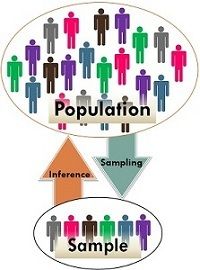
- Total population
- Inferential stadistics
- Sample
- Descriptive stadistics
Random sampling
- Simple
- Number assigned to elements of population
- Ex. Write on a paper names of friends to determine who is going to give who in an exchange
- Number assigned to elements of population
- Cluster
- Population is spared in groups and only one sample of the groups is chosen
- Ex. At ITESM, you divide the generation into 4 groups of 20 students but you take into account only group 1
- Population is spared in groups and only one sample of the groups is chosen
- Systematic
- Number assigned to population but the second sample is determined by a k constant
- k=N/n
- Ex. You have a population of 100 dogs and you need 20
- k=100/20 = 50
- You select random the first element (4) and then you add 50 for the second element
- 4+50 = 54
- You select random the first element (4) and then you add 50 for the second element
- k=100/20 = 50
- N=population
- n= sample
- Ex. You have a population of 100 dogs and you need 20
- k=N/n
- Number assigned to population but the second sample is determined by a k constant
- Stratified
- Divides population in subgroups based on characteristics. The selection of sample consider elements of each stratum of the population in proportional number.
- Ex. You want to make a survey about dogs who eat croquettes. You randomly select dogs who eat Dog Chow and is the 5% of the total dogs, the number of dogs selected in this brand should represent 6% of the sample
- Divides population in subgroups based on characteristics. The selection of sample consider elements of each stratum of the population in proportional number.
- Simple
Hypotesis
- States of a parameter to say if it is true or false
- Analysis unit: units or elements we are gonna use asa sample
- Logic: Defines what we are analyzing, it is a phrase."... is lower than..."
- Variables: What we are going to analyze about the elements in our sample
Bilder und Dateien der Mindmap
Informationen
- Beschreibung
- Mindmap am Inferential staistics, erstellt von Heidi Mauricett am 08/03/2018.
- Erstellt von
- Heidi Mauricett
- Aufrufe
- 0
- Bewertung