
Mindmap
Uses and Gratifications Model
Inhalt der Mindmap
Uses and Gratifications Model
Of all the media models, uses and gratifications believes that the audience are the most active and that the media has little effect on the audience. Rather than seeing the media as manipulating and influencing the audience, they believe that the audience use the media in various different ways for their own pleasures and interests
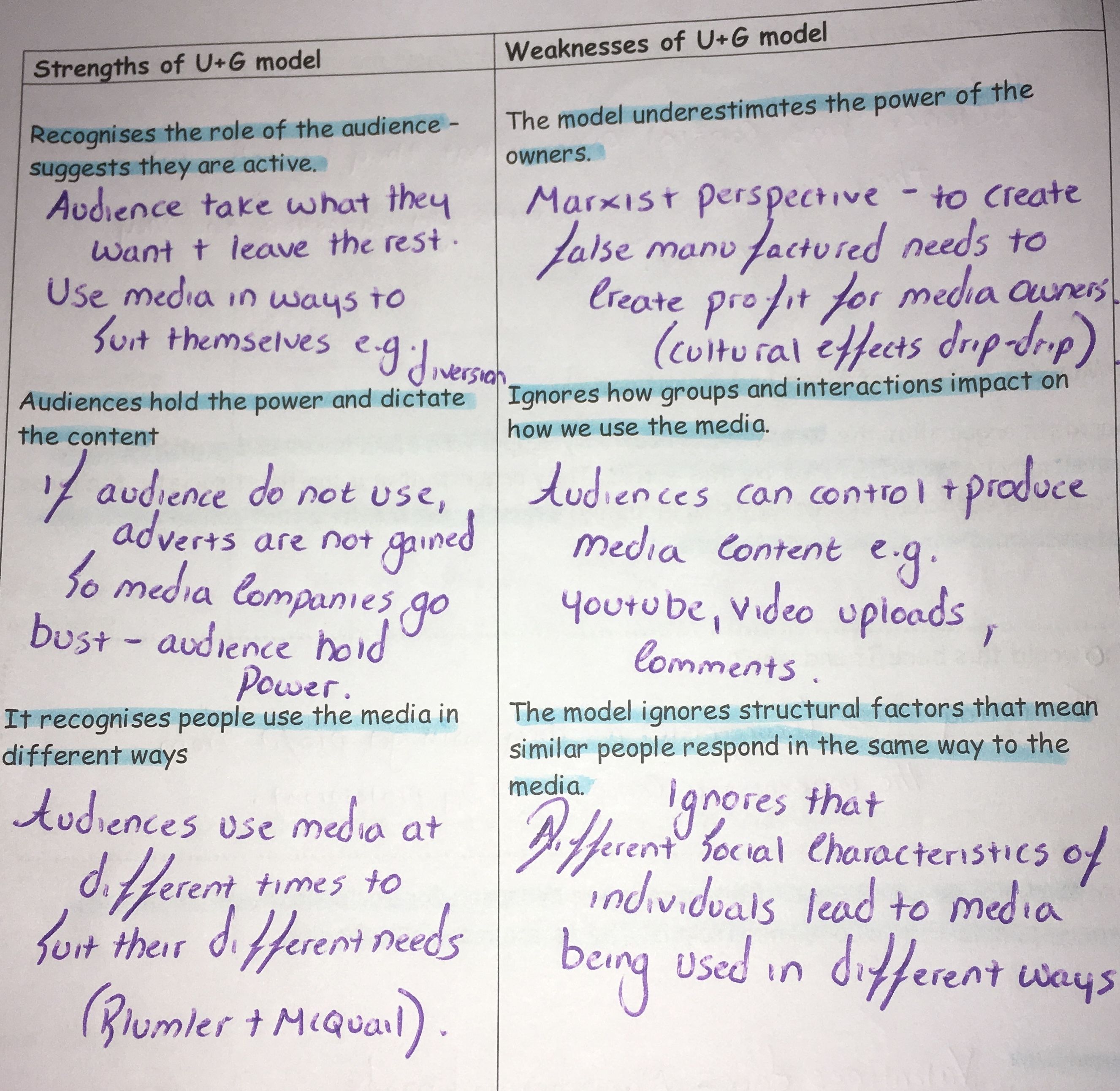
- Audience has control over what they watch, when they stop watching adverts get cancelled and owners lose money
Blumler and McQuail (1968) and Lull (1995) identified a variety of uses and gratifications of the media.
- Diversion
- For leisure, entertainment and relaxation to escape from daily routine
- E.g. Soaps such as Hollyoaks
- Affects working people
- E.g. Soaps such as Hollyoaks
- For leisure, entertainment and relaxation to escape from daily routine
- Personal Relationships
- To keep up with family and friends, or companionship through identification with the media communities like Coronation Street. It can be used as a conversation starter to establish new relationships with people you have never met
- E.g. FaceTime, Facebook, Twitter
- Affects everyone particularly younger people
- E.g. FaceTime, Facebook, Twitter
- To keep up with family and friends, or companionship through identification with the media communities like Coronation Street. It can be used as a conversation starter to establish new relationships with people you have never met
- Personal Identity
- To explore and confirm peoples own identities or to seek out new sources of identity e.g. keeping up with contemporary trends
- E.g. Fashion TV, Instagram
- Affects younger people
- E.g. Fashion TV, Instagram
- To explore and confirm peoples own identities or to seek out new sources of identity e.g. keeping up with contemporary trends
- Surveillance
- To access information about current affairs, to find out about the world, to make your mind up about issues that may be affecting you
- E.g. News, Twitter
- Affects Older people
- E.g. News, Twitter
- To access information about current affairs, to find out about the world, to make your mind up about issues that may be affecting you
- Background Wallpaper
- To have on while doing other things
- E.g. Tv programmes, Radio
- Affects everyone especially Young people and Housewives
- E.g. Tv programmes, Radio
- To have on while doing other things
- Diversion
Park et al (2009) used the uses and gratifications model in a web survey of those who were members of Facebook groups, they used Facebook for:
- Diversion- Entertainment and amusement
- Personal Relationships- Talking and meeting with others to achieve a sense of common community and peer support
- Personal Identity- Making and seeking out their own personal status
- Surveillance- To receive information about events going on
Marxist critique of U&G
- Marxists argue that the 'needs' referred to by supporters of the uses and gratifications model may be manufactured by the media. They argue that in a capitalist society, the mass media (and especially the advertising industry) promote the ideology that consumption and materialism are positive goals to pursue.
- This would benefit the bourgeoisie (ruling class) as they will get profit from the unnecessary consumption by the proletariat
- These manufactured needs are mistaken for social needs as the media convinces people that a consumer item is vital to their social wellbeing
- Examples include; Valentines Day, Easter, Mothers Day, Fathers Day, Halloween, Bonfire Night and Christmas
- Marxists argue that the 'needs' referred to by supporters of the uses and gratifications model may be manufactured by the media. They argue that in a capitalist society, the mass media (and especially the advertising industry) promote the ideology that consumption and materialism are positive goals to pursue.
To conclude, there is no easy way of assessing the effects of the media on audiences, as researchers face many methodological issues. Postmodernists suggest we live in a media saturated society, in which everyones view is formed through media imagery and interpretations rather than experience. Our social characteristics are likely to have some influence on how we select, interpret and respond to the media. However, we must consider that for some, the media will have a greater effect than for others. This is evident when we explore the effects of media violence
Bilder und Dateien der Mindmap
Informationen
- Beschreibung
- Mindmap am Uses and Gratifications Model, erstellt von Declan Haydock am 12/03/2018.
- Erstellt von
- Declan Haydock
- Aufrufe
- 0
- Bewertung