
Mindmap
Radioactivity and Particles.
Inhalt der Mindmap
Radioactivity and Particles.
Structure of atom.
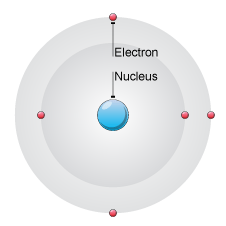
- Radioactive atoms have nucleus in centre of atom surrounded by electrons. Atoms consist of two main parts - nucleus and electrons surrounding nucleus. Electrons lost/ gained - forms charged particles - ions. Nucleus contains two types particles - neutrons and protons. Protons, neutrons and electrons building blocks of atoms - sub-atomic particles.
- Protons, neutrons + electrons.
- Properties - sub-atomic particles.
- Some materials radioactive because nucleus of each atom unstable and decay/ split up - give out nuclear radiation in form of alpha particles, beta particles or gamma rays. Nuclear radiation given off detected Geiger counter. Number of nuclei decaying and giving off radiation every second called activity of material and is measured in Becquerels (Bq).
- Proton.
- Proton: Relative mass = 1
- Proton: Relative charge = +1
- Neutron.
- Neutron: Relative mass = 1
- Neutron: Relative charge = 0
- Electron.
- Electron: Relative mass: Nearly 0
- Electron: Relative charge: -1
- Properties - sub-atomic particles.
- Symbols - describe particular nuclei.
- A = atomic mass - number of protons and neutrons.
- Z - atomic number - number of protons.
- X = chemical symbol - shown on Periodic Table.
Atomic (proton) number.
- Number of protons.
- Mass (nucleon) number.
- Number of protons and neutrons.
- Isotope.
- Radioactive form of element that has same number of protons as other forms of element but different number of neutrons therefore different atomic mass but same chemical properties.
Alpha, beta particles and gamma rays - ionising radiations.
- Three ways unstable nucleus decays.
- Give out alpha particle.
- Two protons + 2 neutrons - same as helium nucleus.
- Give out beta particle.
- Fast - moving electron.
- Give out gamma ray.
- High energy electromagnetic radiation.
- Ionisation ability.
- Ionising radiation - radiation with enough energy to cause other atoms - lose electrons + form ions. Different forms radiation different levels ionisation abilities.
- Alpha particles - very ionising.
- Beta particles - moderately ionising.
- Gamma rays - weakly ionising.
- Ionising radiation - radiation with enough energy to cause other atoms - lose electrons + form ions. Different forms radiation different levels ionisation abilities.
- Give out alpha particle.
- Three ways unstable nucleus decays.
Alpha decay.
- When alpha particle emitted from nucleus, nucleus loses 2 protons and 2 neutrons. Atomic mass decreases by 4, atomic number decreases by 2. New element formed - 2 places lower in Periodic Table than original element.
- Beta decay.
- Neutron changes into proton and electron. Proton stays in nucleus and electron leaves atom with high energy - beta particle. When beta particle emitted from nucleus nucleus has one more proton and one less neutron - atomic mass number unchanged and atomic number increases by 1.
- Nature - beta particles.
- Beta particles electrons emitted from nucleus of atom when neutron turns into proton and electron. When beta particle emitted number protons in nucleus increases by 1, atomic number increases by 1 and mass number stays same. Move fast and small. Penetrate moderately then collide and moderately ionising. Negatively charged, beta particles deflected by electric and magnetic fields.
- Gamma decay.
- Gamma rays opposite of alpha particles - gamma ray emmission has no effect on atomic or mass numbers of isotope. If nucleus has excess energy, loses energy by emitting gamma ray.
- Nature of alpha particles.
- Alpha particles are helium nuclei. Consist of 2 protons and 2 neutrons - big, heavy and slow - moving. Don't penetrate far into materials - stopped quickly. Due to large size, strongly ionising - hit lots of atoms, knock electrons off them, slow down and creates lots of ions. Electrically charged - positive charge, deflected - direction changes by electric and magnetic fields. Emitting alpha particle - decreases atomic number of nucleus by 2 and mass number by 4.
- Gamma rays nature.
- Gamma rays - short wavelength electromagnetic waves. Opposite of alpha particles - have no mass just enegry in fomr of electromagnetic wave. Penetrate long way into materials wihtout being stopped and therefore weakly ionising - pass through odn't collide with atoms. Hit something and do damage. No charge - not deflected by electric/ magnetic fields. Gamma emission - happens after beta/ alpha decay - don't only get gamma rays emitted. Gamma ray emission no effect on atomic mass or moss number of isotope. If nucleus has excess energy, loses energy by emitting gamma ray.
Bilder und Dateien der Mindmap
Informationen
- Beschreibung
- Year 10 Physics Mindmap am Radioactivity and Particles., erstellt von Mariyam Zaman am 21/03/2018.
- Erstellt von
- Mariyam Zaman
- Aufrufe
- 0
- Bewertung