
Mindmap
TYPES OF MEANING
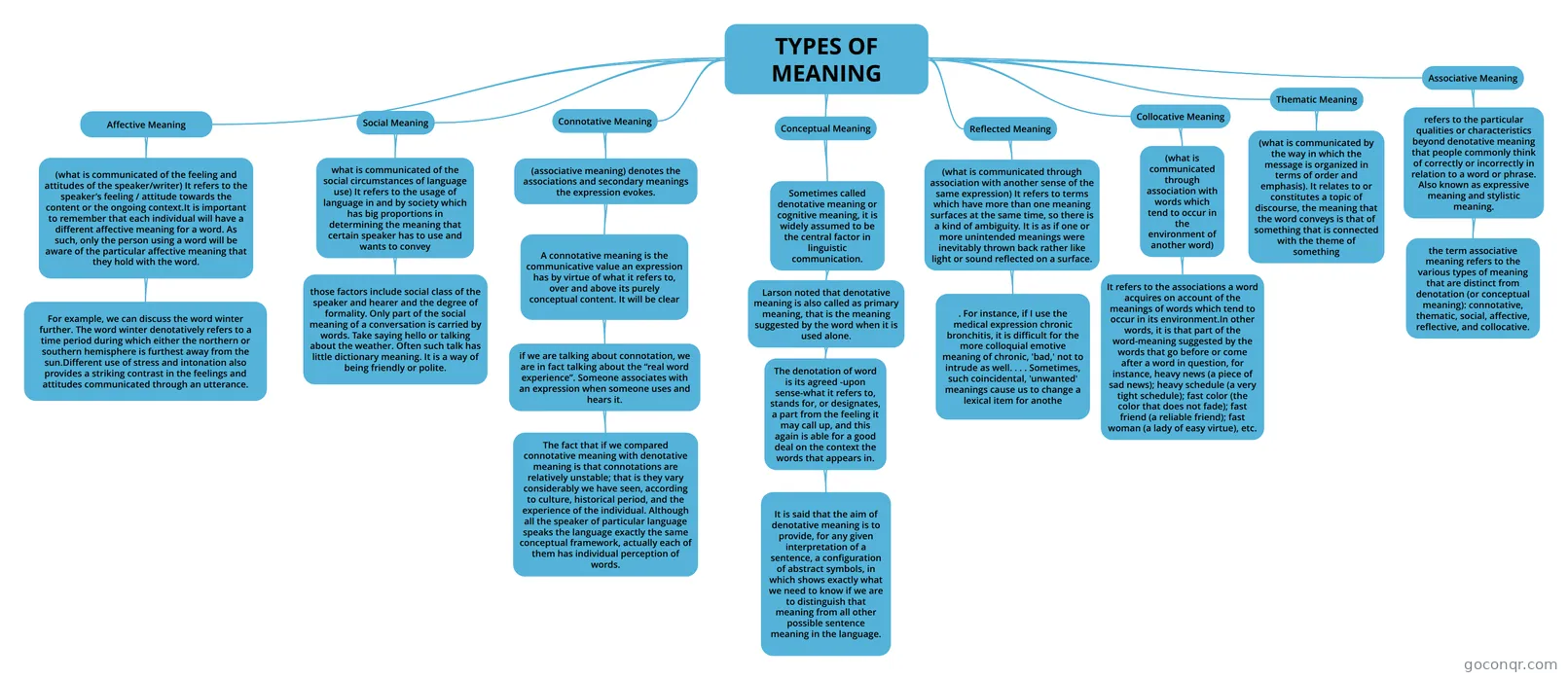
Mind map: types of meaning
Inhalt der Mindmap
TYPES OF MEANING
Conceptual Meaning
- Sometimes called denotative meaning or cognitive meaning, it is widely assumed to be the central factor in linguistic communication.
- Larson noted that denotative meaning is also called as primary meaning, that is the meaning suggested by the word when it is used alone.
- The denotation of word is its agreed -upon sense-what it refers to, stands for, or designates, a part from the feeling it may call up, and this again is able for a good deal on the context the words that appears in.
- It is said that the aim of denotative meaning is to provide, for any given interpretation of a sentence, a configuration of abstract symbols, in which shows exactly what we need to know if we are to distinguish that meaning from all other possible sentence meaning in the language.
- The denotation of word is its agreed -upon sense-what it refers to, stands for, or designates, a part from the feeling it may call up, and this again is able for a good deal on the context the words that appears in.
- Larson noted that denotative meaning is also called as primary meaning, that is the meaning suggested by the word when it is used alone.
- Sometimes called denotative meaning or cognitive meaning, it is widely assumed to be the central factor in linguistic communication.
Connotative Meaning
- (associative meaning) denotes the associations and secondary meanings the expression evokes.
- A connotative meaning is the communicative value an expression has by virtue of what it refers to, over and above its purely conceptual content. It will be clear
- if we are talking about connotation, we are in fact talking about the “real word experience”. Someone associates with an expression when someone uses and hears it.
- The fact that if we compared connotative meaning with denotative meaning is that connotations are relatively unstable; that is they vary considerably we have seen, according to culture, historical period, and the experience of the individual. Although all the speaker of particular language speaks the language exactly the same conceptual framework, actually each of them has individual perception of words.
- if we are talking about connotation, we are in fact talking about the “real word experience”. Someone associates with an expression when someone uses and hears it.
- A connotative meaning is the communicative value an expression has by virtue of what it refers to, over and above its purely conceptual content. It will be clear
- (associative meaning) denotes the associations and secondary meanings the expression evokes.
Social Meaning
- what is communicated of the social circumstances of language use) It refers to the usage of language in and by society which has big proportions in determining the meaning that certain speaker has to use and wants to convey
- those factors include social class of the speaker and hearer and the degree of formality. Only part of the social meaning of a conversation is carried by words. Take saying hello or talking about the weather. Often such talk has little dictionary meaning. It is a way of being friendly or polite.
- what is communicated of the social circumstances of language use) It refers to the usage of language in and by society which has big proportions in determining the meaning that certain speaker has to use and wants to convey
Affective Meaning
- (what is communicated of the feeling and attitudes of the speaker/writer) It refers to the speaker’s feeling / attitude towards the content or the ongoing context.It is important to remember that each individual will have a different affective meaning for a word. As such, only the person using a word will be aware of the particular affective meaning that they hold with the word.
- For example, we can discuss the word winter further. The word winter denotatively refers to a time period during which either the northern or southern hemisphere is furthest away from the sun.Different use of stress and intonation also provides a striking contrast in the feelings and attitudes communicated through an utterance.
- (what is communicated of the feeling and attitudes of the speaker/writer) It refers to the speaker’s feeling / attitude towards the content or the ongoing context.It is important to remember that each individual will have a different affective meaning for a word. As such, only the person using a word will be aware of the particular affective meaning that they hold with the word.
Reflected Meaning
- (what is communicated through association with another sense of the same expression) It refers to terms which have more than one meaning surfaces at the same time, so there is a kind of ambiguity. It is as if one or more unintended meanings were inevitably thrown back rather like light or sound reflected on a surface.
- . For instance, if I use the medical expression chronic bronchitis, it is difficult for the more colloquial emotive meaning of chronic, 'bad,' not to intrude as well. . . . Sometimes, such coincidental, 'unwanted' meanings cause us to change a lexical item for anothe
- (what is communicated through association with another sense of the same expression) It refers to terms which have more than one meaning surfaces at the same time, so there is a kind of ambiguity. It is as if one or more unintended meanings were inevitably thrown back rather like light or sound reflected on a surface.
Collocative Meaning
- (what is communicated through association with words which tend to occur in the environment of another word)
- It refers to the associations a word acquires on account of the meanings of words which tend to occur in its environment.In other words, it is that part of the word-meaning suggested by the words that go before or come after a word in question, for instance, heavy news (a piece of sad news); heavy schedule (a very tight schedule); fast color (the color that does not fade); fast friend (a reliable friend); fast woman (a lady of easy virtue), etc.
- (what is communicated through association with words which tend to occur in the environment of another word)
Thematic Meaning
- (what is communicated by the way in which the message is organized in terms of order and emphasis). It relates to or constitutes a topic of discourse, the meaning that the word conveys is that of something that is connected with the theme of something
Associative Meaning
- refers to the particular qualities or characteristics beyond denotative meaning that people commonly think of correctly or incorrectly in relation to a word or phrase. Also known as expressive meaning and stylistic meaning.
- the term associative meaning refers to the various types of meaning that are distinct from denotation (or conceptual meaning): connotative, thematic, social, affective, reflective, and collocative.
- refers to the particular qualities or characteristics beyond denotative meaning that people commonly think of correctly or incorrectly in relation to a word or phrase. Also known as expressive meaning and stylistic meaning.
Informationen
- Beschreibung
- Mindmap am TYPES OF MEANING, erstellt von karen minotta am 05/04/2018.
- Erstellt von
- karen minotta
- Aufrufe
- 0
- Bewertung
Mehr zu Types and Theories of Meaning