
Semantics
33 resources created by 27 users
This Semantics page on GoConqr gathers community-made quizzes, mind maps, flashcards, flowcharts and notes, from word meaning and sense relations to sentence semantics, context and inference. It's built for university students and professional candidates practising key terms and analysis, and for teachers after ready-made material. There are over 600 resources here, including more than 10 quizzes and over 500 mind maps, almost all at university level. Pick a resource, try a quiz to find your gaps, then make your own revision sets.
Top Semantics resources
-
30 cards9.) Semantics 2 Paradigmatic vs. syntagmatic
-
51 questionsFirst partial English semantics exam First content of the English semantics course of the BA in Teaching English.
-
34 cards8.) Semantics 1 Semantics is the study of...
-
94 cardsSem&Prag proposition (as part of message)
-
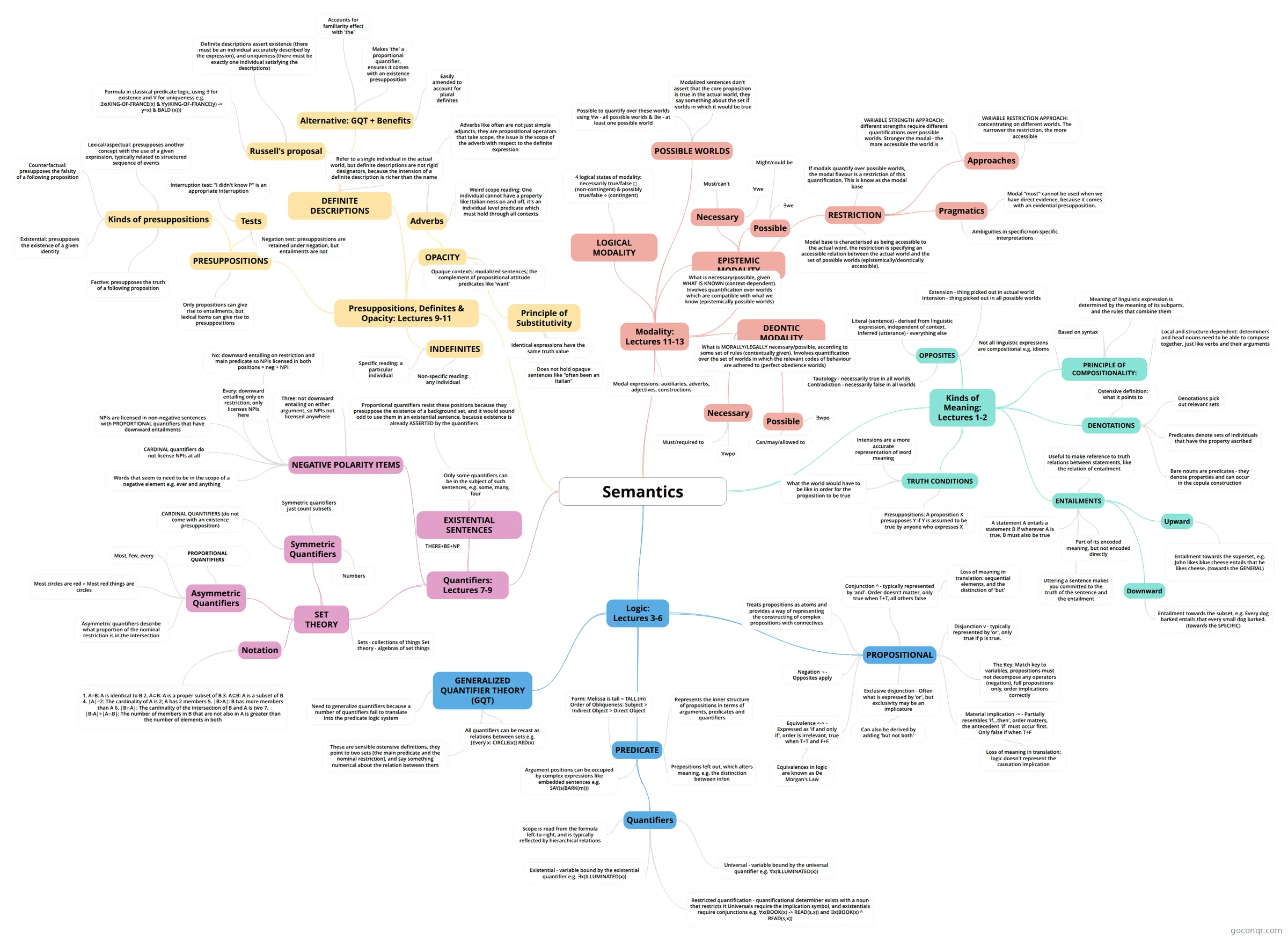 Mind map Semantics Semantics mind map
-
39 cardsWords & Meaning What is lexical cohesion?
-
34 cards10.) Semantics 3 Lexical ambiguity examples
-
Mind map SEMANTICS IN LINGUISTIC
Quizzes
Mind maps
See all 22 mind maps-
Semantics Semantics mind map
-
SEMANTICS IN LINGUISTIC
-
SEMANTICS IMPORTANT ASPECTS ABOUT SEMANTICS. MADE BY: Laura Amaya, María José Malaver and María Fernanda Vaca.
-
 The study of meaning different approaches to the investigation of meaning. what language is and how a child acquires it.
-
Semantic relations The 11 semantic relationships that exist in the English language are defined.
-
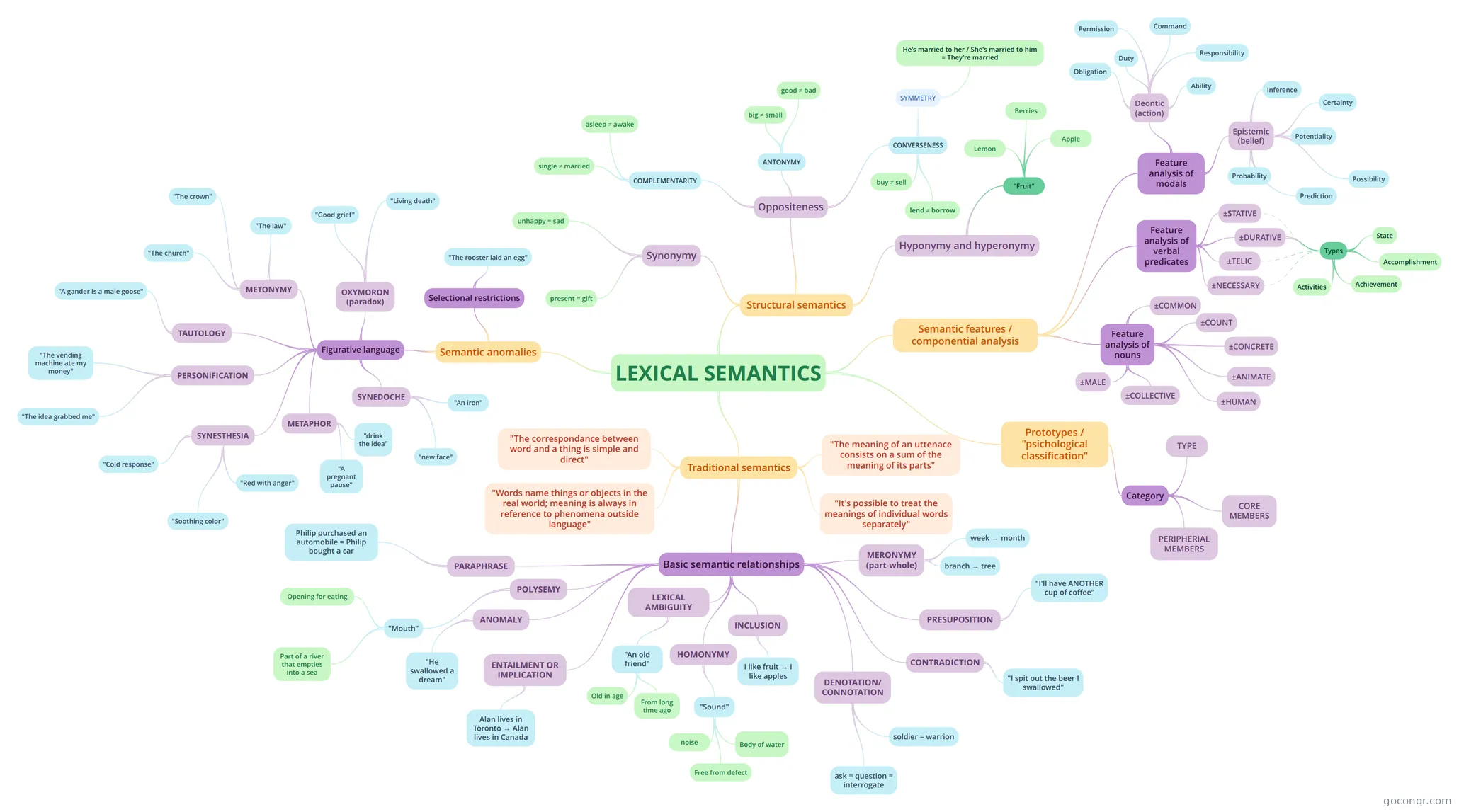 LEXICAL SEMANTICS A mind map that briefly explains the lexical semantics of modern English according to the book "The structu...
-
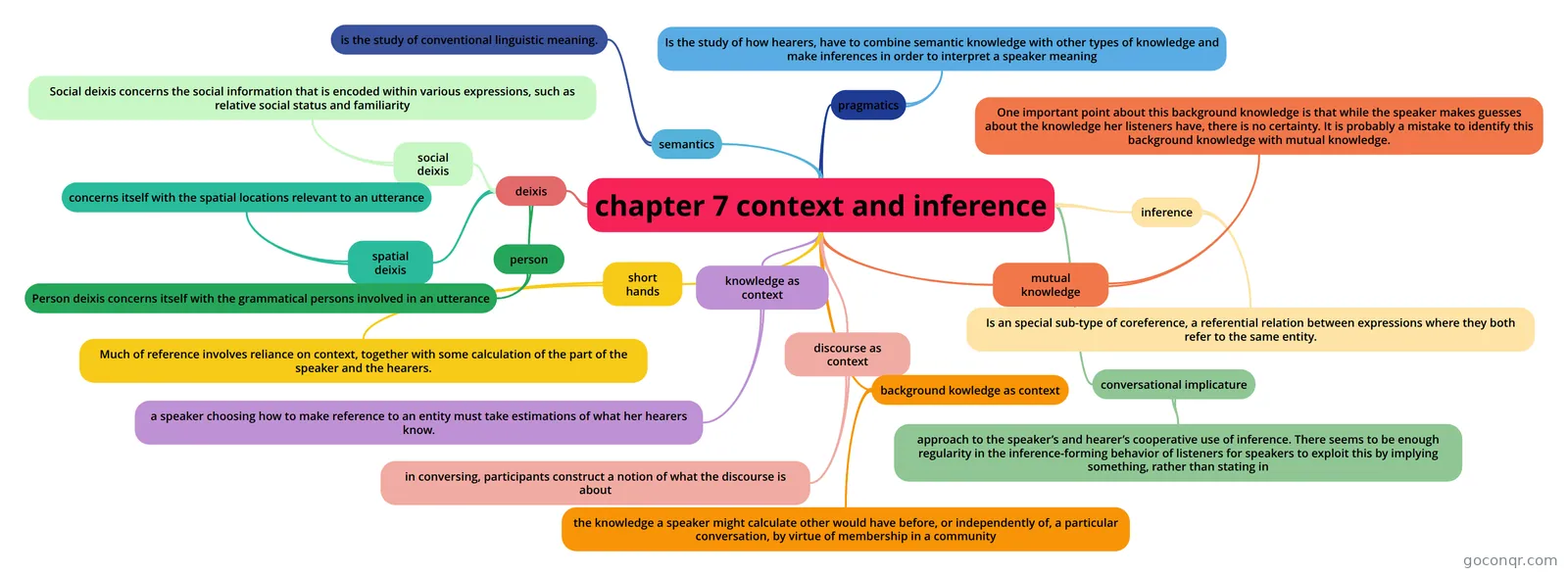 chapter 7 context and inference
-
LEXICAL SEMANTICS UNA CHIMBITA
Flashcards
-
30 cards9.) Semantics 2 Paradigmatic vs. syntagmatic
-
34 cards8.) Semantics 1 Semantics is the study of...
-
94 cardsSem&Prag proposition (as part of message)
-
39 cardsWords & Meaning What is lexical cohesion?
-
34 cards10.) Semantics 3 Lexical ambiguity examples
-
23 cardsSemantics Einige Grundbegriffe der Semantik. Englische Sprachwissenschaft
-
22 cardsUNIT 11 TABLE OF CONTENTS:
-
8 cardsLexical Semantics What is USUAL MEANING?
Notes
More Linguistics and philology topics
About Semantics
GoConqr OriginalWhat the page covers
This unit collects community-made material on the study of meaning. The notes titled Traditional Semantics set out the field: lexical semantics, sentence semantics and discourse semantics. Other resources go deeper into word meaning, the semiotic triangle, synonymy, antonymy, hyponymy, connotation and denotation, and semantic change.
Where to start
- Open the notes Traditional Semantics for an overview of the field.
- Work through the flashcard decks 9.) Semantics 2 and 8.) Semantics 1. They cover ideas such as arbitrary and conventional meaning, conceptual and associative meaning, and paradigmatic versus syntagmatic relations.
- Move on to Morphology and Semantics and Words & Meaning for terms like reference, sense, lexeme, collocate and lexical cohesion.
- Look at Sem&Prag for propositions, entailment and felicity conditions.
Using quizzes and maps together
Mind maps make up most of this page. Many follow a textbook chapter by chapter, such as Word Meaning, Meaning, Thought and Reality, Sentence Semantics 1: situations, Sentence Semantics 2: Participants, and Context and Inference. Read a map first to see how the ideas connect. Then test yourself with Semantic Change, which asks about words that gain or lose status, or with First partial English semantics exam, which starts from the basic question of what semantics is and what a theory should include.
Maps on sense relationships, semantic features, ambiguity and logic in semantic analysis suit later revision, once the basic terms feel familiar. Flowcharts such as Sense properties and Stereotype give a quick visual summary.
Where it sits
Semantics belongs to the Meaning, Use and Text strand within Linguistics and philology. Its neighbour in the listings, pragmatics, appears here too in the PRAGMATICS mind map.
Make it your own
Every resource was made by GoConqr users, so styles and chapter labels vary. Choose the one that matches your course, then build your own maps and flashcards to fill any gaps.
Frequently asked questions
Which resource should I open first?
Start with the notes Traditional Semantics. They explain that semantics is the study of linguistic meaning and separate lexical, sentence and discourse semantics. After that, the flashcard decks 8.) Semantics 1 and 9.) Semantics 2 let you check the key terms.
What do the mind maps cover?
There are over 500 mind maps. Many follow chapters on word meaning, meaning, thought and reality, sentence semantics, participants, context and inference. Others cover sense relationships, semantic features, ambiguity, lexical semantics and logic in semantic analysis.
Are the resources free to use?
Yes. Every resource listed here is free to open, study and take, with no account needed. They were made by GoConqr users, not by GoConqr itself, so it helps to compare a few before settling on one.
Who is this page for?
It mainly suits university students and professional candidates revising semantics, as almost all the resources are at that level. Teachers can also use the quizzes, maps and flashcards as ready-made material for classes or revision tasks.
Is there a quiz on semantic change?
Yes. The quiz called Semantic Change asks about words that take on a more positive or more negative meaning over time. It uses examples such as pretty and priest, so it works well after reading the notes on semantic changes.
What if the topic I need is missing?
Try nearby resources first, such as the pragmatics mind map or the flashcards on words and meaning. If you still find a gap, a free account lets you save quiz scores and create your own quizzes, mind maps, flashcards and notes.