
Mindmap
Snowy Owls
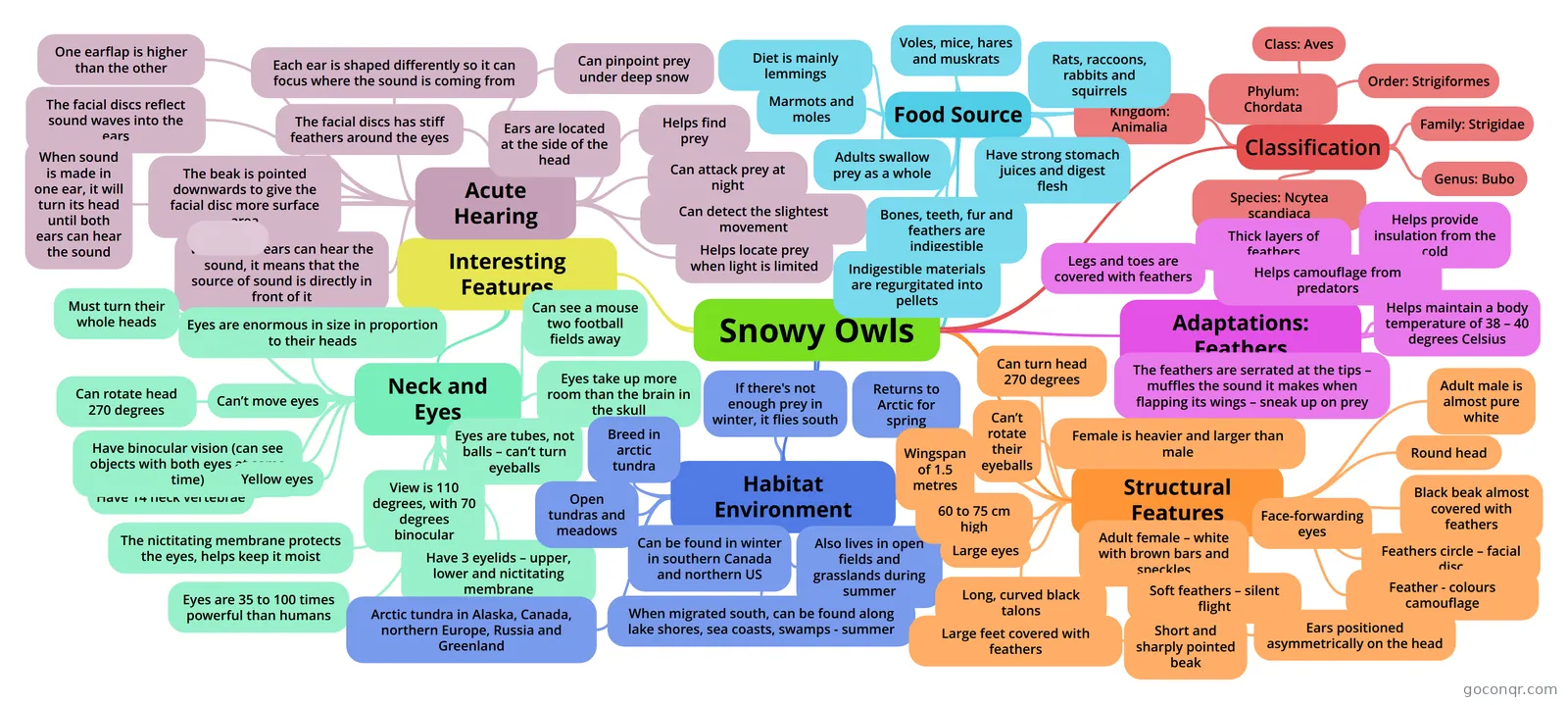
Mind map: Snowy owls
Inhalt der Mindmap
Snowy Owls
Classification
- Kingdom: Animalia
- Phylum: Chordata
- Class: Aves
- Order: Strigiformes
- Family: Strigidae
- Genus: Bubo
- Species: Ncytea scandiaca
Habitat Environment
- Open tundras and meadows
- Arctic tundra in Alaska, Canada, northern Europe, Russia and Greenland
- If there's not enough prey in winter, it flies south
- Can be found in winter in southern Canada and northern US
- Breed in arctic tundra
- Returns to Arctic for spring
- When migrated south, can be found along lake shores, sea coasts, swamps - summer
- Also lives in open fields and grasslands during summer
Food Source
- Diet is mainly lemmings
- Adults swallow prey as a whole
- Rats, raccoons, rabbits and squirrels
- Have strong stomach juices and digest flesh
- Marmots and moles
- Voles, mice, hares and muskrats
- Bones, teeth, fur and feathers are indigestible
- Indigestible materials are regurgitated into pellets
Interesting Features
- Acute Hearing
- Helps find prey
- One earflap is higher than the other
- Each ear is shaped differently so it can focus where the sound is coming from
- Can detect the slightest movement
- Ears are located at the side of the head
- Can attack prey at night
- Can pinpoint prey under deep snow
- The facial discs has stiff feathers around the eyes
- The facial discs reflect sound waves into the ears
- The beak is pointed downwards to give the facial disc more surface area
- When sound is made in one ear, it will turn its head until both ears can hear the sound
- Helps locate prey when light is limited
- When both ears can hear the sound, it means that the source of sound is directly in front of it
- Neck and Eyes
- Must turn their whole heads
- Have 14 neck vertebrae
- Eyes are enormous in size in proportion to their heads
- Can’t move eyes
- Can see a mouse two football fields away
- Eyes take up more room than the brain in the skull
- Eyes are 35 to 100 times powerful than humans
- Have binocular vision (can see objects with both eyes at same time)
- View is 110 degrees, with 70 degrees binocular
- Can rotate head 270 degrees
- Eyes are tubes, not balls – can’t turn eyeballs
- Have 3 eyelids – upper, lower and nictitating membrane
- The nictitating membrane protects the eyes, helps keep it moist
- Yellow eyes
- Acute Hearing
Adaptations: Feathers
- Thick layers of feathers
- Legs and toes are covered with feathers
- Helps provide insulation from the cold
- Helps camouflage from predators
- The feathers are serrated at the tips – muffles the sound it makes when flapping its wings – sneak up on prey
- Helps maintain a body temperature of 38 – 40 degrees Celsius
Structural Features
- Can turn head 270 degrees
- Can’t rotate their eyeballs
- Wingspan of 1.5 metres
- Adult male is almost pure white
- 60 to 75 cm high
- Female is heavier and larger than male
- Adult female – white with brown bars and speckles
- Black beak almost covered with feathers
- Round head
- Large eyes
- Large feet covered with feathers
- Long, curved black talons
- Short and sharply pointed beak
- Face-forwarding eyes
- Soft feathers – silent flight
- Ears positioned asymmetrically on the head
- Feathers circle – facial disc
- Feather - colours camouflage
Informationen
- Beschreibung
- Mindmap am Snowy Owls, erstellt von Trinity Liao am 18/09/2014.
- Erstellt von
- Trinity Liao
- Aufrufe
- 13
- Bewertung