
Mindmap
Cooperative Language Learning
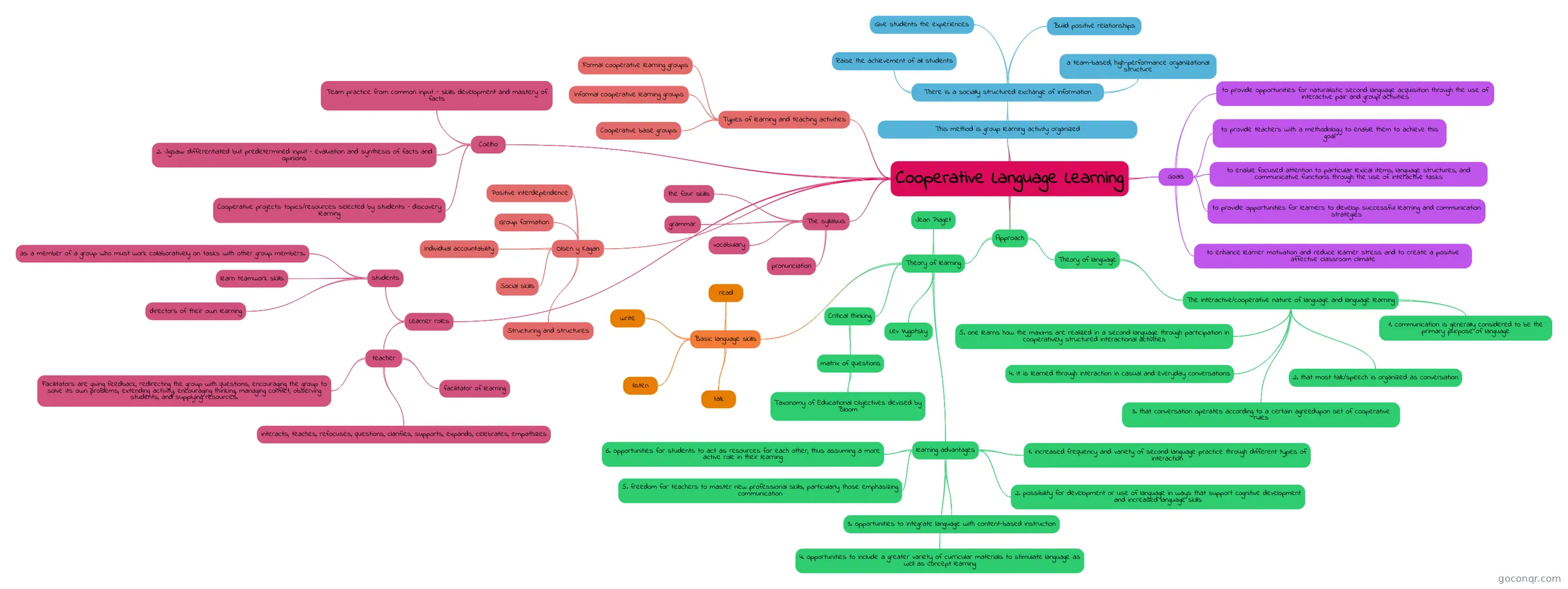
Mind map: Cooperative Language Learning
Inhalt der Mindmap
Cooperative Language Learning
This method is group learning activity organized
- There is a socially structured exchange of information
- Raise the achievement of all students
- Build positive relationships
- Give students the experiences
- a team-based, high-performance organizational structure
- There is a socially structured exchange of information
Goals
- to provide opportunities for naturalistic second language acquisition through the use of interactive pair and group activities
- to provide teachers with a methodology to enable them to achieve this goal
- to enable focused attention to particular lexical items, language structures, and communicative functions through the use of interactive tasks
- to provide opportunities for learners to develop successful learning and communication strategies
- to enhance learner motivation and reduce learner stress and to create a positive affective classroom climate
Approach
- Theory of language
- The interactive/cooperative nature of language and language learning
- 1. communication is generally considered to be the primary purpose of language
- 2. that most talk/speech is organized as conversation
- 3. that conversation operates according to a certain agreedupon set of cooperative rules
- 4. It is learned through interaction in casual and everyday conversations
- 5. one learns how the maxims are realized in a second language through participation in cooperatively structured interactional activities
- The interactive/cooperative nature of language and language learning
- Theory of learning
- Jean Piaget
- Lev Vygotsky
- Basic language skills
- read
- write
- listen
- talk
- Critical thinking
- matrix of questions
- Taxonomy of Educational Objectives devised by Bloom
- matrix of questions
- learning advantages
- 1. increased frequency and variety of second language practice through different types of interaction
- 2. possibility for development or use of language in ways that support cognitive development and increased language skills
- 3. opportunities to integrate language with content-based instruction
- 4. opportunities to include a greater variety of curricular materials to stimulate language as well as concept learning
- 5. freedom for teachers to master new professional skills, particularly those emphasizing communication
- 6. opportunities for students to act as resources for each other, thus assuming a more active role in their learning
- Theory of language
The syllabus
- the four skills
- grammar
- pronunciation
- vocabulary
Types of learning and teaching activities
- Formal cooperative learning groups
- Informal cooperative learning groups
- Cooperative base groups
Olsen y Kagan
- Positive interdependence
- Group formation
- Individual accountability
- Social skills
- Structuring and structures
Coelho
- Team practice from common input – skills development and mastery of facts
- 2. Jigsaw: differentiated but predetermined input – evaluation and synthesis of facts and opinions
- Cooperative projects: topics/resources selected by students – discovery learning
Learner roles
- students
- as a member of a group who must work collaboratively on tasks with other group members.
- learn teamwork skills
- directors of their own learning
- teacher
- facilitator of learning
- interacts, teaches, refocuses, questions, clarifies, supports, expands, celebrates, empathizes
- Facilitators are giving feedback, redirecting the group with questions, encouraging the group to solve its own problems, extending activity, encouraging thinking, managing conflict, observing students, and supplying resources.
- students
Informationen
- Beschreibung
- Mindmap am Cooperative Language Learning, erstellt von ana carrillo am 08/04/2018.
- Erstellt von
- ana carrillo
- Aufrufe
- 7
- Bewertung
Mehr zu Cooperative and Learner-Centred Language Teaching