
Mindmap
Owls
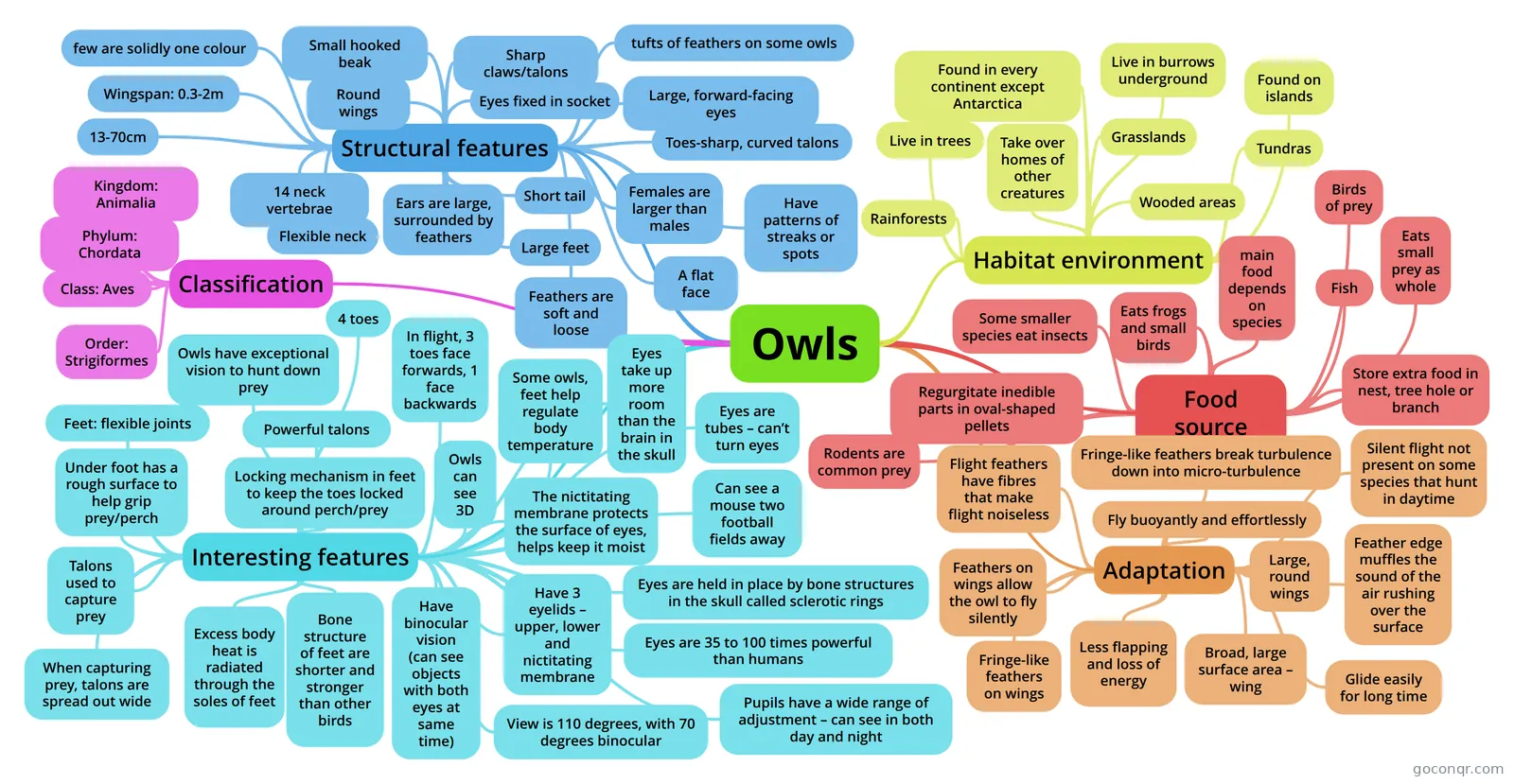
Mind map: Owls
Inhalt der Mindmap
Owls
Classification
- Kingdom: Animalia
- Phylum: Chordata
- Class: Aves
- Order: Strigiformes
Structural features
- A flat face
- Small hooked beak
- Large, forward-facing eyes
- Short tail
- Round wings
- Large feet
- Sharp claws/talons
- Ears are large, surrounded by feathers
- Have patterns of streaks or spots
- Feathers are soft and loose
- 14 neck vertebrae
- Eyes fixed in socket
- Flexible neck
- 13-70cm
- Wingspan: 0.3-2m
- Females are larger than males
- Toes-sharp, curved talons
- few are solidly one colour
- tufts of feathers on some owls
Habitat environment
- Found in every continent except Antarctica
- Rainforests
- Grasslands
- Wooded areas
- Tundras
- Live in trees
- Live in burrows underground
- Found on islands
- Take over homes of other creatures
Food source
- Rodents are common prey
- Some smaller species eat insects
- Regurgitate inedible parts in oval-shaped pellets
- Eats frogs and small birds
- Eats small prey as whole
- Birds of prey
- Fish
- main food depends on species
- Store extra food in nest, tree hole or branch
Interesting features
- Owls have exceptional vision to hunt down prey
- Powerful talons
- Feet: flexible joints
- Talons used to capture prey
- Under foot has a rough surface to help grip prey/perch
- Locking mechanism in feet to keep the toes locked around perch/prey
- Excess body heat is radiated through the soles of feet
- When capturing prey, talons are spread out wide
- Bone structure of feet are shorter and stronger than other birds
- 4 toes
- In flight, 3 toes face forwards, 1 face backwards
- Some owls, feet help regulate body temperature
- Have binocular vision (can see objects with both eyes at same time)
- Owls can see 3D
- View is 110 degrees, with 70 degrees binocular
- Have 3 eyelids – upper, lower and nictitating membrane
- The nictitating membrane protects the surface of eyes, helps keep it moist
- Eyes are 35 to 100 times powerful than humans
- Eyes take up more room than the brain in the skull
- Eyes are held in place by bone structures in the skull called sclerotic rings
- Pupils have a wide range of adjustment – can see in both day and night
- Can see a mouse two football fields away
- Eyes are tubes – can’t turn eyes
Adaptation
- Flight feathers have fibres that make flight noiseless
- Fringe-like feathers on wings
- Fringe-like feathers break turbulence down into micro-turbulence
- Feathers on wings allow the owl to fly silently
- Feather edge muffles the sound of the air rushing over the surface
- Large, round wings
- Broad, large surface area – wing
- Less flapping and loss of energy
- Glide easily for long time
- Fly buoyantly and effortlessly
- Silent flight not present on some species that hunt in daytime
Informationen
- Beschreibung
- Mindmap am Owls, erstellt von Trinity Liao am 20/09/2014.
- Erstellt von
- Trinity Liao
- Aufrufe
- 24
- Bewertung