
Mindmap
Variations in Growth
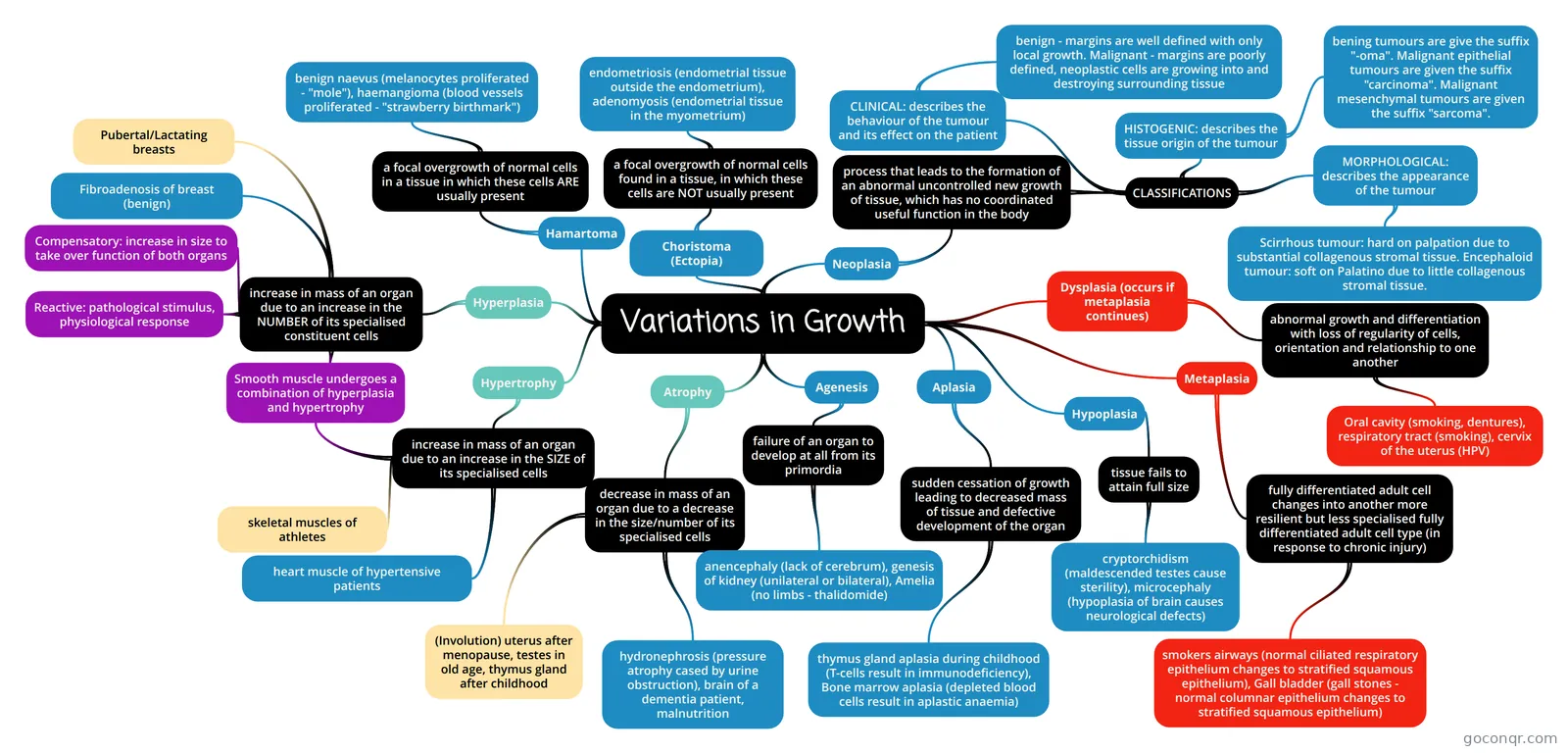
Mind map: Variations in growth
Inhalt der Mindmap
Variations in Growth
Hyperplasia
- increase in mass of an organ due to an increase in the NUMBER of its specialised constituent cells
- Pubertal/Lactating breasts
- Fibroadenosis of breast (benign)
- Compensatory: increase in size to take over function of both organs
- Reactive: pathological stimulus, physiological response
- increase in mass of an organ due to an increase in the NUMBER of its specialised constituent cells
Hypertrophy
- increase in mass of an organ due to an increase in the SIZE of its specialised cells
- skeletal muscles of athletes
- heart muscle of hypertensive patients
- Smooth muscle undergoes a combination of hyperplasia and hypertrophy
- increase in mass of an organ due to an increase in the SIZE of its specialised cells
Atrophy
- decrease in mass of an organ due to a decrease in the size/number of its specialised cells
- (Involution) uterus after menopause, testes in old age, thymus gland after childhood
- hydronephrosis (pressure atrophy cased by urine obstruction), brain of a dementia patient, malnutrition
- decrease in mass of an organ due to a decrease in the size/number of its specialised cells
Agenesis
- failure of an organ to develop at all from its primordia
- anencephaly (lack of cerebrum), genesis of kidney (unilateral or bilateral), Amelia (no limbs - thalidomide)
- failure of an organ to develop at all from its primordia
Aplasia
- sudden cessation of growth leading to decreased mass of tissue and defective development of the organ
- thymus gland aplasia during childhood (T-cells result in immunodeficiency), Bone marrow aplasia (depleted blood cells result in aplastic anaemia)
- sudden cessation of growth leading to decreased mass of tissue and defective development of the organ
Hypoplasia
- tissue fails to attain full size
- cryptorchidism (maldescended testes cause sterility), microcephaly (hypoplasia of brain causes neurological defects)
- tissue fails to attain full size
Metaplasia
- fully differentiated adult cell changes into another more resilient but less specialised fully differentiated adult cell type (in response to chronic injury)
- smokers airways (normal ciliated respiratory epithelium changes to stratified squamous epithelium), Gall bladder (gall stones - normal columnar epithelium changes to stratified squamous epithelium)
- fully differentiated adult cell changes into another more resilient but less specialised fully differentiated adult cell type (in response to chronic injury)
Dysplasia (occurs if metaplasia continues)
- abnormal growth and differentiation with loss of regularity of cells, orientation and relationship to one another
- Oral cavity (smoking, dentures), respiratory tract (smoking), cervix of the uterus (HPV)
- abnormal growth and differentiation with loss of regularity of cells, orientation and relationship to one another
Hamartoma
- a focal overgrowth of normal cells in a tissue in which these cells ARE usually present
- benign naevus (melanocytes proliferated - "mole"), haemangioma (blood vessels proliferated - "strawberry birthmark")
- a focal overgrowth of normal cells in a tissue in which these cells ARE usually present
Choristoma (Ectopia)
- a focal overgrowth of normal cells found in a tissue, in which these cells are NOT usually present
- endometriosis (endometrial tissue outside the endometrium), adenomyosis (endometrial tissue in the myometrium)
- a focal overgrowth of normal cells found in a tissue, in which these cells are NOT usually present
Neoplasia
- process that leads to the formation of an abnormal uncontrolled new growth of tissue, which has no coordinated useful function in the body
- CLASSIFICATIONS
- CLINICAL: describes the behaviour of the tumour and its effect on the patient
- benign - margins are well defined with only local growth. Malignant - margins are poorly defined, neoplastic cells are growing into and destroying surrounding tissue
- HISTOGENIC: describes the tissue origin of the tumour
- bening tumours are give the suffix "-oma". Malignant epithelial tumours are given the suffix "carcinoma". Malignant mesenchymal tumours are given the suffix "sarcoma".
- MORPHOLOGICAL: describes the appearance of the tumour
- Scirrhous tumour: hard on palpation due to substantial collagenous stromal tissue. Encephaloid tumour: soft on Palatino due to little collagenous stromal tissue.
- CLINICAL: describes the behaviour of the tumour and its effect on the patient
- CLASSIFICATIONS
- process that leads to the formation of an abnormal uncontrolled new growth of tissue, which has no coordinated useful function in the body
Informationen
- Beschreibung
- Mindmap am Variations in Growth, erstellt von Evette Kelly am 12/04/2018.
- Erstellt von
- Evette Kelly
- Aufrufe
- 1
- Bewertung