
Mindmap
AA III, IV, V
Inhalt der Mindmap
AA III, IV, V
Algebraic Reorientation
- A binary operation on S is a rule which for every two elements of S gives another element of S.
- f ◦ (g ◦h) = (f ◦ g ) ◦h
- . Let S be a set and ◦ a binary operation on S. We say that the binary operation ◦ is commutative on S if a ◦ b = b ◦ a for all a, b ∈ S. We say that the binary operation ◦ is associative on S if (a ◦ b) ◦ c = a ◦ (b ◦ c) for all a, b, c ∈ S.
Matrices Revisited
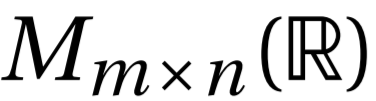
- is the set of m × n matrices with entries in R
- The zero matrix of size m × n is the unique m × n matrix whose entries are all 0. This is denoted by 0m×n, or simply 0 if no confusion is feared
- If m =/= n, then we can’t multiply two matrices in Mm×n(R). However, matrix multiplication is defined on Mn×n(R) and the result is again in Mn×n(R). In other words, multiplication is a binary operation on Mn×n(R)
- (Properties of Determinants) Let A, B be 2×2 matrices. (a) det(I2) = 1. (b) det(AB) = det(A)det(B). (c) If A is invertible then det(A) =/= 0 and det(A^−1 ) = 1/det(A) .
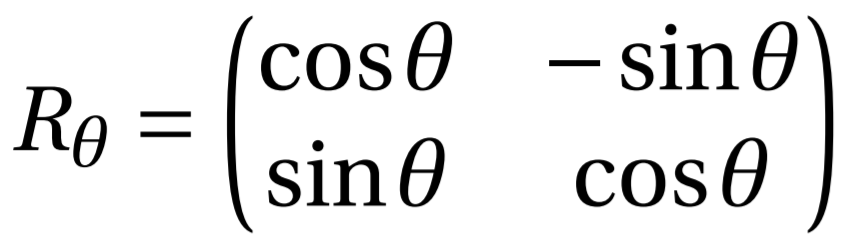
- Anticlockwise rotation about the origin through an angle θ can be achieved by multiplying by the matrix
Groups
- A group is a pair (G,◦) where G is a set and ◦ is a binary operation on G, such that the following four properties hold 2 (i) (closure) for all a, b ∈ G, a ◦b ∈ G; (ii) (associativity) for all a, b, c ∈ G, a ◦ (b ◦ c) = (a ◦b) ◦ c; (iii) (existence of the identity element) there is an element e ∈ G such that for all a ∈ G, a ◦ e = e ◦ a = a; (iv) (existence of inverses) for every a ∈ G, there is an element b ∈ G (called the inverse of a) such that a ◦b = b ◦ a = e.
- If ◦ is a binary operation then (i) automatically holds. So why did I list (i) in the definition? I’ve put it in for good measure! When you suspect an operation gives you a group the first thing you should check is that the operation is really a binary operation
- We say that a group (G,◦) is abelian if (in addition to the defining properties (i)–(iv) of a group) it also satisfies (v) (commutativity) for all a, b ∈ G, a ◦b = b ◦ a
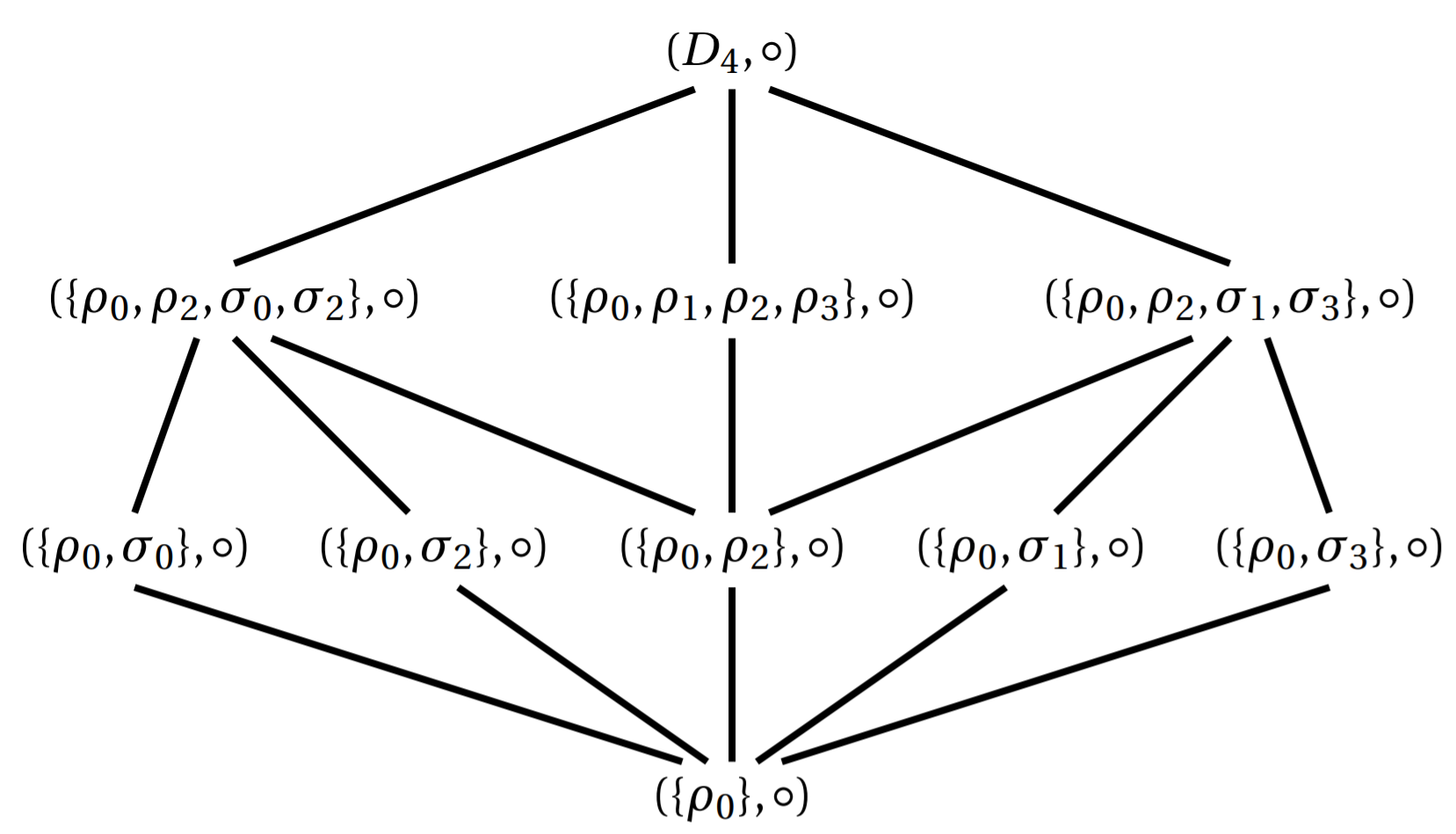
- The group of symmetries of a square is a great example of a group; it is shameless hard sell finite, non-abelian and there is no additional structure. Let ρ0, ρ1, ρ2, ρ3 be anticlockwise rotations of the square about O by 0◦ , 90◦ , 180◦ and 270◦. σ0 the reflection about the diagonal joining the top-right vertex to the bottom-left vertex; • σ1 the reflection about the line joining the midpoint of top side and the midpoint of bottom side; • σ2 the reflection about the diagonal joining top-left vertex and the bottom-right vertex; • σ3 the reflection about the line joining the midpoint of the left side and the midpoint of the right side. Thus the symmetries of a square form a set which we shall denote by D4 = {ρ0,ρ1,ρ2,ρ3,σ0,σ1,σ2,σ3}.
- We define α◦ β to be the symmetry we obtain by doing β first then α
- What’s left is to prove associativity, we can think of ρ1 as a function from {1, 2, 3, 4} to itself.
- A group is a pair (G,◦) where G is a set and ◦ is a binary operation on G, such that the following four properties hold 2 (i) (closure) for all a, b ∈ G, a ◦b ∈ G; (ii) (associativity) for all a, b, c ∈ G, a ◦ (b ◦ c) = (a ◦b) ◦ c; (iii) (existence of the identity element) there is an element e ∈ G such that for all a ∈ G, a ◦ e = e ◦ a = a; (iv) (existence of inverses) for every a ∈ G, there is an element b ∈ G (called the inverse of a) such that a ◦b = b ◦ a = e.
Bilder und Dateien der Mindmap
Informationen
- Beschreibung
- Mindmap am AA III, IV, V, erstellt von Anthony Rajecki-Doyle am 18/04/2018.
- Erstellt von
- Anthony Rajecki-Doyle
- Aufrufe
- 0
- Bewertung