
Abstract Algebra
57 resources created by 37 users
This Abstract Algebra page on GoConqr gathers community-made flashcards, mind maps, notes, slides, a quiz and a flowchart, from binary operations and groups to rings, ideals and Galois theory. It's built for university students working through the topic and teachers after ready-made material. There are over 50 resources here, including more than 10 mind maps and over 30 flashcard decks, all at university level. Pick a deck, then see how much of it you can recall.
Top Abstract Algebra resources
-
23 cardsAbstract Algebra Definitions
-
Mind map Abstract Algebra
-
79 cardsAbstract Algebra Definitions Order of permutation
-
14 cardsCh. 4: Cyclic Groups Def: Cyclic Group
-
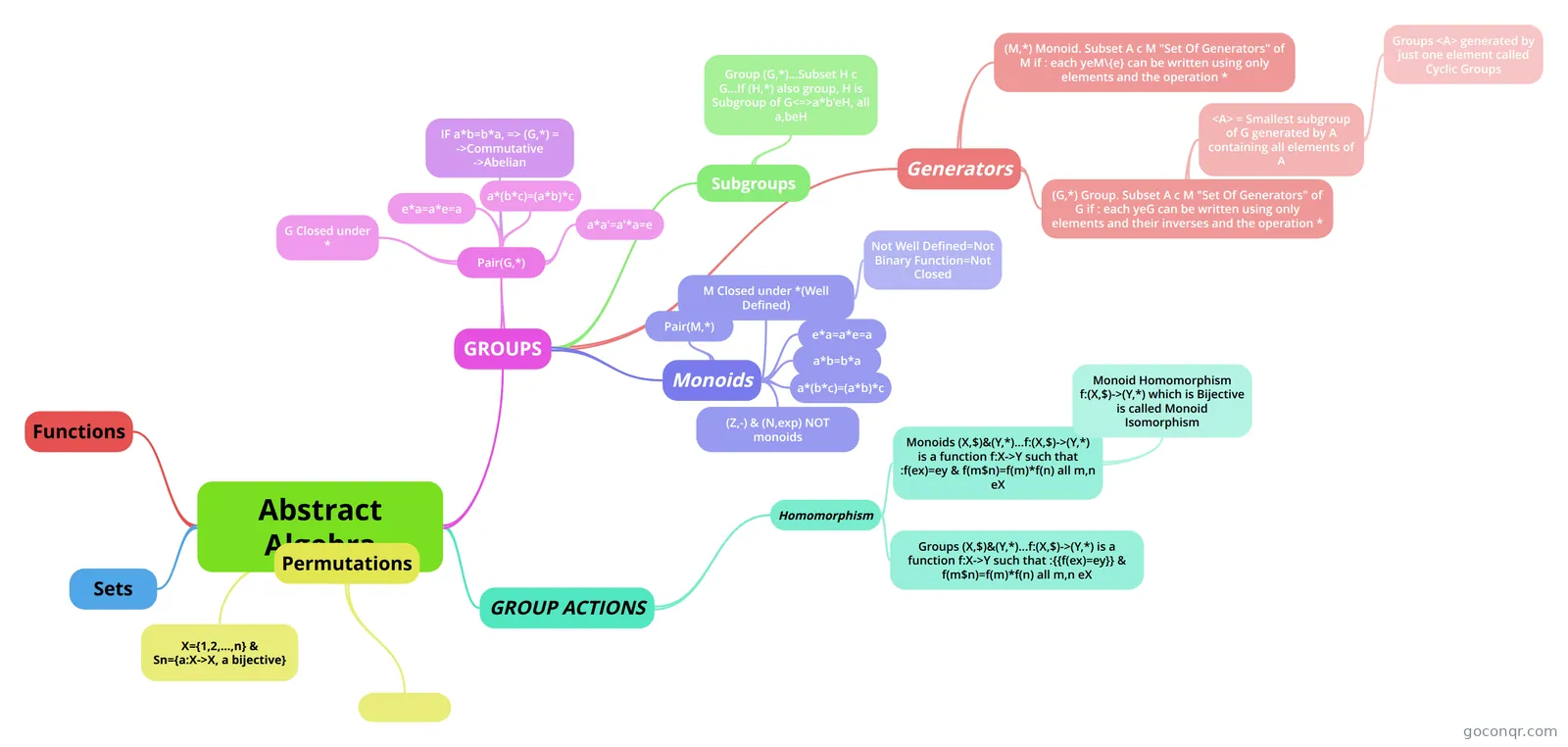 Mind map Abstract Algebra
-
31 cardsGalois Chapter 1 What is an integral domain?
-
67 cardsGroups Definition of a group
-
Mind map AA XIV
Quizzes
Mind maps
See all 12 mind mapsFlashcards
See all 39 flashcards-
23 cardsAbstract Algebra Definitions
-
79 cardsAbstract Algebra Definitions Order of permutation
-
14 cardsCh. 4: Cyclic Groups Def: Cyclic Group
-
31 cardsGalois Chapter 1 What is an integral domain?
-
67 cardsGroups Definition of a group
-
66 cardsGroup Theory
-
11 cardsCh. 6: Group Isomorphisms Define: Group Isomorphism
-
44 cardsAbstract Algebra DEFINITIONS Definition 1: What is a RELATION?
Flowcharts
Notes
Slides
Topics in Abstract Algebra
More Mathematics topics
About Abstract Algebra
GoConqr OriginalWhat this unit covers
The unit follows the usual path of an abstract algebra course. It starts with sets, binary operations and algebraic structures, moves through groups, subgroups and cyclic groups, and then reaches permutations, isomorphisms, group actions, rings and ideals. Nearly every item was made by GoConqr users, and the mix is mostly flashcards and mind maps.
Where to start
Begin with the flashcard deck Abstract Algebra Definitions. It runs from equivalence relations and binary operations through identity elements, isomorphisms, groups, abelian groups, cancellation laws and subgroups. Definitions come first in this subject, because every proof depends on them.
Next, open the mind map titled Abstract Algebra that links binary operations, semigroups, monoids, inverses, groups and homomorphisms. A second map of the same name adds sets, functions, permutations and group actions, and it shows why a structure that is not closed is not a binary operation.
Working through groups
- Read the notes called Groups, which open with the definition of a group and examples.
- Test yourself with the decks Ch. 4: Cyclic Groups and Ch. 6: Group Isomorphisms. They cover criteria for powers of an element, orders of elements, Cayley's Theorem and the steps for showing a function is an isomorphism.
- Use Permutation Groups and Cayley Tables to practise with concrete examples.
- Move on to Rings: Intro and Definitions, Rings: Homomorphisms and Rings: Ideals.
Using maps, the quiz and the flowchart
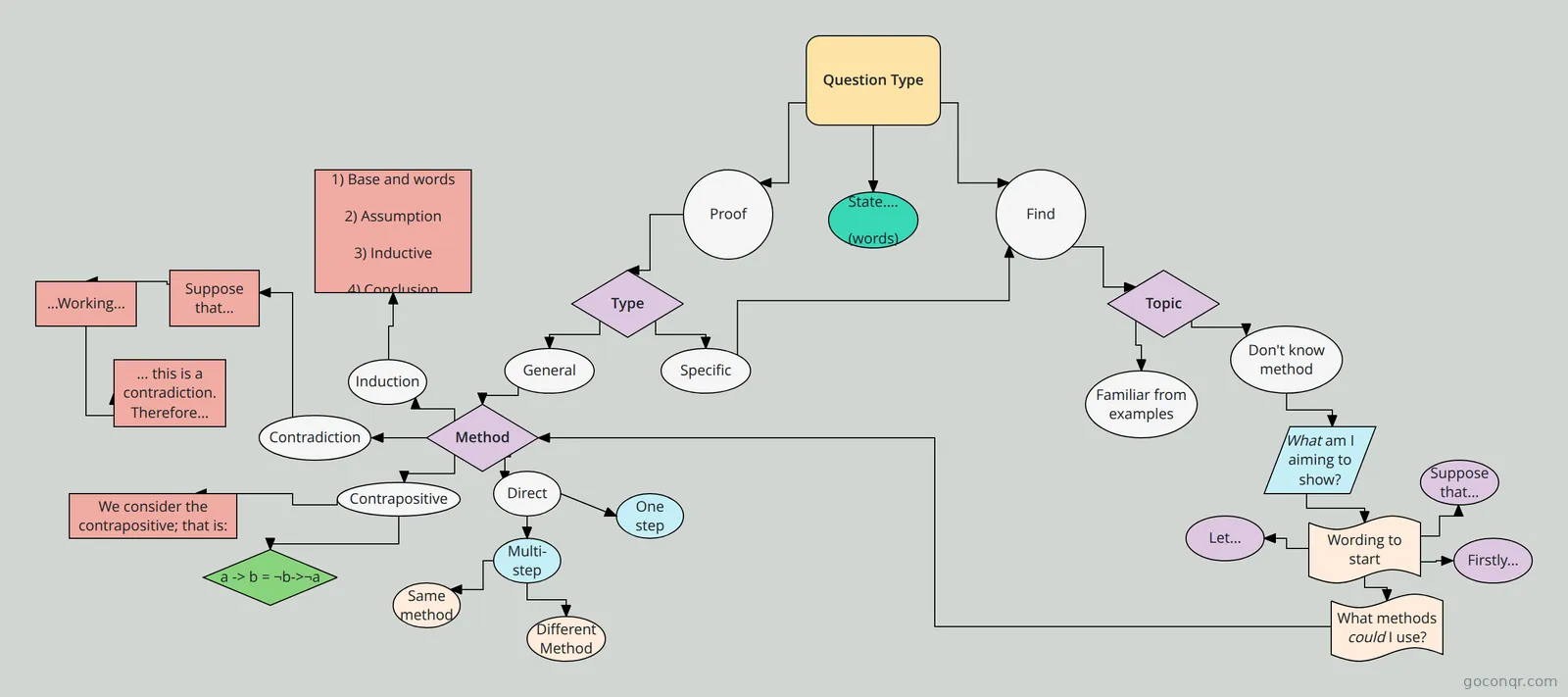
Mind maps give you the shape of a topic, and flashcards help you recall its details. Read a map first, then close it and try the matching deck. The quiz Abstract Algebra THEOREMS is a good check once you have been through the definitions. When a problem stumps you, the flowchart on how to approach a question gives you a way in.
Where it sits
This unit belongs to the Advanced Pure Mathematics strand of Mathematics. Teachers can pick out single decks or maps for a class, and students can mix and match by chapter.
Choose one deck today, work through it, and then try the quiz to see what has stuck.
Frequently asked questions
Which resource should I open first?
Start with the flashcard deck Abstract Algebra Definitions. It covers equivalence relations, binary operations, identity elements, isomorphisms, groups, abelian groups, cancellation laws and subgroups. Once those are familiar, the mind map called Abstract Algebra shows how semigroups, monoids and groups connect.
What do the mind maps cover?
There are over 10 mind maps. They cover binary operations, semigroups, monoids, inverses, groups and homomorphisms, and one adds sets, functions, permutations and group actions. Others deal with symmetric groups, group axioms, algebraic structures and rings.
Is there a quiz on this page?
Yes, there is one quiz, called Abstract Algebra THEOREMS. It suits you once you have read the definitions and notes and want to check what you remember. Flashcard decks on proofs and definitions can help you prepare.
Do the resources cover rings as well as groups?
Yes. Groups, cyclic groups, permutation groups and isomorphisms are well covered, and there are separate flashcard decks on rings: introduction and definitions, homomorphisms, ideals and ideal homomorphisms. A mind map on rings and a deck on Galois theory are also listed.
Are these resources free, and who made them?
Every resource here is free to open, study and take, with no account needed. They were made by GoConqr users, not by GoConqr. A free account lets you save quiz scores and create your own quizzes, mind maps, flashcards and notes.
What level are these resources?
All the resources are at university level. They suit university students studying abstract algebra and teachers who want ready-made decks, maps or slides to share with a class.