
Mindmap
IR 2006
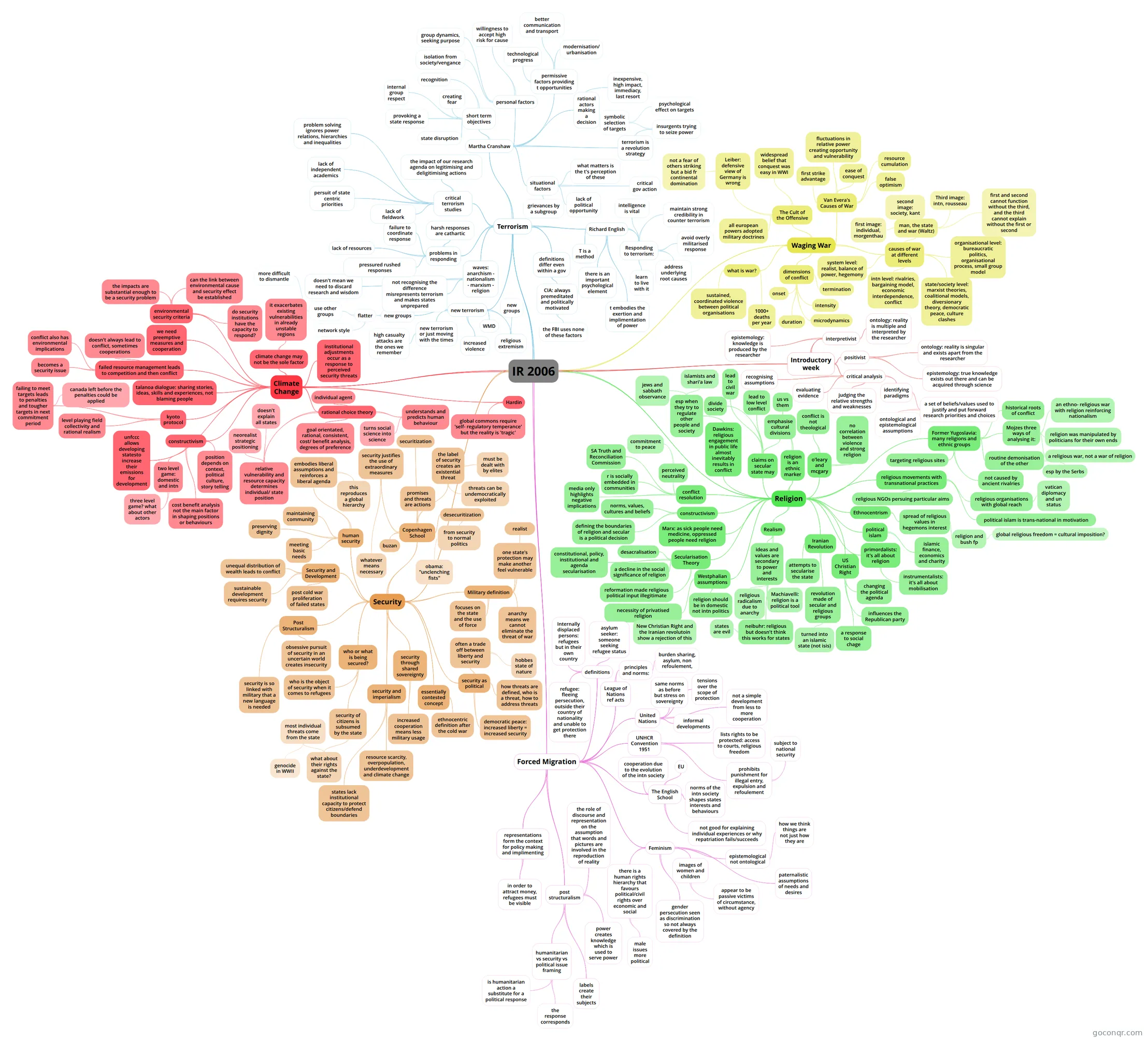
Mind map: IR 2006 international relations
Inhalt der Mindmap
IR 2006
Introductory week
- critical analysis
- recognising assumptions
- evaluating evidence
- judging the relative strengths and weaknesses
- identifying paradigms
- a set of beliefs/values used to justify and put forward research priorities and choices
- ontological and epistemological assumptions
- a set of beliefs/values used to justify and put forward research priorities and choices
- positivist
- epistemology: true knowledge exists out there and can be acquired through science
- ontology: reality is singular and exists apart from the researcher
- interpretivist
- epistemology: knowledge is produced by the researcher
- ontology: reality is multiple and interpreted by the researcher
- critical analysis
Waging War
- what is war?
- sustained, coordinated violence between political organisations
- 1000+ deaths per year
- dimensions of conflict
- onset
- duration
- intensity
- microdynamics
- termination
- causes of war at different levels
- system level: realist, balance of power, hegemony
- intn level: rivalries, bargaining model, economic interdependence, conflict
- state/society level: marxist theories, coalitional models, diversionary theory, democratic peace, culture clashes
- organisational level: bureaucratic politics, organisational process, small group model
- man, the state and war (Waltz)
- first image: individual, morgenthau
- second image: society, kant
- Third image: intn, rousseau
- first and second cannot function without the third, and the third cannot explain without the first or second
- Van Evera's Causes of War
- false optimism
- ease of conquest
- first strike advantage
- resource cumulation
- fluctuations in relative power creating opportunity and vulnerability
- The Cult of the Offensive
- widespread belief that conquest was easy in WWI
- all european powers adopted military doctrines
- Leiber: defensive view of Germany is wrong
- not a fear of others striking but a bid fr continental domination
- what is war?
Terrorism
- definitions differ even within a gov
- CIA: always premeditated and politically motivated
- the FBI uses none of these factors
- CIA: always premeditated and politically motivated
- Richard English
- T is a method
- there is an important psychological element
- t embodies the exertion and implimentation of power
- Responding to terrorism:
- learn to live with it
- address underlying root causes
- avoid overly militarised response
- intelligence is vital
- maintain strong credibility in counter terrorism
- Martha Cranshaw
- terrorism is a revolution strategy
- insurgents trying to seize power
- symbolic selection of targets
- psychological effect on targets
- symbolic selection of targets
- insurgents trying to seize power
- rational actors making a decision
- inexpensive, high impact, immediacy, last resort
- permissive factors providing t opportunities
- modernisation/ urbanisation
- better communication and transport
- technological progress
- situational factors
- grievances by a subgroup
- lack of political opportunity
- critical gov action
- what matters is the t's perception of these
- personal factors
- willingness to accept high risk for cause
- group dynamics, seeking purpose
- isolation from society/vengance
- short term objectives
- recognition
- state disruption
- creating fear
- provoking a state response
- internal group respect
- terrorism is a revolution strategy
- new terrorism
- WMD
- religious extremism
- new groups
- increased violence
- new terrorism or just moving with the times
- high casualty attacks are the ones we remember
- new groups
- flatter
- network style
- use other groups
- more difficult to dismantle
- flatter
- waves: anarchism - nationalism - marxism - religion
- not recognising the difference misrepresents terrorism and makes states unprepared
- doesn't mean we need to discard research and wisdom
- problems in responding
- lack of resources
- pressured rushed responses
- failure to coordinate response
- harsh responses are cathartic
- critical terrorism studies
- lack of fieldwork
- persuit of state centric priorities
- lack of independent academics
- problem solving ignores power relations, hierarchies and inequalities
- the impact of our research agenda on legitimising and deligitimising actions
- definitions differ even within a gov
Religion
- Dawkins: religious engagement in public life almost inevitably results in conflict
- esp when they try to regulate other people and society
- jews and sabbath observance
- islamists and shari'a law
- esp when they try to regulate other people and society
- claims on secular state may
- divide society
- lead to low level conflict
- lead to civil war
- emphasise cultural divisions
- religion is an ethnic marker
- us vs them
- o'leary and mcgary
- conflict is not theological
- no correlation between violence and strong religion
- Former Yugoslavia: many religions and ethnic groups
- historical roots of conflict
- not caused by ancient rivalries
- Mojzes three ways of analysing it:
- a religious war, not a war of religion
- an ethno- religious war with religion reinforcing nationalism
- religion was manipulated by politicians for their own ends
- routine demonisation of the other
- esp by the Serbs
- targeting religious sites
- religious movements with transnational practices
- religious organisations with global reach
- vatican diplomacy and un status
- religious NGOs persuing particular aims
- political islam is trans-national in motivation
- religious organisations with global reach
- Ethnocentrism
- spread of religious values in hegemons interest
- religion and bush fp
- global religious freedom = cultural imposition?
- religion and bush fp
- spread of religious values in hegemons interest
- conflict resolution
- perceived neutrality
- commitment to peace
- r is socially embedded in communities
- media only highlights negative implications
- SA Truth and Reconciliation Commission
- perceived neutrality
- constructivism
- norms, values, cultures and beliefs
- defining the boundaries of religion and secular is a political decision
- Marx: as sick people need medicine, oppressed people need religion
- Secularisation Theory
- a decline in the social significance of religion
- desacralisation
- constitutional, policy, institutional and agenda secularisation
- reformation made religious political input illegitimate
- Westphalian assumptions
- necessity of privatised religion
- New Christian Right and the Iranian revolutoin show a rejection of this
- religion should be in domestic not intn politics
- necessity of privatised religion
- Realism
- ideas and values are secondary to power and interests
- religious radicalism due to anarchy
- Machiavelli: religion is a political tool
- neibuhr: religious but doesn't think this works for states
- states are evil
- ideas and values are secondary to power and interests
- Iranian Revolution
- attempts to secularise the state
- revolution made of secular and religious groups
- turned into an islamic state (not isis)
- political islam
- islamic finance, economics and charity
- US Christian Right
- a response to social chage
- changing the political agenda
- influences the Republican party
- primordalists: it's all about religion
- instrumentalists: it's all about mobilisation
- Dawkins: religious engagement in public life almost inevitably results in conflict
Forced Migration
- definitions
- refugee: fleeing persecution, outside their country of nationality and unable to get protection there
- asylum seeker: someone seeking refugee status
- Internally displaced persons: refugees but in their own country
- League of Nations ref acts
- principles and norms:
- burden sharing, asylum, non refoulement,
- principles and norms:
- United Nations
- same norms as before but stress on sovereignty
- informal developments
- tensions over the scope of protection
- not a simple development from less to more cooperation
- UNHCR Convention 1951
- lists rights to be protected: access to courts, religious freedom
- prohibits punishment for illegal entry, expulsion and refoulement
- subject to national security
- The English School
- cooperation due to the evolution of the intn society
- EU
- norms of the intn society shapes states interests and behaviours
- not good for explaining individual experiences or why repatriation fails/succeeds
- Feminism
- epistemological not ontological
- how we think things are not just how they are
- images of women and children
- appear to be passive victims of circumstance, without agency
- paternalistic assumptions of needs and desires
- gender persecution seen as discrimination so not always covered by the definition
- there is a human rights hierarchy that favours political/civil rights over economic and social
- male issues more political
- epistemological not ontological
- representations form the context for policy making and implimenting
- in order to attract money, refugees must be visible
- post structuralism
- the role of discourse and representation on the assumption that words and pictures are involved in the reproduction of reality
- power creates knowledge which is used to serve power
- labels create their subjects
- humanitarian vs security vs political issue framing
- the response corresponds
- is humanitarian action a substitute for a political response
- definitions
Security
- Military definition
- focuses on the state and the use of force
- realist
- anarchy means we cannot eliminate the threat of war
- one state's protection may make another feel vulnerable
- security as political
- often a trade off between liberty and security
- hobbes state of nature
- how threats are defined, who is a threat, how to address threats
- democratic peace: increased liberty = increased security
- often a trade off between liberty and security
- essentially contested concept
- ethnocentric definition after the cold war
- security through shared sovereignty
- increased cooperation means less military usage
- security and imperialism
- resource scarcity, overpopulation, underdevelopment and climate change
- states lack institutional capacity to protect citizens/defend boundaries
- who or what is being secured?
- security of citizens is subsumed by the state
- what about their rights against the state?
- most individual threats come from the state
- genocide in WWII
- most individual threats come from the state
- what about their rights against the state?
- who is the object of security when it comes to refugees
- security of citizens is subsumed by the state
- Post Structuralism
- obsessive pursuit of security in an uncertain world creates insecurity
- security is so linked with military that a new language is needed
- Security and Development
- post cold war proliferation of failed states
- sustainable development requires security
- unequal distribution of wealth leads to conflict
- human security
- meeting basic needs
- preserving dignity
- maintaining community
- embodies liberal assumptions and reinforces a liberal agenda
- this reproduces a global hierarchy
- Copenhagen School
- buzan
- security justifies the use of extraordinary measures
- whatever means necessary
- promises and threats are actions
- the label of security creates an existential threat
- must be dealt with by elites
- threats can be undemocratically exploited
- securitization
- desecuritization
- from security to normal politics
- obama: "unclenching fists"
- from security to normal politics
- Military definition
Climate Change
- Hardin
- global commons require 'self- regulatory temperance' but the reality is 'tragic'
- rational choice theory
- understands and predicts human behaviour
- turns social science into science
- goal orientated, rational, consistent, cost/ benefit analysis, degrees of preference
- individual agent
- relative vulnerability and resource capacity determines individual/ state position
- neorealist strategic positioning
- doesn't explain all states
- understands and predicts human behaviour
- constructivism
- position depends on context, political culture, story telling
- cost benefit analysis not the main factor in shaping positions or behaviours
- two level game: domestic and intn
- three level game? what about other actors
- unfccc allows developing statesto increase their emissions for development
- kyoto protocol
- level playing field collectivity and rational realism
- failing to meet targets leads to penalties and tougher targets in next commitment period
- canada left before the penalties could be applied
- talanoa dialogue: sharing stories, ideas, skills and experiences, not blaming people
- failed resource management leads to competition and then conflict
- becomes a security issue
- conflict also has environmental implications
- doesn't always lead to conflict, sometimes cooperations
- we need preemptive measures and cooperation
- environmental security criteria
- the impacts are substantial enough to be a security problem
- can the link between environmental cause and security effect be established
- do security institutions have the capacity to respond?
- climate change may not be the sole factor
- it exacerbates existing vulnerabilities in already unstable regions
- institutional adjustments occur as a response to perceived security threats
- Hardin
Informationen
- Beschreibung
- Mindmap am IR 2006, erstellt von Jessica Leech am 04/05/2018.
- Erstellt von
- Jessica Leech
- Aufrufe
- 0
- Bewertung