
International Relations Theory
28 resources created by 23 users
This International Relations Theory page on GoConqr gathers community-made mind maps, flashcards, quizzes and notes on realism, liberalism, constructivism, feminism, postcolonialism and more. It's built for university students revising theories and testing their recall, and for teachers after ready-made material. There are over 300 resources here, including more than 10 quizzes and over 200 mind maps, all made by GoConqr users. Open a mind map to get the big picture, then try a quiz and build your own flashcards.
Top International Relations Theory resources
-
60 cardsInternational Relations // Definitions & Concepts agency versus. structure debate
-
27 cardsConstructed Identities and the Middle East Historical background of constructivism
-
50 questionsTheory of international relations Chapter 6-10 The lineage of classical realism is said to have begun with:
-
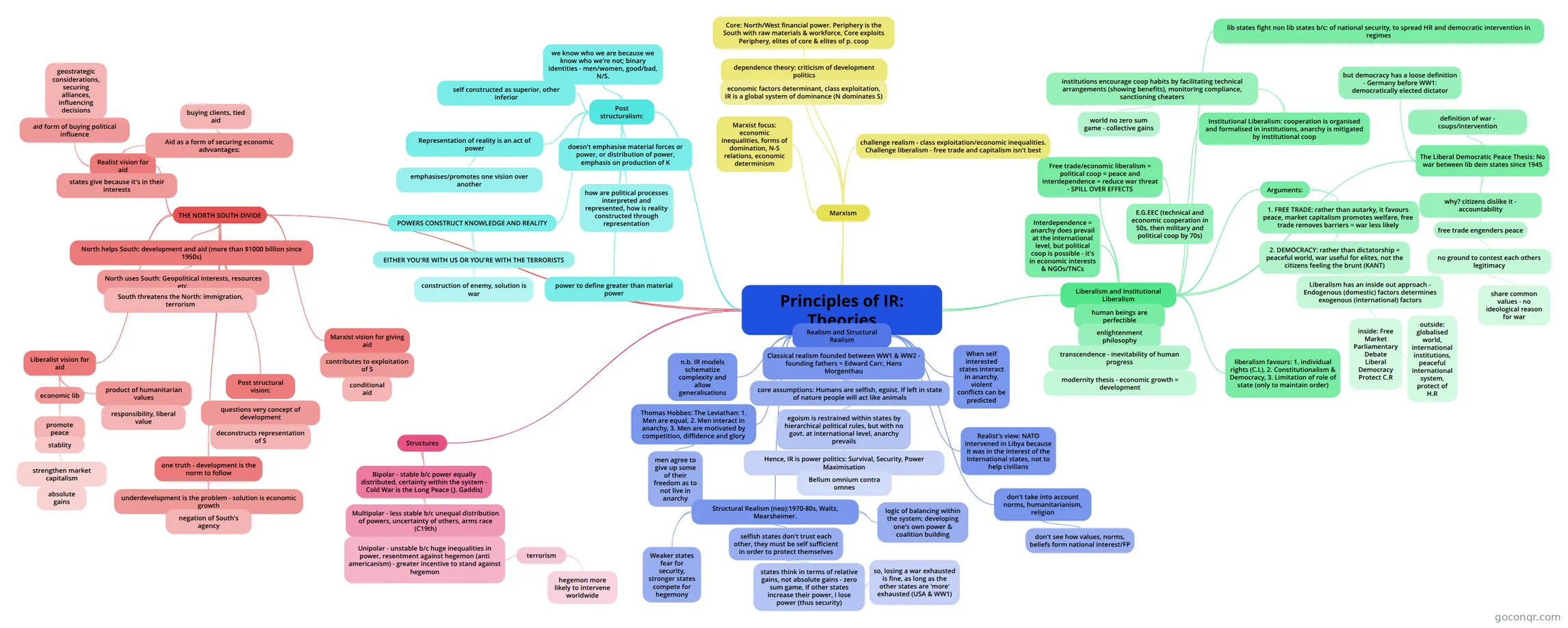 Mind map Principles of IR: Theories
-
 Mind map A critical analysis of the U.S pivot toward the Asia-Pacific: How realistic is neo-realism? Global Politics 3/4
-
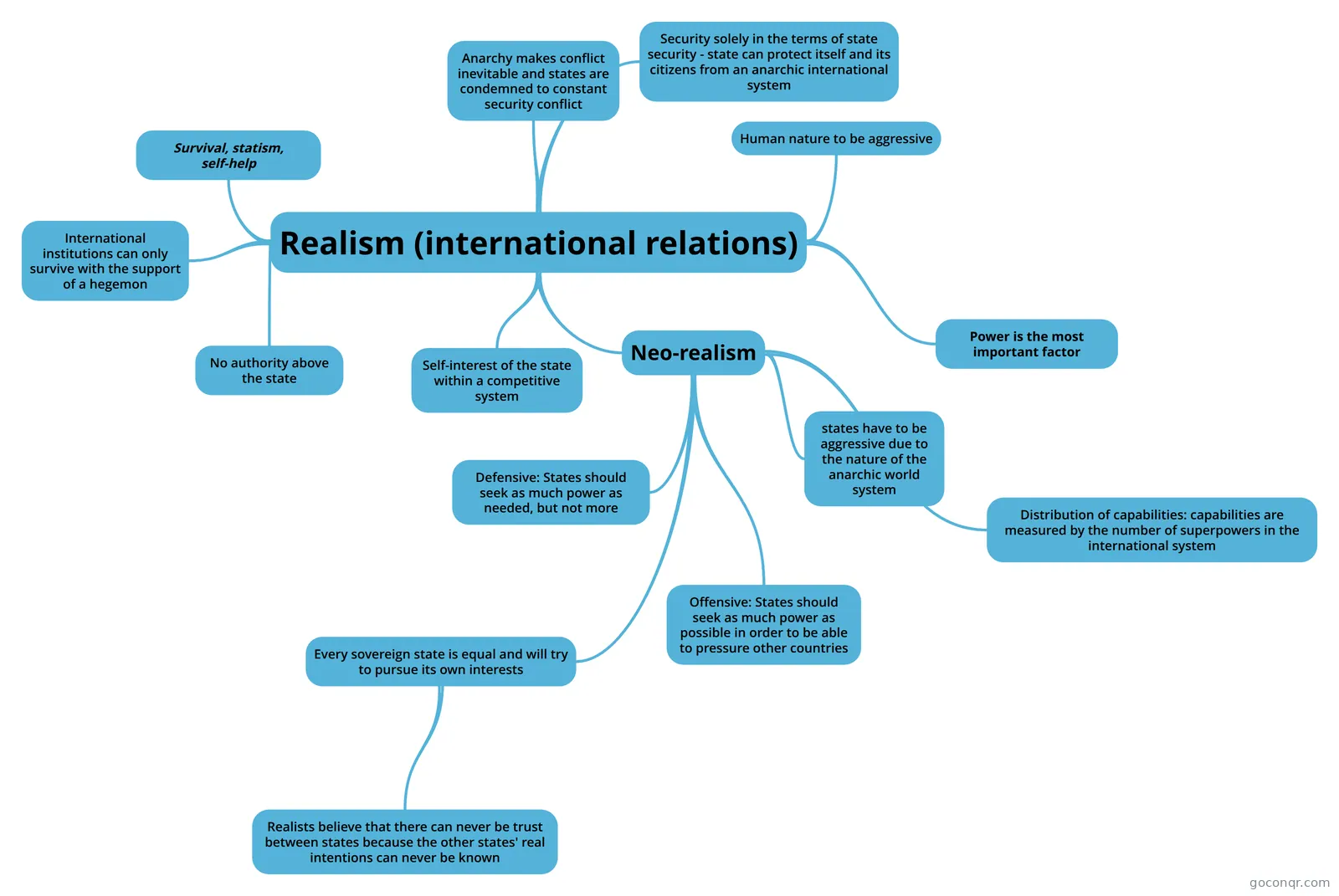 Mind map Realism (international relations) Realist theory (international relations)
-
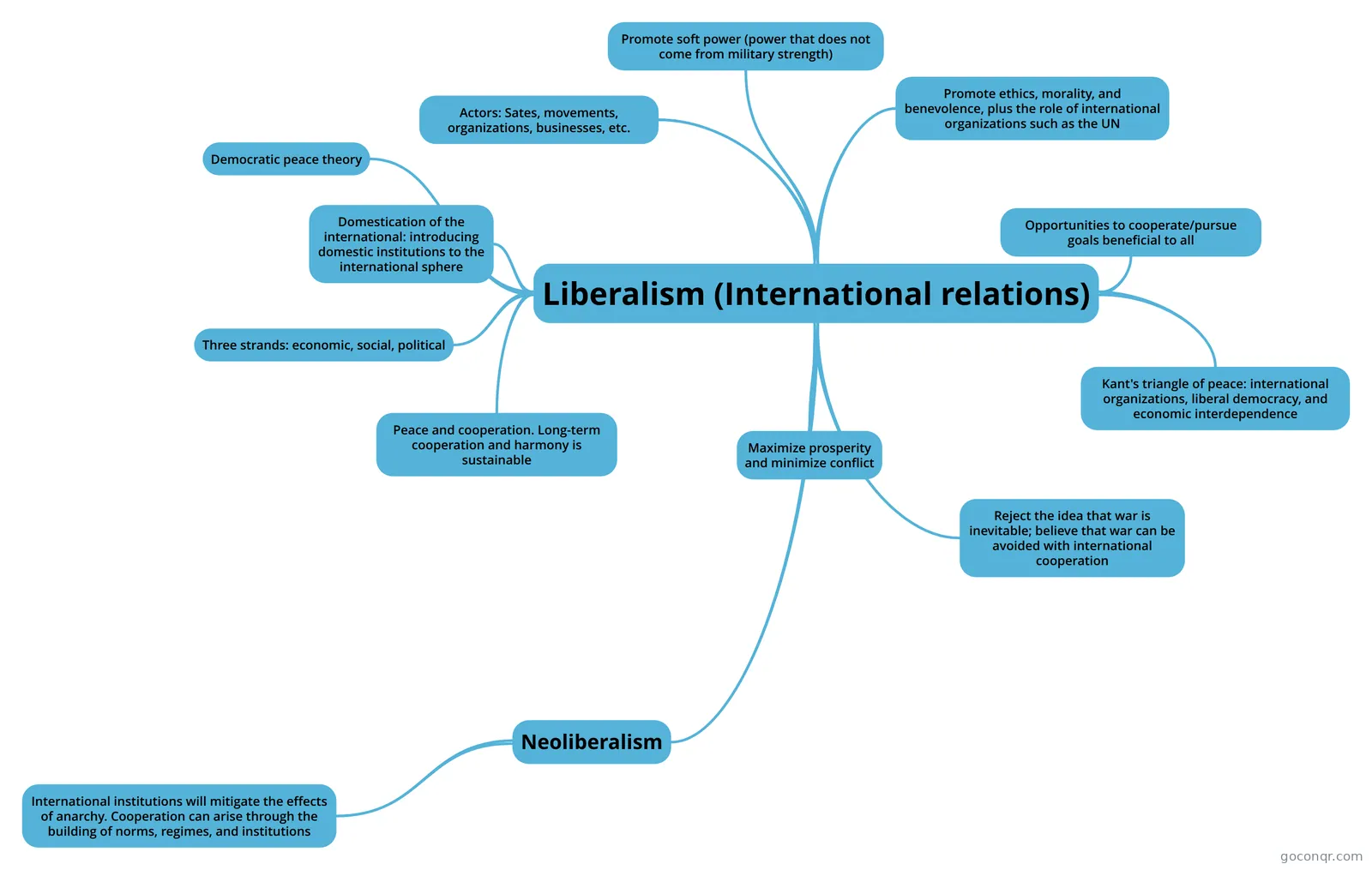 Mind map Liberalism (International relations) Liberalism (international relations)
-
Mind map THEORIES INTERNATIONAL RELATIONS THEORIES INTERNATIONAL RELATIONS
Quizzes
-
50 questionsTheory of international relations Chapter 6-10 The lineage of classical realism is said to have begun with:
-
51 questionsTheory of international relations chapter 11 - 15 Post-structuralism takes which view of identity and foreign policy?
-
6 questionsLevels of Analysis (Week 2) What are Waltz's (1959) three 'images' (levels) of analysis as to why war takes place?
Mind maps
See all 18 mind maps-
Principles of IR: Theories
-
A critical analysis of the U.S pivot toward the Asia-Pacific: How realistic is neo-realism? Global Politics 3/4
-
Realism (international relations) Realist theory (international relations)
-
Liberalism (International relations) Liberalism (international relations)
-
THEORIES INTERNATIONAL RELATIONS THEORIES INTERNATIONAL RELATIONS
-
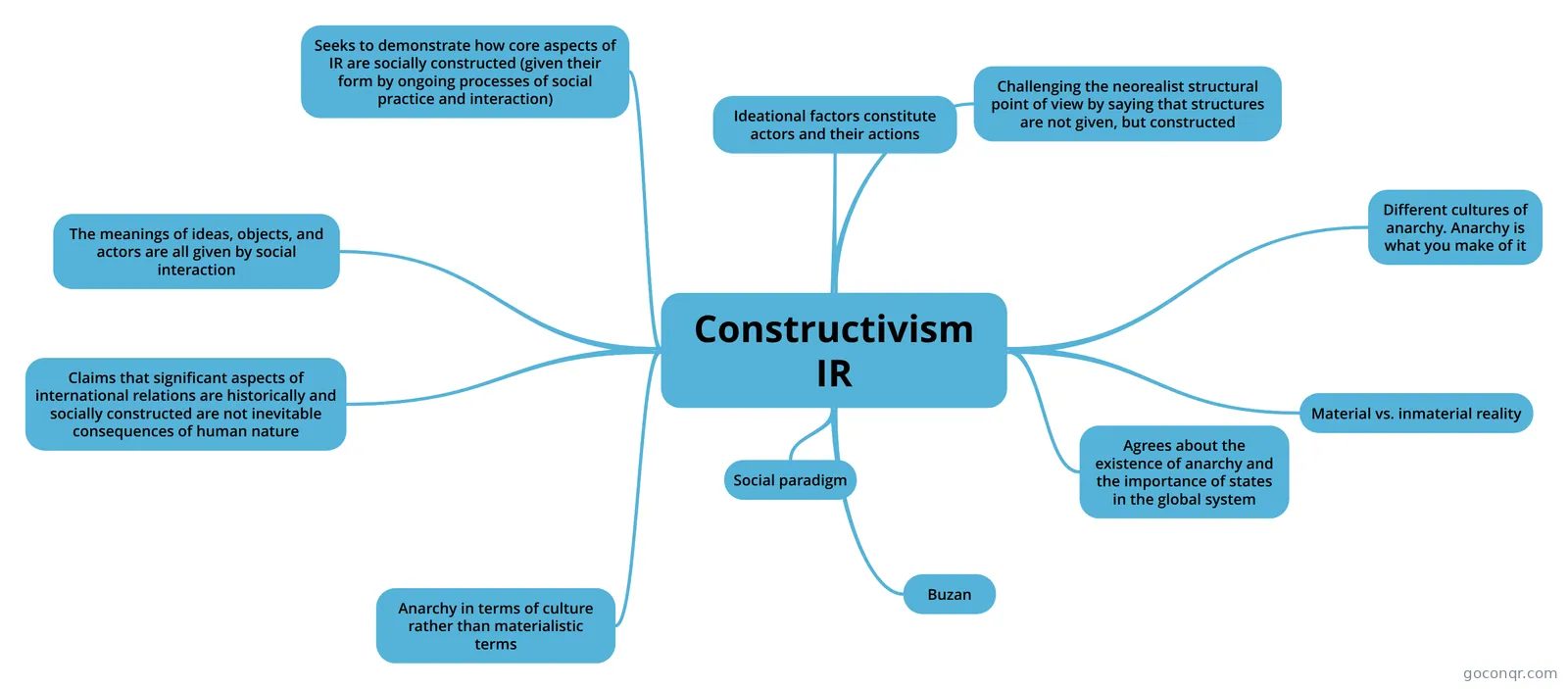 Constructivism IR Constructivism (international relations)
-
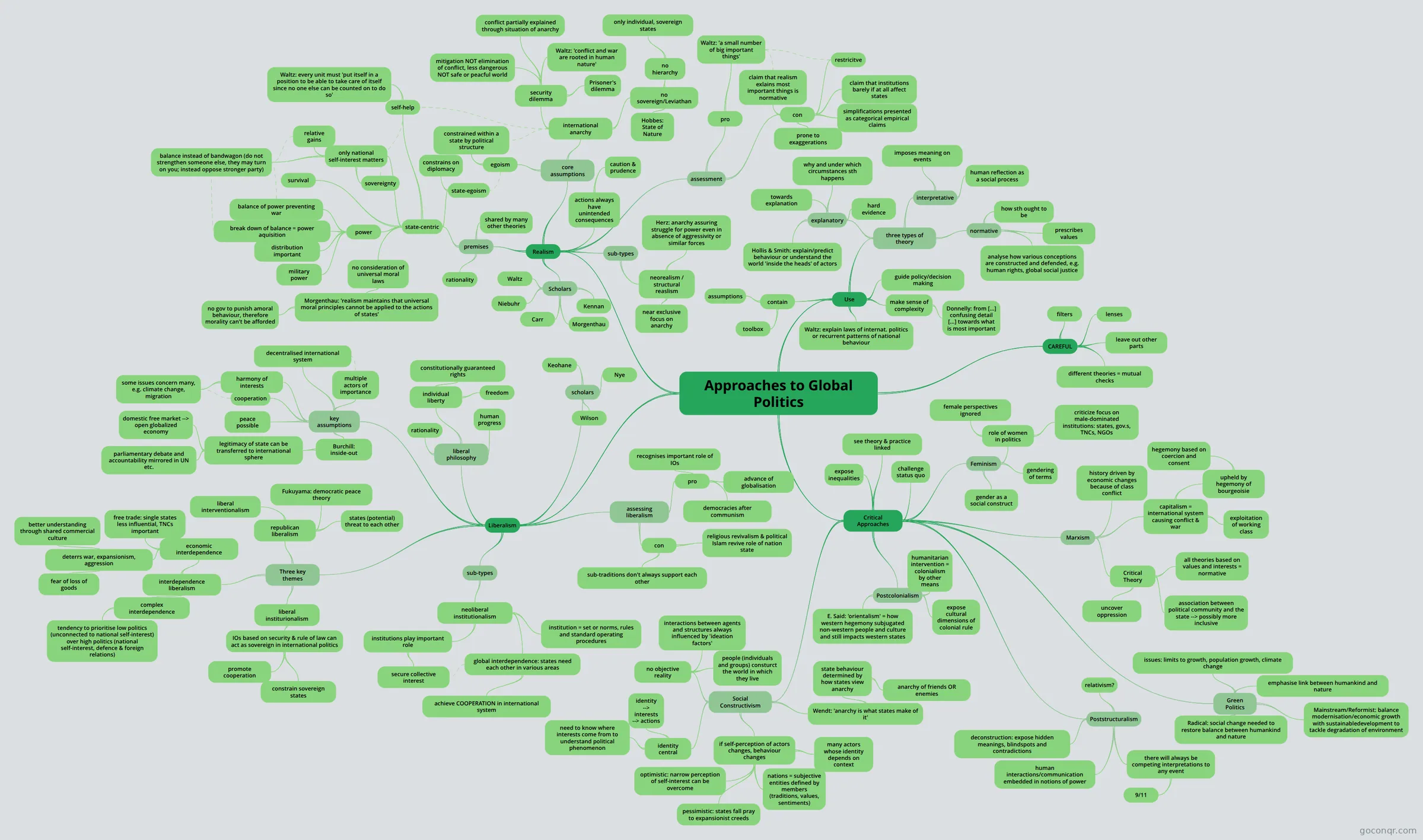 Approaches to Global Politics Key facts about major theoretical approaches in IR
-
Classical Realism vs. Structural Realism
Flashcards
-
60 cardsInternational Relations // Definitions & Concepts agency versus. structure debate
-
27 cardsConstructed Identities and the Middle East Historical background of constructivism
-
12 cardsWho Thought What? International Politics Readings Flashcards for the important theories/theorists presented in International Politics readings from lectures ...
-
10 cardsIR How many central propositions has Realism?
Notes
-
Seminar 1: Balance of Power Theory & Military Dominance in the Western Pacific Saddat Nazir Seminar ! Yale Young Global Scholars Realists believe that power is the currency of international politics. Defensive realists argue that structural factors limit how much power states c...
-
Seminar 1: Balance of Power Theory & Military Dominance in the Western Pacific Saddat Nazir Yale Young Global Scholars Seminar 1: Balance of Power Theory & Military Dominance in the Western Pacific Realists believe that power is the currency of international politics. Defensive realists a...
-
International Instituions Overview INTERNATIONAL INSTITUIONS International relations is driven by concurrences, clashes, compromises, coordination, norms, motivations and values International institutions are an important area of debate between IR theo...
More Political science topics
About International Relations Theory
GoConqr OriginalWhat this unit covers
The page is built around the main schools of thought in international relations. Realism has the widest coverage, with mind maps, flashcard decks on power politics, anarchy and classical realism, and a flowchart of realist theoretical approaches. Liberalism comes next, with maps on classic liberal internationalism, interwar liberal institutionalism and democratic peace theory. Constructivism, feminism, postcolonialism, the English School and critical theory are also listed.
Where to start
Begin with the Realism (international relations) mind map. It sets out the core ideas: states act in their own interest, there is no authority above the state, and survival and self-help matter most. Then open the Liberalism (International relations) mind map to see the contrast, including the belief that war can be avoided through international cooperation.
- Read one overview map, such as Principles of IR: Theories.
- Move to a single theory, such as Constructivism IR.
- Use the comparison notes on realism and liberalism to line the ideas up.
Using quizzes and maps together
Read a map, close it, and then take a quiz on the same theory. The Realism quiz and the Critical Theory Quiz suit a single topic. The longer Theory of international relations quizzes cover chapters in sequence, so they work well later in your revision. Note which questions you miss, go back to the matching map, and try again.
Flashcards help with vocabulary. International Relations // Definitions & Concepts covers terms such as balance of power, bandwagoning and bipolarity. For cases, try the notes on balance of power and military dominance in the Western Pacific, or the flashcards on constructed identities in the Middle East.
Where it sits
This unit belongs to the International Relations strand of Political science. Teachers can use the maps and decks as ready-made starting points for seminars or revision sessions.
Pick a theory that feels shaky, work through its map and quiz, and then make your own version.
Frequently asked questions
Which resource should I open first?
Start with the Realism (international relations) mind map, then the Liberalism (International relations) mind map. Together they give you the two best-covered traditions and show where they disagree. After that, move on to constructivism, feminism or postcolonialism, depending on what your course asks of you.
What do the mind maps cover?
They cover realism and neorealism, liberalism and neoliberalism, constructivism, feminism, idealism, the English School, democratic peace theory, geopolitics theories and middle powers. Some are broad overviews of IR theories, while others take on a single question, such as how cooperation among states can be achieved.
Are the resources free to use?
Yes. Every resource listed here is free to open, study and take, with no account needed. They were made by GoConqr users rather than by GoConqr itself, so styles and depth vary. A free account lets you save quiz scores and make your own quizzes, maps, flashcards and notes.
Which quizzes are there?
There are quizzes on realism, critical theory, feminism and normative theory, plus a general world politics quiz. You will also find a levels of analysis quiz and several chapter-based quizzes titled Theory of international relations. Use the topic quizzes first and the chapter quizzes for wider revision.
Who are these resources for?
They are written for university students who want to revise theories, learn key terms and test their recall. Teachers can also use them as ready-made material for seminars or revision classes. The page lists mind maps, flashcards, quizzes, notes, flowcharts and slide sets.
What if I can't find a theory I need?
Check the related theories first, since many maps overlap. Constructivism, for example, appears under several titles. If a topic is still missing, you can build your own mind map, flashcard deck or quiz on GoConqr and use it for your own revision.