
Mindmap
Speech Perception
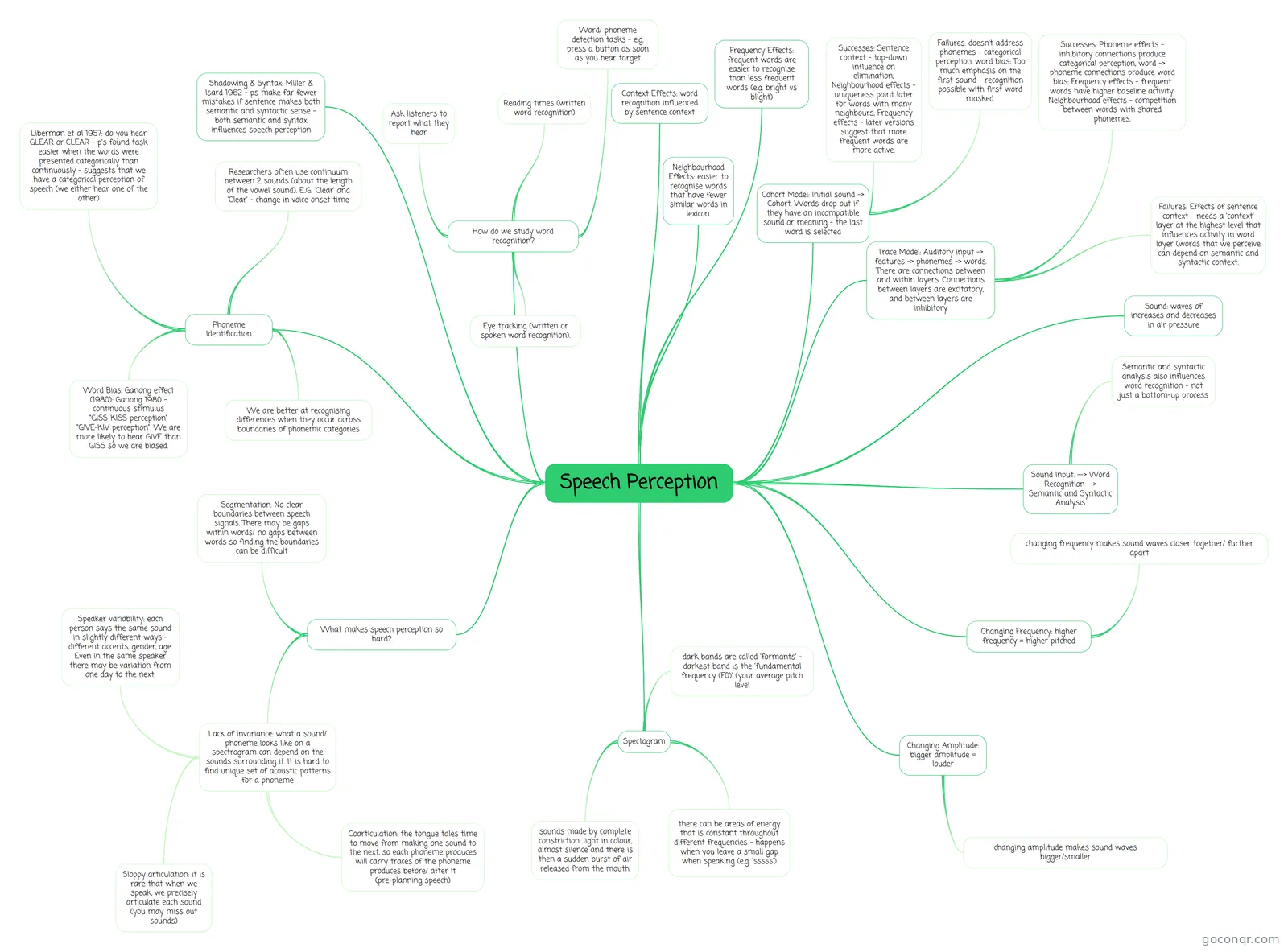
Mind map: Speech perception
Inhalt der Mindmap
Speech Perception
Sound: waves of increases and decreases in air pressure
Sound Input. --> Word Recognition --> Semantic and Syntactic Analysis
- Semantic and syntactic analysis also influences word recognition - not just a bottom-up process
Changing Frequency: higher frequency = higher pitched
- changing frequency makes sound waves closer together/ further apart
Changing Amplitude: bigger amplitude = louder
- changing amplitude makes sound waves bigger/smaller
Spectogram
- dark bands are called 'formants' - darkest band is the 'fundamental frequency (F0)' (your average pitch level
- there can be areas of energy that is constant throughout different frequencies - happens when you leave a small gap when speaking (e.g. 'sssss')
- sounds made by complete constriction: light in colour, almost silence and there is then a sudden burst of air released from the mouth.
What makes speech perception so hard?
- Segmentation: No clear boundaries between speech signals. There may be gaps within words/ no gaps between words so finding the boundaries can be difficult
- Lack of Invariance: what a sound/ phoneme looks like on a spectrogram can depend on the sounds surrounding it. It is hard to find unique set of acoustic patterns for a phoneme
- Coarticulation: the tongue tales time to move from making one sound to the next, so each phoneme produces will carry traces of the phoneme produces before/ after it (pre-planning speech)
- Sloppy articulation: it is rare that when we speak, we precisely articulate each sound (you may miss out sounds)
- Speaker variability: each person says the same sound in slightly different ways - different accents, gender, age. Even in the same speaker there may be variation from one day to the next.
Phoneme Identification
- Researchers often use continuum between 2 sounds (about the length of the vowel sound). E..G. 'Clear' and 'Clear' - change in voice onset time
- Liberman et al 1957: do you hear GLEAR or CLEAR - p's found task easier when the words were presented categorically than continuously - suggests that we have a categorical perception of speech (we either hear one of the other)
- We are better at recognising differences when they occur across boundaries of phonemic categories
- Word Bias: Ganong effect (1980): Ganong 1980 - continuous stimulus "GISS-KISS perception" "GIVE-KIV perception". We are more likely to hear GIVE than GISS so we are biased.
Shadowing & Syntax: Miller & Isard 1962 - ps make far fewer mistakes if sentence makes both semantic and syntactic sense - both semantic and syntax influences speech perception
How do we study word recognition?
- Ask listeners to report what they hear
- Reading times (written word recognition)
- Word/ phoneme detection tasks - e.g. press a button as soon as you hear target
- Eye tracking (written or spoken word recognition).
Context Effects: word recognition influenced by sentence context
Frequency Effects: frequent words are easier to recognise than less frequent words (e.g. bright vs blight)
Neighbourhood Effects: easier to recognise words that have fewer similar words in lexicon.
Cohort Model: Initial sound -> Cohort. Words drop out if they have an incompatible sound or meaning - the last word is selected
- Successes: Sentence context - top-down influence on elimination; Neighbourhood effects - uniqueness point later for words with many neighbours; Frequency effects - later versions suggest that more frequent words are more active.
- Failures: doesn't address phonemes - categorical perception, word bias; Too much emphasis on the first sound - recognition possible with first word masked.
Trace Model: Auditory input -> features -> phonemes -> words. There are connections between and within layers. Connections between layers are excitatory, and between layers are inhibitory
- Successes: Phoneme effects - inhibitory connections produce categorical perception, word -> phoneme connections produce word bias; Frequency effects - frequent words have higher baseline activity; Neighbourhood effects - competition between words with shared phonemes.
- Failures: Effects of sentence context - needs a 'context' layer at the highest level that influences activity in word layer (words that we perceive can depend on semantic and syntactic context.
Informationen
- Beschreibung
- Mindmap am Speech Perception, erstellt von Emily Collyer am 28/05/2018.
- Erstellt von
- Emily Collyer
- Aufrufe
- 0
- Bewertung
Mehr zu Speech Perception and Language Comprehension