
Mindmap
Linguistic Subsystems
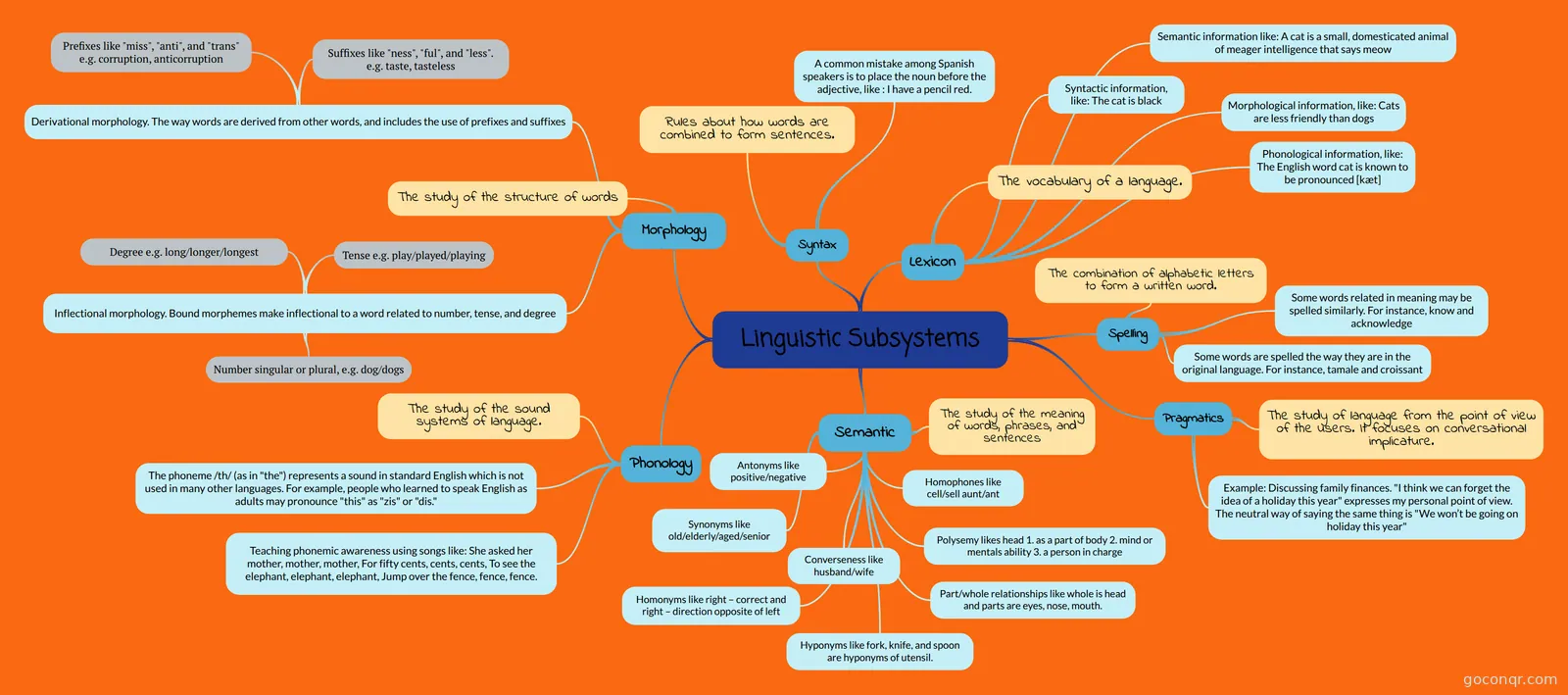
Mind map: Linguistic subsystems
Inhalt der Mindmap
Linguistic Subsystems
Spelling
- The combination of alphabetic letters to form a written word.
- Some words are spelled the way they are in the original language. For instance, tamale and croissant
- Some words related in meaning may be spelled similarly. For instance, know and acknowledge
Morphology
- The study of the structure of words
- Derivational morphology. The way words are derived from other words, and includes the use of prefixes and suffixes
- Prefixes like "miss", "anti", and "trans" e.g. corruption, anticorruption
- Suffixes like "ness", "ful", and "less". e.g. taste, tasteless
- Inflectional morphology. Bound morphemes make inflectional to a word related to number, tense, and degree
- Degree e.g. long/longer/longest
- Tense e.g. play/played/playing
- Number singular or plural, e.g. dog/dogs
Phonology
- The study of the sound systems of language.
- The phoneme /th/ (as in "the") represents a sound in standard English which is not used in many other languages. For example, people who learned to speak English as adults may pronounce "this" as "zis" or "dis."
- Teaching phonemic awareness using songs like: She asked her mother, mother, mother, For fifty cents, cents, cents, To see the elephant, elephant, elephant, Jump over the fence, fence, fence.
Semantic
- Synonyms like old/elderly/aged/senior
- Homonyms like right – correct and right – direction opposite of left
- Converseness like husband/wife
- Homophones like cell/sell aunt/ant
- The study of the meaning of words, phrases, and sentences
- Polysemy likes head 1. as a part of body 2. mind or mentals ability 3. a person in charge
- Part/whole relationships like whole is head and parts are eyes, nose, mouth.
- Hyponyms like fork, knife, and spoon are hyponyms of utensil.
- Antonyms like positive/negative
Syntax
- Rules about how words are combined to form sentences.
- A common mistake among Spanish speakers is to place the noun before the adjective, like : I have a pencil red.
Lexicon
- The vocabulary of a language.
- Phonological information, like: The English word cat is known to be pronounced [kæt]
- Semantic information like: A cat is a small, domesticated animal of meager intelligence that says meow
- Morphological information, like: Cats are less friendly than dogs
- Syntactic information, like: The cat is black
Pragmatics
- The study of language from the point of view of the users. It focuses on conversational implicature.
- Example: Discussing family finances. "I think we can forget the idea of a holiday this year" expresses my personal point of view. The neutral way of saying the same thing is "We won’t be going on holiday this year"
Informationen
- Beschreibung
- Mindmap am Linguistic Subsystems, erstellt von Estela Nencescue am 03/09/2018.
- Erstellt von
- Estela Nencescue
- Aufrufe
- 31
- Tags
- Bewertung
Mehr zu Levels and Subsystems of Language