
Mindmap
(pathology)
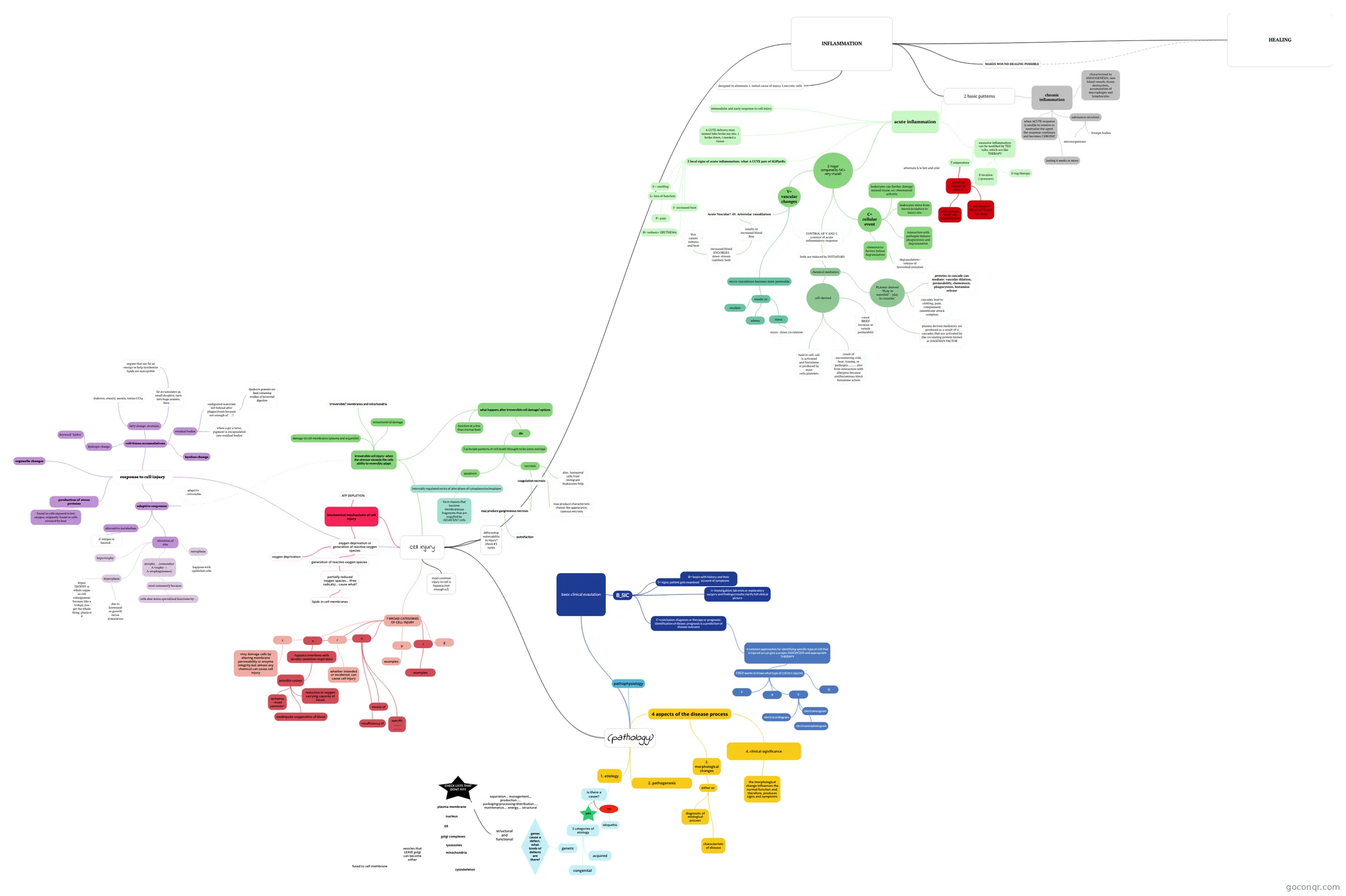
Mind map: pathology
Inhalt der Mindmap
(pathology)
- study of disease; focuses on the study of structural and functional changes in cells-tissues-organs that underlie disease BY USING 2 THINGS:
1. etiology
- study of cause of disease
- is there a cause?
- yes
- usually there are a combination of factors contributing to a cause
- 3 categories of etiology
- ginas cooking? appauling
- genetic
- genes pass on defect ex: cystic fibrosis
- genes cause a defect. what kinds of defects are there?
- structural and functional
- plasma membrane
- separation
- nucleus
- management
- ER
- production
- rough (RER)
- synthesize fatty acids and phospholipids enzymes detoxify hormones, drugs, toxins
- ribosomes
- sites where amino acids polymerized to form proteins
- smooth
- synthesizes plasma membrane, organelle, and secreted proteins
- NO ribosomes, but is contineous with RER
- golgi complexes
- packaging, processing, distribution
- vesicles that LEAVE golgi can become either
- lysosomes
- degrades waste
- fused to cell membrane
- secreted molecules, membrane components
- lysosomes
- lysosomes
- maintenance
- mitochondria
- ENERGY
- cytoskeleton
- structural network of filamentous proteins (3) within the cytoplasm
- 3 classes of protein fibers
- microfilaments (actin) intermediate fibers microtubules
- separation... management,,, production..... packaging/processing/distribution..... maintenance.... energy.... structural
- CHECK LISTS THAT DONT FIT!!
- plasma membrane
- structural and functional
- congenital
- acquired
- no
- idiopathic
- yes
2. pathogenesis
- sequence of events that form the cell or tissues response to the etiological agent sequence goes from initial stimulus to ultimate expression of disease
4 aspects of the disease process
- 3. morphological changes
- STRUCTURAL alterations induced in cells/organs.
- either or:
- ???? need better explanation
- characteristic of disease
- diagnostic of etiological process
- 4. clinical significance
- FUNCTIONAL consequences of morphological changes
- the morphological change influences the normal function and, therefore, produces signs and symptoms
- 3. morphological changes
pathophysiology
- pathology WITH emphasis on medical procedures and patient care
cell injury
- 7 BROAD CATEGORIES OF CELL INJURY
- c
- chemical agents
- may damage cells by altering membrane permeability or enzyme integrity but almost any chemical can cause cell injury
- pollutants. poison. insecticides.
- o
- oxygen deprivation
- hypoxia interferes with aerobic oxidative respiration
- hypoxia =oxygen deficiency
- possible causes
- ischemia ~most common~
- loss of blood supply in tissue due to impeded (hindered) arterial flow
- inadequate oxygenation of blood
- pneumonia
- reduction in oxygen carrying capacity of blood
- anemia and CO poisoning
- ischemia ~most common~
- r
- immunologic (r)eactions
- whether intended or incidental, can cause cell injury
- incidental =auto immune disorers like lupus intended= epi pen use (needed)
- n
- nutritional imbalances
- insufficiency of
- protein-calorie
- specific _____ ______
- vitamin deficiencies
- excess of
- nutrients
- p
- physical agents
- examples
- trauma radiation electric shock temperature extremes & sudden changes in atmospheric pressure
- i
- infectious agents
- examples
- submicroscopic virus bacteria fungi protozoans tape worms
- g
- genetic defects genetic abnormalities can have very distinct cell damage
- c
- biochemical mechanisms of cell injury
- ATP DEPLETION
- oxygen deprivation or generation of reactive oxygen species
- oxygen deprivation
- lack of oxygen underlies cell injury in ischemia
- generation of reactive oxygen species
- partially reduced oxygen species... (free radicals)... cause what?
- massive damage to LIPIDS in cell membraneS
- lipids in cell membranes
- partially reduced oxygen species... (free radicals)... cause what?
- oxygen deprivation
- response to cell injury
- adaptive responses
- cells reversably adapt to allow for normal function
- adaptive ->reversible
- alternative metabolism
- if oxygen is limited..
- some cells can use glycolysis to make ATP instead of oxidative phosphorylation
- if oxygen is limited..
- alteration of size
- hypertrophy
- cell/organ enlargement in response to increased demand... ex: myocardial cells increase in size in response to pumping through narrowed heart valve
- hyperplasia
- increase in # of cells in tissue/organ in response to demands
- due to hormonal or growth factor stimulation
- hyper TROPHY is whole organ or cell enlargement because like a trohpy, you get the whole thing. plasia is #
- atrophy....(remember A-trophy -> A-utophagosomes)
- shrinking of cell. the reduction in size lowers energy/metabolic requirements. ex: ur muscle if u were bed ridden for a year
- most commonly because
- disuse atrophy which is just reduced workload
- cells shut down specialized functions by...
- reducing organelle number via lysosomal enzymes (autophagosomes)
- metaplasia
- replacing the normal cell type with another cell type that can better withstand the environment
- happens with epithelial cells
- hypertrophy
- production of stress proteins
- found in cells exposed to low oxygen; originally found in cells stressed by heat
- organelle changes
- livers can produce more smooth ER to have more enzymes to degrade toxic chemicals some cells can produce more mitochondia to address increased ATP demands
- cell/tissue accumulations
- happens because injury disrupts either: cell metabolism protein synthesis... substances accumulate in cell
- hydropic change
- keyword "hydro"
- cells fill up with water in response to decrease of atp (the energy currency)
- keyword "hydro"
- fatty change: steatosis;
- steve oh he is fatty.
- diabetes, obesity, anoxia, toxins CCl4
- fat accumulates as small droplets, turn into huge masses, then....
- cell swells entire organ can enlarge cells can rupture fat forms deposits in organs
- organs that use fat as energy or help synthesize lipids are susceptible
- kidney heart liver (usually alcohol) DUE TO LOW OXYGEN OR INTOXICATIONS
- residual bodies
- undigested materials left behind after phagocytosis because not enough of ...?
- not enoguh lipofuscin granules or a resistance to them
- lipofuscin granules are lipid containing residues of lysosomal digestion
- when u get a tatoo, pigment is encapsulated into residual bodies
- undigested materials left behind after phagocytosis because not enough of ...?
- hyaline change
- accumulatiion of the pink staining protein
- adaptive responses
- most common injury to cell is hypoxia (not enough o2)
- irreversible cell injury- when the stressor exceeds the cells ability to reversibly adapt
- damage to cell membranes (plasma and organelle)
- mitochondrial damage
- irreversible? membranes and mitochondria
- what happens after irreversible cell damage? options
- function at a less than normal level
- die
- 2 principle patterns of cell death (thought to be some overlap)
- necrosis
- always pathologic. neyo is a pathological liar cells suffer injury. lysosomal enzymes releades into cytoplasm to degrade cell.
- coagulation necrosis
- tissues coagulate (become firm)
- may produce gangreneous necrosis
- foul smelling gases from bacteria
- putrefaction
- bacteria gain access to area of damage and proliferate =PROCESS OF DECAYING
- may produce characteristic cheese like appearance; caseous necrosis
- necrosis... tuberculosis
- also.. lysosomal cells from immigrant leukocytes help
- apoptosis
- not always pathologic = PROGRAMMED CELL DEATH
- internally regulated series of alterations of cytoplasm/nucleoplasm
- form masses that become membraneous fragments that are engulfed by ADJACENT cells
- necrosis
- 2 principle patterns of cell death (thought to be some overlap)
- differential vulnerability to injury? check #1 notes
- INFLAMMATION
- a complex reaction in VASCULARIZED C.T. induced by cell injury
- HEALING
- designed to eliminate 1. initial cause of injury 2.necrotic cells
- MAKES WOUND HEALING POSSIBLE
- 2 basic patterns
- acute inflammation
- few minutes to days
- immeadiate and early response to cell injury
- A CUTE delivery man named luke broke my mic. i broke down, i needed a tissue
- designed to deliver leukocytes to site of injury to clear invading microbes and break down necrotic tissue
- 5 local signs of acute inflammation: what A CUTE pair of SLIPpeRs
- S = swelling
- L= loss of function
- I= increased heat
- P= pain
- R= redness= ERYTHEMA
- 2 major components (VC= very crucial)
- V= vascular changes
- Acute Vascular? AV. Arteriolar vasodilation
- results in increased blood flow
- increased blood ENGORGES down-stream capillary beds
- this causes redness and heat
- increased blood ENGORGES down-stream capillary beds
- results in increased blood flow
- micro-vasculature becomes more permeable
- results in:
- exudate
- edema
- water moves into EXTRA vascular tissue
- stasis
- increasing blood viscosity/ slows circulation
- stasis- slows circulation
- results in:
- Acute Vascular? AV. Arteriolar vasodilation
- C= cellular event
- leukocytes move from microcirculation to injury site
- includes chemotaxis
- chemotactic factors induce degranulation
- degranulation= release of lysosomal enzymes
- interaction with pathogen induces phagocytosis and degranulation
- leukocytes can further damage injured tissue. ex: rheumatoid arthritis
- leukocytes move from microcirculation to injury site
- CONTROL OF V AND C (control of acute inflammatory response
- both are induced by INITIATORS
- initiators initiate the inflammatory response IN-directly through chemical mediators
- chemical mediators
- cell-derived
- held in cell. cell is activated and histamine is produced by mast cells/platelets
- result of encountering cold, heat, trauma, or pathogen......... also from interaction with allergens because antihistamines block histamine action
- cause BRIEF increase in venule permeabilit
- PLAsma-derived "PLAy in waterfall"- "play in cascades"
- plasma derived mediators are produced as a result of 4 cascades that are activated by the circulating protein known as HAGEMAN FACTOR
- cascades lead to clotting, pain, complement (membrane attack complex)
- proteins in cascade can mediate: vascular dilation, permeability, chemotaxis, phagocytosis, histamine release
- cell-derived
- both are induced by INITIATORS
- V= vascular changes
- excessive inflammation can be modified by TED talks, which are like THERAPY
- a cute teddy bear
- T emperature
- reduces swellinh (vasoconstriction and reduced exudate formation just like E +P)
- do not go beyond 10 mins or
- cold induces MAST cell degranulation
- hot induces PHAGOCYTOSIS "hot phag"
- alternate b/w hot and cold
- E levation (+pressure)
- elevating damaged limbs REDUCES BLOOD FLOW and promote DRAINAGE which reduces SWELLING, pressure with constrictive wrappings can do the same
- D rug therapy
- antihistamines, aspirin, acetomenaphne
- chronic inflammation
- days to years
- when ACUTE response is unable to remove or neutralize the agent the response continues and becomes CHRONIC
- lasting 6 weeks or more
- substances involved:
- microorganisms
- myobacterium tuberculosis
- foreign bodies
- asbestos, silica
- microorganisms
- characterized by ANGIOGENESIS; new blood vessels, tissue destruction, accumalation of macrophages and lymphocytes
- acute inflammation
- 7 BROAD CATEGORIES OF CELL INJURY
basic clinical evaulation
- B_SIC
- B= begin with history and their personal account of symptoms
- things clinician cannot detect like pain
- S= signs; patient gets examined
- I= Investigation; lab tests or exploratory surgery and findings/results clarify full clinical picture
- C=conclusion; diagnosis or therapy or prognosis; identification of diease; prognosis is a prediction of disease outcome
- 4 common approaches for identifying specific type of cell that is injured so can give a proper DIAGNOSIS and appropriate THERAPY
- FRED wants to know what type of cell he's injured
- functional release electrical direct (biopsy)
- F
- assessment of (F)unctional loss; observation (bone injury limiting mobility) or a lab test (elevated bilirubin in blood is a liver problem
- R
- detection of (R)elease of cell constituents from injured cells; high k+ in blood means widespread tissue damage bc they were (wrongly) released into blood
- E
- monitoring (E)lectrical activity to detect changes from normal
- electrocardiogram
- heart problems
- electroencephalogram
- activity of brain (encephalus) like if someone has a seizure or is in a coma
- electromyogram
- muscle contractions evaluate muscle weakness or paralysis
- D
- direct biopsy
- FRED wants to know what type of cell he's injured
- 4 common approaches for identifying specific type of cell that is injured so can give a proper DIAGNOSIS and appropriate THERAPY
- B= begin with history and their personal account of symptoms
- B_SIC
Informationen
- Beschreibung
- Mindmap am (pathology), erstellt von angela m am 19/09/2018.
- Erstellt von
- angela m
- Aufrufe
- 1
- Bewertung
Mehr zu Cellular Adaptation, Injury and Death