
Mindmap
Unit 1: Motion
Inhalt der Mindmap
Unit 1: Motion
Use and describe the use of a stopwatch to measure the period of oscillation of a pendulum
- 1. Place a refererence marker directly under the pendulum's rest position and observe the pendulum as it repeatedly moves past the marker.
- 2. Time how long the pendulum takes to undergo a measured number of at least 10 oscillations of the pendulum from when it passes the marker in a certain direction
- 3. Calculate the average time for the measured number of oscillations: average time for measured number of oscillations / number of oscillations
Use and describe the use of a micrometer to measure short lengths accurately
- A micrometer is used to measure lengths of up to 30mm wide to within 0.01mm.
Interpret a distance-time graph to tell if an object is stationary or moving at constant speed or has an increasing/decreasing speed
- The slope on a distance-time graph represents speed
- The steeper a distance-time graph is, the greater the speed it represents
Make measurements and calculate the speed of a body
- speed (m/s) = distance travelled (m) / time take (s)
Distinguish between speed and velocity
- Speed and velocity are the same thing except that velocity is 'speed in a given direction'
Interpret speed and time data to tell if an object is accelerating and if its accceleration is constant
- Any object with an increasing speed is accelerating
- Any object with a decreasing speed is decelerating
Use speed and time data calculate the acceleration of an object undergoing constant acceleration
- The acceleration of an object is its change of veloctiy per second
- acceleration (m/s2) = change in velocity / time taken
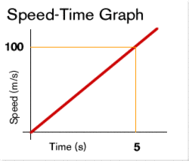
Use a speed-time graph to tell us about acceleration from the slope and distance travelled from the area under the graph
- The area under a speed-time graph represents distance travelled
Recall that objects in free fall accelerate at constant acceleration and that air resistance is negligible
- The acceleration of a freely falling body near to the Earth's surface is constant
- Any object released near the Earth's surface falls at a constant acceleration, provided air resistance is insignificant. Such motion is described as free fall
- Using a camera and a light flashing at a constant rate, the photograph can show the distance between successive images of the object, increases as it falls. This means that the object's speed increases as it falls.
- If results were put into a speed-time graph, there would be a constant slope. This shows that the speed of the falling weight increased steadily - the object fell at constant acceleration
- The acceleration of a freely falling body near to the Earth's surface is constant
Explain why an object falls at terminal speed if air resistance is not negligible
- The acceleration of a frelly falling object near the Earth is 10m/s2
- The air resistance (or drag force) on any falling object increases as it gains speed. If it continues to fall, the increasing air resistance causes it to reach a constant speed, referred to as its terminal speed. At this speed, the air resistance on the object opposes the force of gravity with an equal force.
Bilder und Dateien der Mindmap

Informationen
- Beschreibung
- GCSE Physics (Unit 1: Motion) Mindmap am Unit 1: Motion, erstellt von cmharrisuk am 23/10/2014.
- Erstellt von
- cmharrisuk
- Aufrufe
- 4
- Bewertung