
Mindmap
Wireless Nws
Inhalt der Mindmap
Wireless Nws
Types
- Mobile Ad Hoc Nw (MANET)
- Self-configurable nw
- Wireless link
- Connects mobile routers and hosts
- Sensor Nw
- nw of many, spatially distributed devices
- sensors
- Monitor conditions
- Temp.
- Humidity
- Pollution level
- Transmitter
- Small microcontroller
- Power source
- eg : Batteries
- Monitor conditions
- Wireless Sensor Nw (WSN)
- mesh nw
- small sensor nodes
- uses RF
- small sensor nodes
- Large scale
- mesh nw
- Mesh Nw
- To Route btw nodes
- Hops from node to node until connection is established
- Continuous Connection
- Reconfiguration around blocked paths
- Hops from node to node until connection is established
- To Route btw nodes
- Wireless Mesh Nw
- Mobile Ad Hoc Nw (MANET)
Elements
- Base station
- as relay
- wired nw
- w/less hosts
- as relay
- Wireless link
- connection
- B.S.
- mobiles
- connection
- Modes
- Infrastructure mode
- b.s. connects *mobile* devices to *wired* nw
- handoff:
- mobile dev. changes B.S.
- Ad hoc mode
- X B.S.
- Nodes Tx within *link coverage*
- Nodes organise themselves -> nw
- Forms route among nodes
- Nodes organise themselves -> nw
- Nodes Tx within *link coverage*
- X B.S.
- Infrastructure mode
- Base station
Wireless Link Characteristics
- Differences
- 1) Decreased signal strength
- 2) Interference
- 3) Multipath propagation
- SNR and BER
- Given phy layer
- increase power
- increase SNR
- *DECREASES* BER
- increase SNR
- increase power
- Given SNR
- choose phy layer
- Meets BER req.
- Gives highest throughput
- SNR can change with mobility
- dynamically adapt phy layer
- Modulation technique, etc
- dynamically adapt phy layer
- choose phy layer
- Given phy layer
- Eg: CDMA
- code set parititioning
- all users
- same freq
- diff 'chipping' seq
- encodes data
- encoded signal = ori data x chipping seq
- encodes data
- Benefits
- multiple users coexist
- transmit at the same time
- min. interference
- 802.11 WLAN
- Architecture
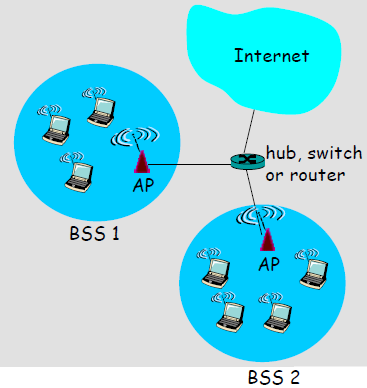
- BSS (Basic Service Set)
- aka cell
- Infrastructure mode
- w/less hosts
- Access Points (B.S.)
- Ad Hoc mode
- Hosts only
- BSS (Basic Service Set)
- Scanning
- Active
- 1. APs broadcast : beacon frames
- 2. Host -> Selected AP : Association Req frame
- 3. AP -> Host : Association Resp. frame
- 2. Host -> Selected AP : Association Req frame
- 1. APs broadcast : beacon frames
- Passive
- 1. H1 broadcast : Probe Req. frame
- 2. AP-> Host : Probe Resp. frame
- 3. Host -> Selected AP : Associatiation Req frame
- 4. AP -> Host : Association Resp. frame
- 3. Host -> Selected AP : Associatiation Req frame
- 2. AP-> Host : Probe Resp. frame
- 1. H1 broadcast : Probe Req. frame
- Active
- CSMA
- sense b4 tx
- difficult to sense all collisions
- hidden terminal
- fading effect
- CSMA/CA (Collision Avoidance)
- Protocol
- Sender
- 1. Sense channel
- a) Idle for DIFS
- Tx entire frame
- b) Busy
- start rand backoff time
- Timer counts down while channel idle
- Timer expires -> Transmit
- If no ACK, increase rand backoff time, repeat b
- Timer expires -> Transmit
- Timer counts down while channel idle
- start rand backoff time
- a) Idle for DIFS
- 1. Sense channel
- Sender
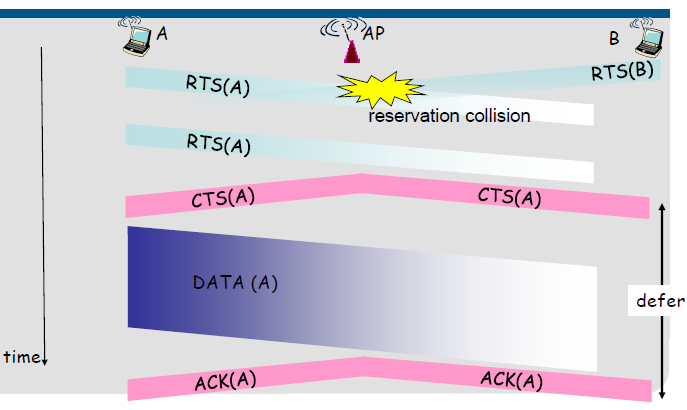
- Improv : usage of RTS and CTS packets
- 1. sender-> BS : Req-to-send (RTS) via CSMA
- 2. BS broadcast : Clear-to-send ( CTS )
- 3. CTS heard by all nodes
- sender : transmit data frame
- others : defer transmissions
- 3. CTS heard by all nodes
- 2. BS broadcast : Clear-to-send ( CTS )
- 1. sender-> BS : Req-to-send (RTS) via CSMA
- Protocol
- difficult to sense all collisions
- sense b4 tx
- Architecture
- Differences
Bilder und Dateien der Mindmap
Informationen
- Beschreibung
- Mindmap am Wireless Nws, erstellt von Jo-Anne Tan am 02/11/2014.
- Erstellt von
- Jo-Anne Tan
- Aufrufe
- 14
- Bewertung