
Wireless Networking
292 resources created by 162 users
This Wireless Networking page on GoConqr gathers community-made quizzes, mind maps, flashcards and notes, from WLAN benefits and 802.11 standards to Bluetooth, sensor networks and CWNA-style review questions. It's built for university students and professional candidates practising for exams such as CCNA, CWNA and ACMP, and for teachers after ready-made material. There are over 280 resources here, including more than 80 quizzes, over 100 mind maps and over 80 flashcard decks. Pick a topic, try a quiz to find your gaps, then make your own revision sets.
Top Wireless Networking resources
-
88 cardsE3_4 WLAN Benefits of Wireless ** Some of the benefits include increased flexibility, increased productivity, reduced...
-
90 questionsACMP Aruba parte 2 A user logged in with the Captive Portal settings shown in the above screen capture. What does the user nee...
-
100 cardsWireless Midterm2 Which of these propagation behaviors can result in multipath?
-
20 questionsCCNA Wireless Pre test The IEEE 802.11n standard provides 40-MHz channels, improved MAC efficiency, and MIMO. Which three elements...
-
23 questionsCCNA 3v5.03 Chapter 4 Which IEEE wireless standard is known as WiGig and operates using a tri-band solution in the 2.4, 5, and 60...
-
15 questionsChapter 1 Review Questions - CWNA: Certified Wireless Network Administrator 1. 802.11 technology is typically deployed at which fundamental layer of network architecture?
-
84 questionswireless test 2 Which of the following are valid ISM bands? (Choose all that apply.)
-
71 questionswireless 3 free space path loss FSPL = 32.44 +(20log10(f) + (20log10(D)) f–Frequency in MHz D - Distance in km between...
Quizzes
See all 86 quizzes-
90 questionsACMP Aruba parte 2 A user logged in with the Captive Portal settings shown in the above screen capture. What does the user nee...
-
20 questionsCCNA Wireless Pre test The IEEE 802.11n standard provides 40-MHz channels, improved MAC efficiency, and MIMO. Which three elements...
-
23 questionsCCNA 3v5.03 Chapter 4 Which IEEE wireless standard is known as WiGig and operates using a tri-band solution in the 2.4, 5, and 60...
-
15 questionsChapter 1 Review Questions - CWNA: Certified Wireless Network Administrator 1. 802.11 technology is typically deployed at which fundamental layer of network architecture?
-
84 questionswireless test 2 Which of the following are valid ISM bands? (Choose all that apply.)
-
71 questionswireless 3 free space path loss FSPL = 32.44 +(20log10(f) + (20log10(D)) f–Frequency in MHz D - Distance in km between...
-
90 questionsACMP- Aruba Certified Mobility Professional Which command will show all client association history?
-
23 questionsCCNP Wireless Implementation Which deployment types do FlexConnect provide? Choose 2
Mind maps
See all 105 mind maps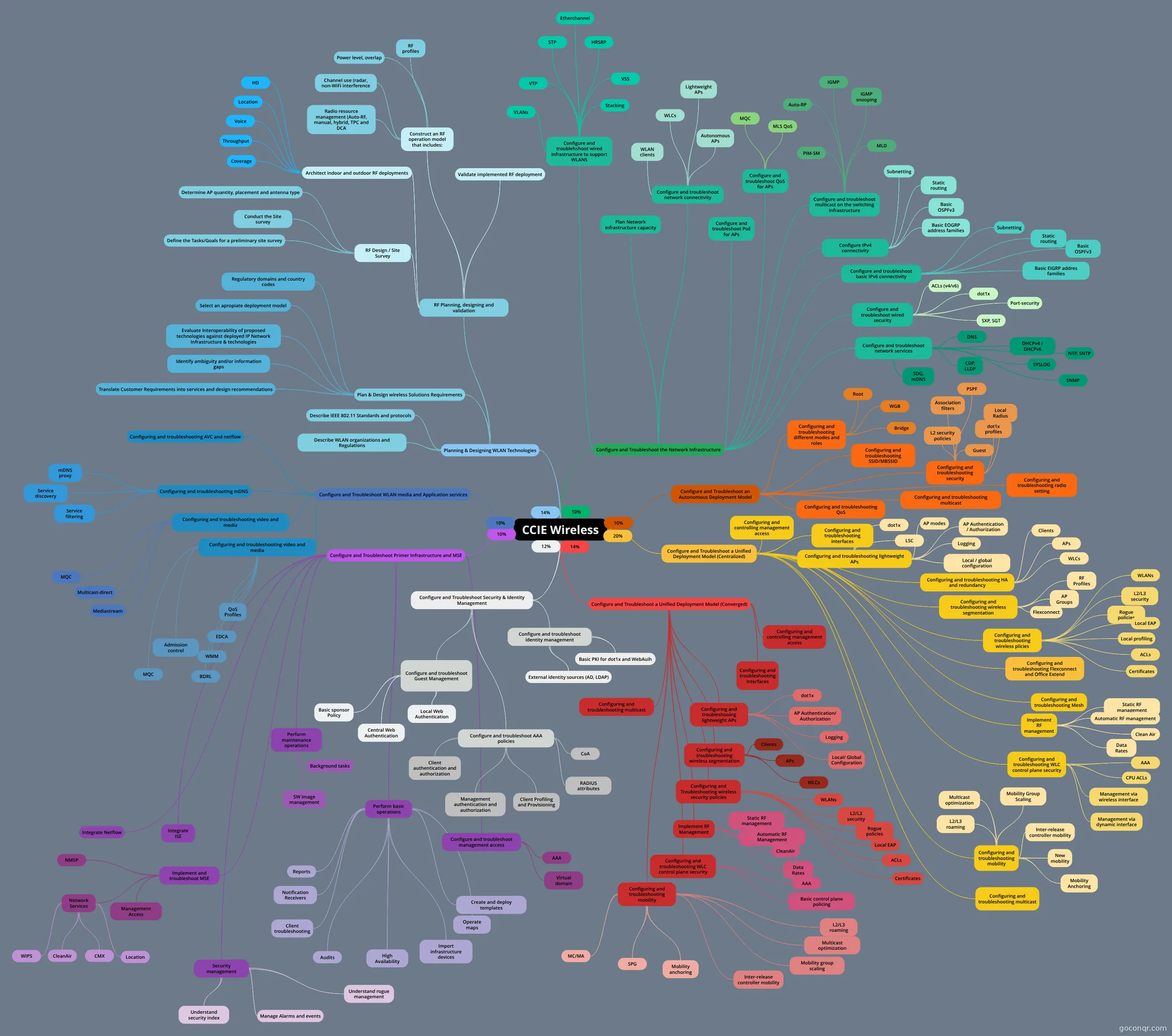
Flashcards
See all 89 flashcards-
88 cardsE3_4 WLAN Benefits of Wireless ** Some of the benefits include increased flexibility, increased productivity, reduced...
-
100 cardsWireless Midterm2 Which of these propagation behaviors can result in multipath?
-
152 cardsCWNA What do these stand for, ITU-R, FCC, IEEE, IETF?
-
52 cards00 Exam Terms CWNP exam terms.
-
32 cardsWireless Networking What is a wireless network
-
48 cardsCWNA - Flash Cards - Chapter 5 3 Phyiscal (PHY) layer specfications for 802.11
-
23 cardsWIRELESS LESSON 1 Wireless Network Types
-
31 cards09 Two sublayers of Data-Link Layer
More Networks and telecommunications topics
About Wireless Networking
GoConqr OriginalWhat the resources cover
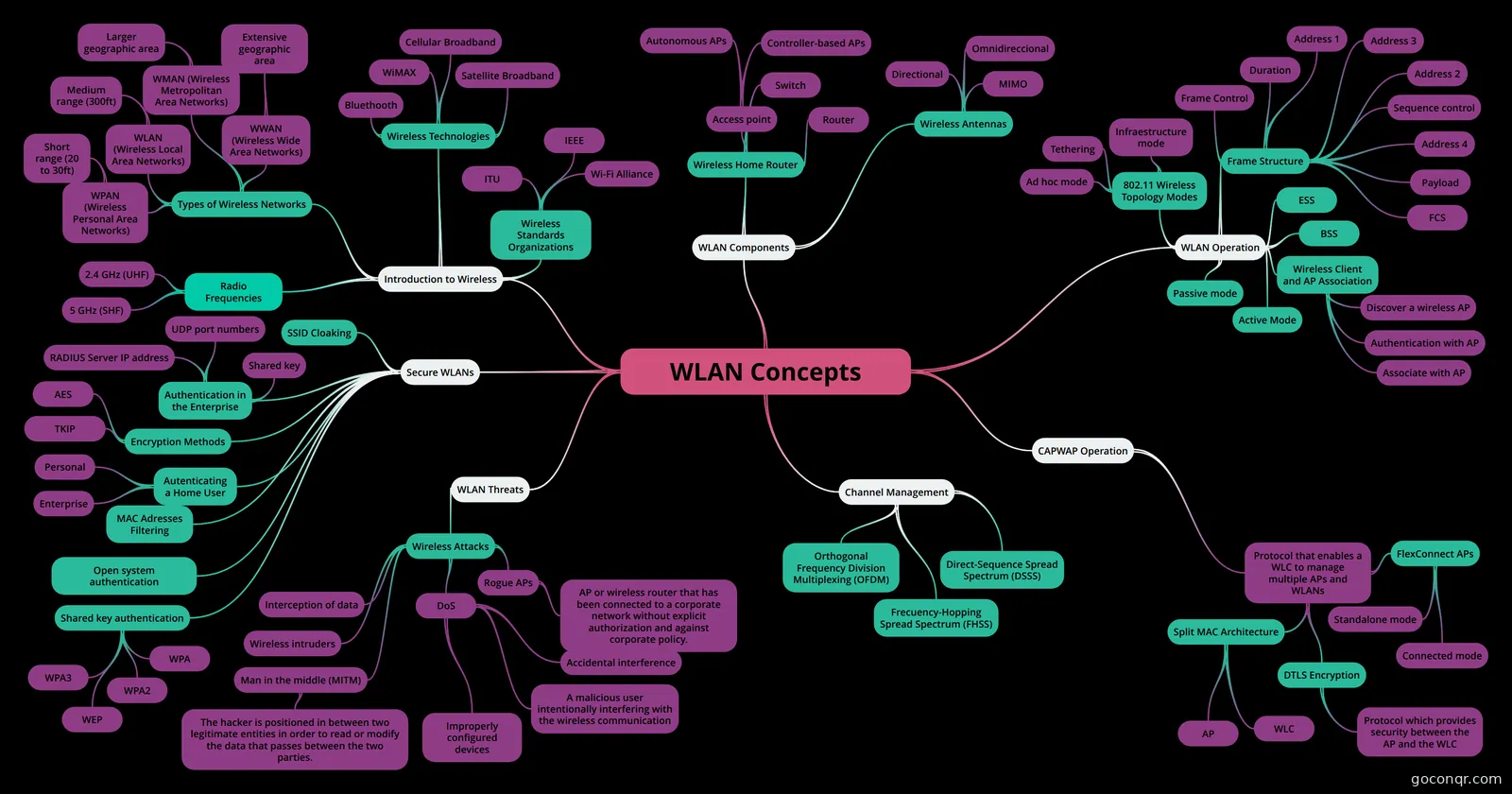
The unit starts with the basics. The flashcard deck E3_4 WLAN — Benefits of Wireless covers flexibility, productivity, lower costs and the ability to adapt as needs change. The mind map WLAN Concepts sets out wireless types: WPAN, WLAN, WMAN and WWAN, along with Bluetooth, WiMAX, cellular and satellite broadband.
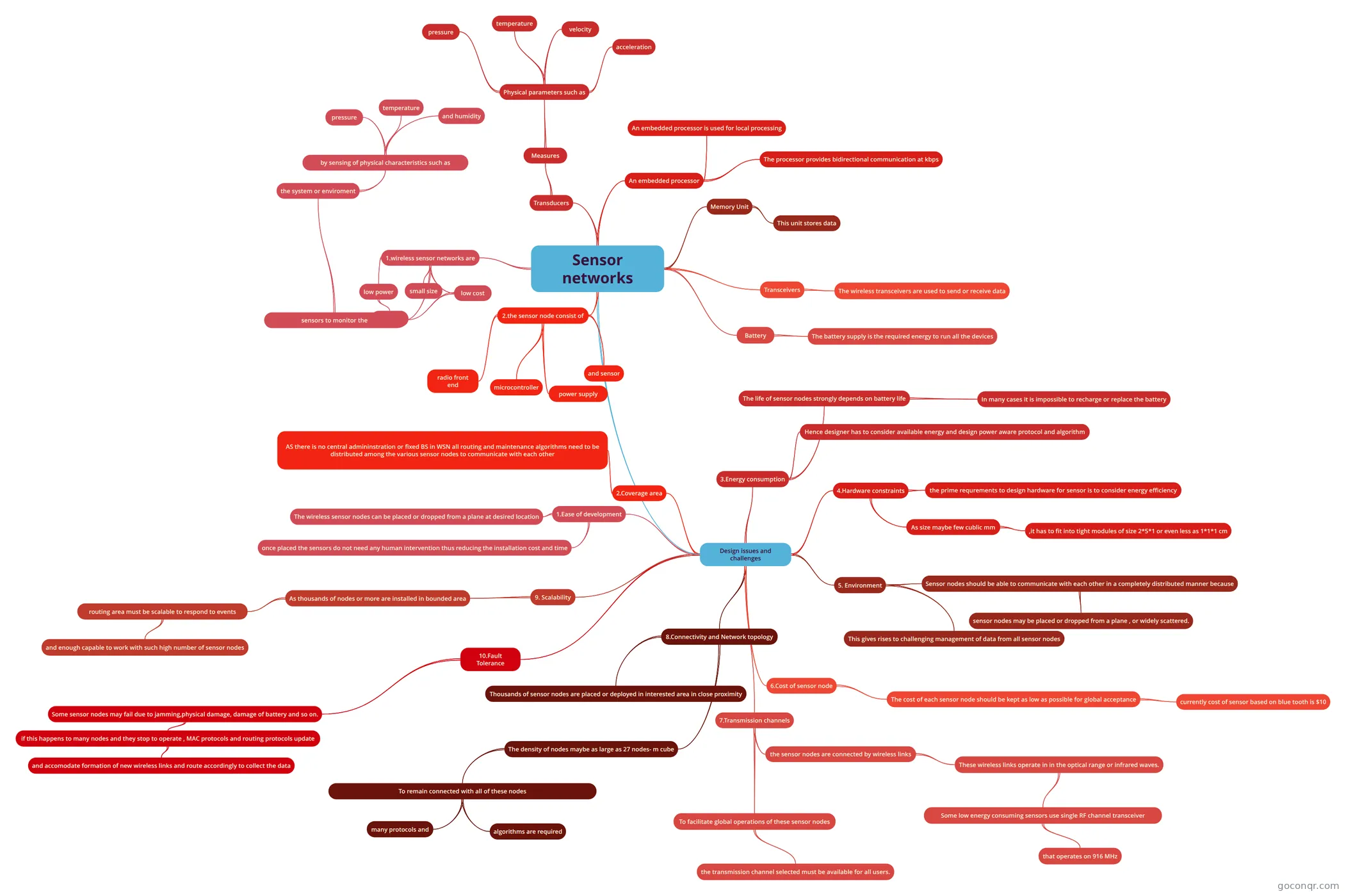
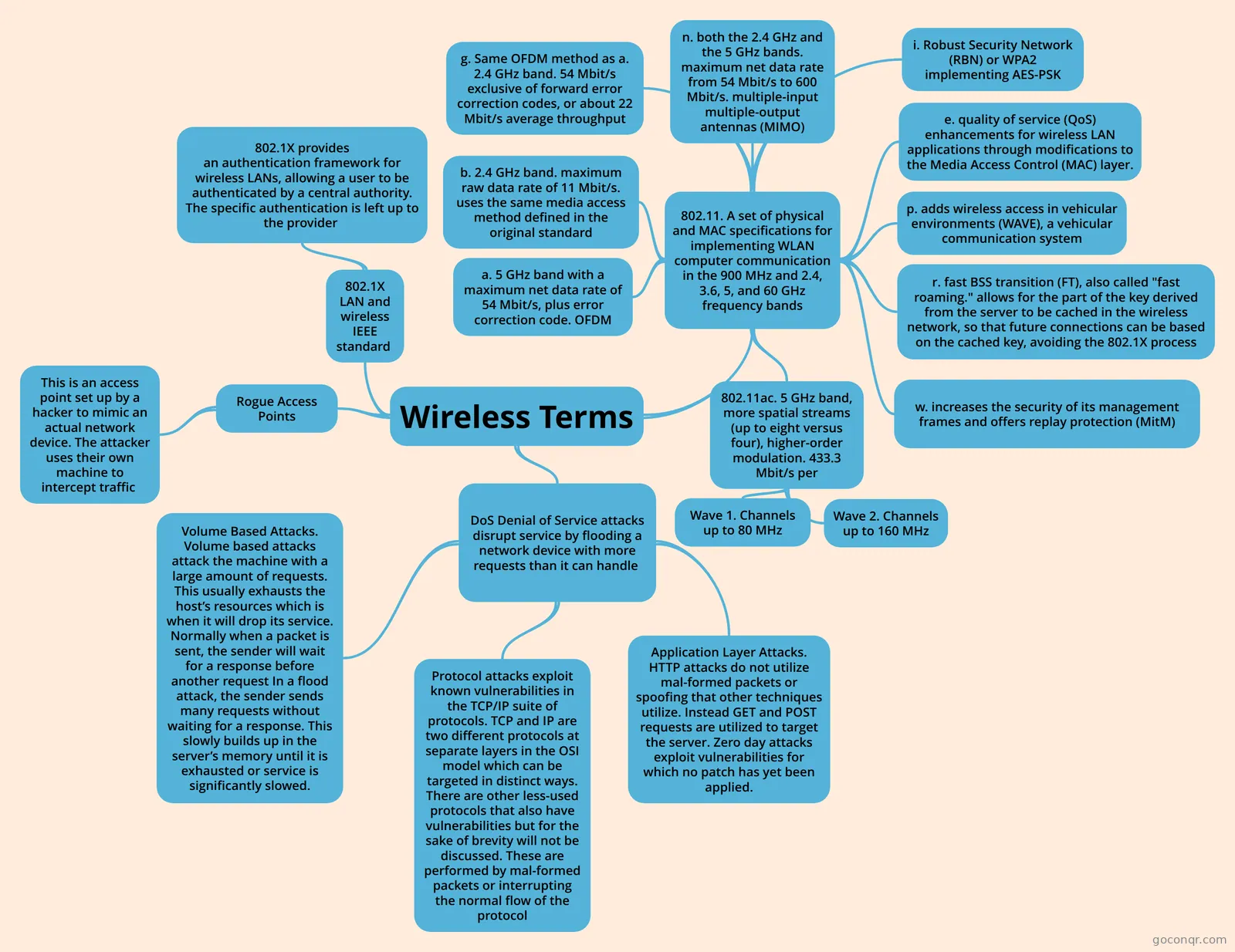
Further in, you will find resources on 802.11 standards and amendments, the 802.11 data link layer, PHY data rates, frequency hopping and direct-sequence spread spectrum, roaming, authentication types and multipath fading. There are also maps on sensor networks, BLE, IEEE 802.15.4 and low power wide area networks.
Where to start
- Read a broad map such as Wireless Networking or Characteristics of Wireless Network to see the shape of the topic.
- Work through the decks 802.11 Standards & Amendments and Wireless Networking Terms to learn the vocabulary.
- Try wireless test 2, which asks about ISM and UNII bands, then wireless 3 for path loss and dBm sums.
Exam-focused practice
Several quizzes are aimed at certification. The CCNA Wireless Pre test asks about 802.11n and MIMO. The CWNA chapter review questions start with where 802.11 sits in network architecture. ACMP- Aruba Certified Mobility Professional and ACMP Aruba parte 2 cover Aruba topics such as captive portals and RAP operating modes.
Using quizzes and maps together
Take a quiz first and note what you miss. Then open the matching map or deck, read that branch again and retake the quiz. Teachers can set a map as pre-reading and a quiz as a quick check.
Where this fits
This unit belongs to the Wireless, Mobile and Telecommunications strand of Networks and telecommunications. Choose one resource today and see where your gaps are.
Frequently asked questions
Which resource should I open first?
Begin with the flashcard deck on the benefits of wireless or the WLAN Concepts mind map. Both give you the overall picture and the main wireless network types. After that, move to the 802.11 standards deck, then test yourself with one of the wireless quizzes.
Which exams do these resources relate to?
The listed resources mention CCNA, CWNA, ACMP and CCNA Wireless. You will find quizzes and flashcards labelled for each, such as the CWNA chapter review questions, the CCNA Wireless Pre test and the Aruba ACMP quizzes.
What do the mind maps cover?
The mind maps cover wireless LANs, 802.11 and its data link layer, Bluetooth link layer services, authentication types, multipath fading, fixed wireless access and sensor networks. Others look at BLE, IEEE 802.15.4 and low power wide area networks, so you can move from core ideas to wider topics.
Are the resources free to use?
Yes. Every resource on this page is free to open, study and take, with no account needed. They were made by GoConqr users rather than by GoConqr itself. A free account also saves your quiz scores and lets you make your own quizzes, maps, flashcards and notes.
Who is this page for?
It suits university students and professional candidates preparing for networking certifications, and teachers looking for ready-made material. A small share of the resources suits school students. Quizzes work well for checking knowledge, while decks help with terms and standards.
What if I cannot find what I need?
Try a neighbouring resource first. Topics such as spread spectrum, roaming or Bluetooth often appear in notes, maps and decks under different titles. If there is still a gap, you can build your own set in your preferred format.