
Mindmap
Atrial Fibrillation
Inhalt der Mindmap
Atrial Fibrillation
Clinical Manifestations
- Symptoms (Jankowska-Polańska, Kaczan, Lomper, Nowakowski, & Dudek, 2018).
- Psychological distress
- Those with atrial fibrillation have a high prevalence of anxiety and depression caused by the symptoms they experience thus resulting in a decreased quality of life (Gehi et al., 2012).
- Shortness of breath
- Atrial Fibrillation may be asymptomatic in some patients (Medical Advisory Secretariat, 2006)
- Weakness
- Heart palpitations
- Chest pain
- Sleep difficulties
- Exercise intolerance (McCabe, Rhudy, Chamberlain, & DeVon, 2016).
- Psychological distress
- Signs (Natale & Jalife, 2008).
- Tachycardia
- Reduced cardiac output
- Symptoms include decreased limp temperature, increased core temperature, decreased urine output, and mottled skin colour (Cuadrado, 2002).
- Radial pulse is lower than apical pulse (Lippincott, 2011).
- Abnormal ECG findings (Lippincott, 2011)
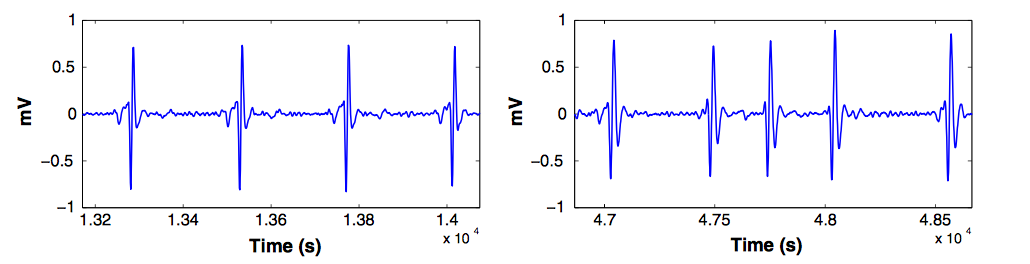
- Atrial activity is no longer represented by P waves but by fibrillatory waves (f waves). This rhythm may be either sustained or paroxysmal (occurring in bursts).
- Irregular pulse rhythm
- Undetectable atrial heart rate
- Ventricular heart rate around 130 beats per minute
- PQR - undetectable
- T wave - undetectable
- QT - unmeasurable
- QRS complex - 0.08 second
- The first figure shows a healthy ECG record. The second figure shows an ECG with atrial fibrillation (Queiroz, Junior, Lucena, & Barros, 2018).
- Symptoms (Jankowska-Polańska, Kaczan, Lomper, Nowakowski, & Dudek, 2018).
Diagnostic Testing
Complications
- Patients with may also experience increased morbidity and mortality from complications such as heart failure, strokes, hemorrhagic and thromboembolic complications, heart attacks and cardiovascular death (Jankowska-Polańska, Kaczan, Lomper, Nowakowski, & Dudek, 2018; Mogensen et al., 2017).
- Roughly 44% of those with one of the three types of atrial fibrillation had a stroke.
- Approximately 43% of those with any of the types of atrial fibrillation have been hospitalized for heart failure at some point.
- Around 69% of the deaths of those with atrial fibrillation was due to a heart attack or other sudden cardiovascular event.
- Patients with may also experience increased morbidity and mortality from complications such as heart failure, strokes, hemorrhagic and thromboembolic complications, heart attacks and cardiovascular death (Jankowska-Polańska, Kaczan, Lomper, Nowakowski, & Dudek, 2018; Mogensen et al., 2017).
Classifications/Variations
Treatment and Management
- Cardiac Ablation (Medical Advisory Secretariat, 2006).
- Cardiac ablation involves using a probe with an electrode at the tip on cardiac tissue with the goal of scarring the area to prevent an electrical current from being conducted through the area.
- Types
- Segmental Pulmonary Vein Ablation: the pulmonary vein is isolated from the left atrium by applying lesions at the ostial region of the pulmonary veins.
- Circumferential pulmonary vein ablation: surrounds the pulmonary veins in linear lesions on the left atrial myocardium outside the pulmonary vein ostia.
- Catheter ablation is the procedure in which cardiac ablation is performed. It involves precisely inserting a catheter through the femoral vein to access the heart in order to perform the ablation procedure
- Types
- Cardiac ablation involves using a probe with an electrode at the tip on cardiac tissue with the goal of scarring the area to prevent an electrical current from being conducted through the area.
- Pharmacotherapy
- Heart Rate Control. In order for heart rate to be considered controlled it must meet three goals: controlled at rest, controlled during activity, and regularization of the heart rate (Natale & Jalife, 2008).
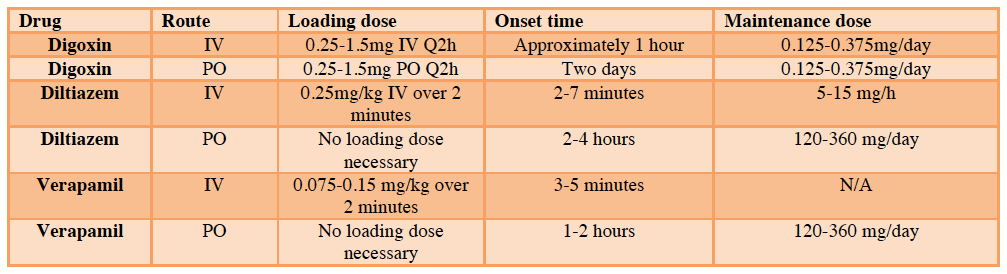
- Diltiazem or verapamil should be used as the preferred method over digoxin when using pharmacotherapy in controlling heart rate as it has a better effect on the control of heart rate during activity. Diltiazem or verapamil both have a rapid onset of action; this is especially important in acute situations. β-blockers are the best at controlling heart rate with activity. Atenolol, metoprolol, pindolol, and nadolol are all effective at controlling heart rates at rest and with exertion.
- Pharmacological Cardioversion
- Heart Rate Control. In order for heart rate to be considered controlled it must meet three goals: controlled at rest, controlled during activity, and regularization of the heart rate (Natale & Jalife, 2008).
- Cardiac Ablation (Medical Advisory Secretariat, 2006).
Etiology
Bilder und Dateien der Mindmap
Informationen
- Beschreibung
- Mindmap am Atrial Fibrillation, erstellt von Emily Rondinone am 30/10/2018.
- Erstellt von
- Emily Rondinone
- Aufrufe
- 59
- Bewertung