
Mindmap
MAP = CO x TPR
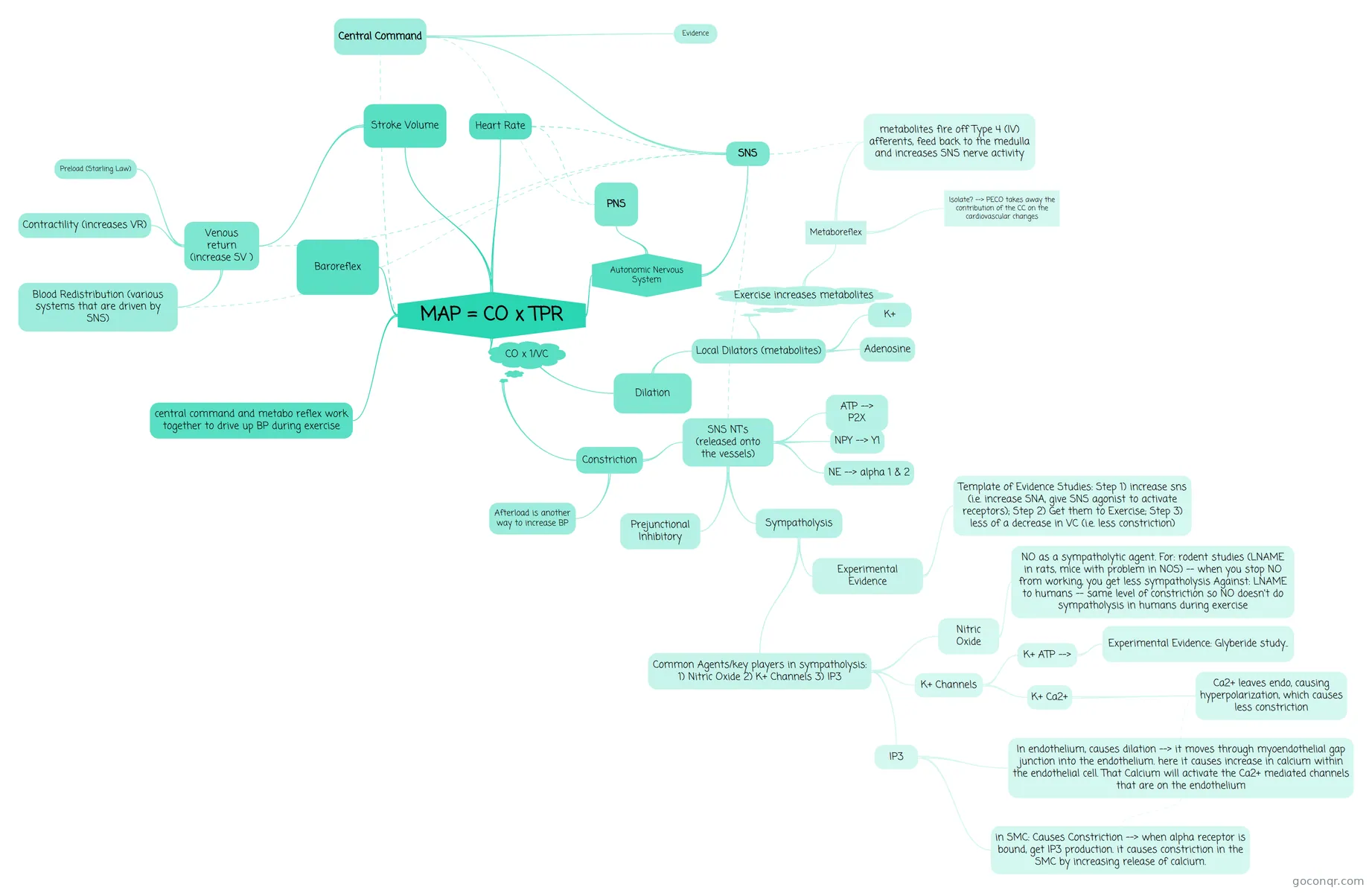
Mind map: MAP = CO x TPR
Inhalt der Mindmap
MAP = CO x TPR
central command and metabo reflex work together to drive up BP during exercise
Heart Rate
- SNS increases heart rate through chronotropy PSNS affects the rate of HR contraction but SNS affects the rate and the force (inotropy and chronotropy)
CO x 1/VC
- Dilation
- Local Dilators (metabolites)
- K+
- This is the main one to worry about
- Adenosine
- Exercise increases metabolites
- These create local dilation they also fire off type 4 afferents = increase SNS activity = constriction = increased afterload, as well as increased HR, inotropy, and preload. these 4 work together to increase BP during exercise.
- Metaboreflex
- metabolites fire off Type 4 (IV) afferents, feed back to the medulla and increases SNS nerve activity
- Isolate? --> PECO takes away the contribution of the CC on the cardiovascular changes
- K+
- Local Dilators (metabolites)
- Constriction
- SNS NT's (released onto the vessels)
- both prejunctional control and sympatholysis moderate/control the release and effects of SNS NT's
- ATP --> P2X
- NPY --> Y1
- NE --> alpha 1 & 2
- Prejunctional Inhibitory
- (NT bind on receptors on the neuron itself, prevent more release of NT from the neurons)
- Sympatholysis
- (attenuates the effect of SNS, not actually breaking down the NT's)
- Experimental Evidence
- "Give evidence for and against sympatholysis" NO as a sympatholytic agent For: rodent studies (LNAME in rats, mice with problem in NOS) -- when you stop NO from working, you get less sympatholysis Against: LNAME to humans -- same level of constriction so NO doesn't do sympatholysis in humans during exercise
- Template of Evidence Studies: Step 1) increase sns (i.e. increase SNA, give SNS agonist to activate receptors); Step 2) Get them to Exercise; Step 3) less of a decrease in VC (i.e. less constriction)
- Common Agents/key players in sympatholysis: 1) Nitric Oxide 2) K+ Channels 3) IP3
- Nitric Oxide
- NO as a sympatholytic agent. For: rodent studies (LNAME in rats, mice with problem in NOS) -- when you stop NO from working, you get less sympatholysis Against: LNAME to humans -- same level of constriction so NO doesn't do sympatholysis in humans during exercise
- K+ Channels
- K+ ATP -->
- Experimental Evidence: Glyberide study..
- 1) applied +40mmHg neck pressure to elicit SNS 2) Exercise: Exercising leg and non-exercising leg to see if there were systemic or local effects 3) Less conductance with glyberide. we see that K+ channels are important bc inhibiting them = less sympatholysis
- Experimental Evidence: Glyberide study..
- K+ Ca2+
- Ca2+ leaves endo, causing hyperpolarization, which causes less constriction
- K+ ATP -->
- IP3
- when alpha receptor is bound (NE on alpha receptors on SMC), alpha receptor is G protein coupled --> part of G protein signalling cascade is IP3 production. it causes constriction in the SMC by increasing release of calcium. THEN it moves through myoendothelial gap junction into the endothelium. here it causes increase in calcium within the endothelial cell. That Calcium will activate the Ca2+ mediated channels that are on the endothelium
- in SMC: Causes Constriction --> when alpha receptor is bound, get IP3 production. it causes constriction in the SMC by increasing release of calcium.
- In endothelium, causes dilation --> it moves through myoendothelial gap junction into the endothelium. here it causes increase in calcium within the endothelial cell. That Calcium will activate the Ca2+ mediated channels that are on the endothelium
- Nitric Oxide
- Afterload is another way to increase BP
- SNS NT's (released onto the vessels)
- Dilation
Stroke Volume
- Venous return (increase SV )
- Blood Redistribution (various systems that are driven by SNS)
- Contractility (increases VR)
- increased by the SNS (called inotropy)
- Preload (Starling Law)
- Venous return (increase SV )
Autonomic Nervous System
- SNS
- SNS increases the release of SNS NT's increases TPR
- Central Command
- What is central command? - important at the onset of exercise - supramedullary brain area - important for voluntary exercise - at the onset, we activate more of CC (more effort) - decreases the PSNS activity, to allow HR to increase - During exercise, get an increase in SNS and a decrease in PNS - note: only increases SNS at high intensity exercises
- Evidence
- 1) right at the onset of exercise, with the handgrip, even before contraction occurred, the HR increased from like 70-95 - that was driven by the anticipatory effect of CC 2) curare studies w attempted hand grip. saw more of change in MSNA when talking about 75% MVC vs a 30% MVC
- PNS
- SNS
Baroreflex
- Baroreceptor firing --> medulla --> SNS --> back to homeostasis
Informationen
- Beschreibung
- Mindmap am MAP = CO x TPR, erstellt von Julia Valerie am 15/11/2018.
- Erstellt von
- Julia Valerie
- Aufrufe
- 0
- Bewertung