
Mindmap
Quarks and Leptons
Inhalt der Mindmap
Quarks and Leptons
Particle Zoo
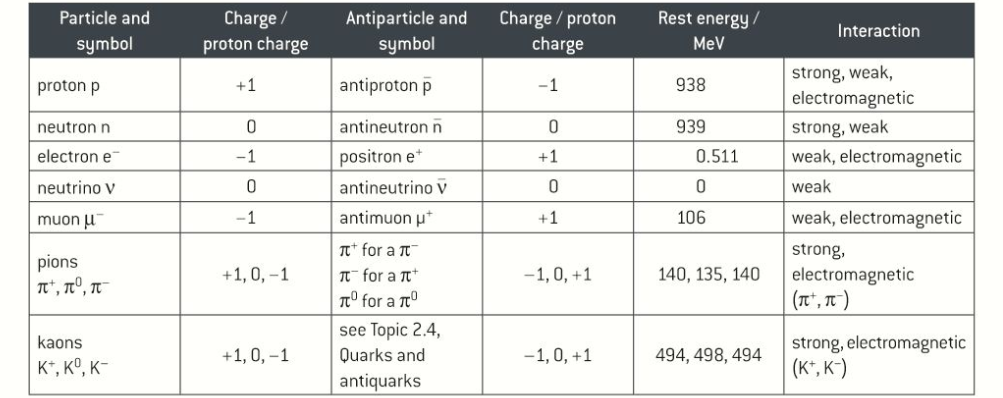
- Cosmic rays are high-energy particles
- When they enter the Earth's atmosphere, they create new short-lived particles and antiparticles
- Most cosmic rays are fast-moving protons or small nuclei
- They collide with gas atoms in the atmosphere creating particles and antiparticles which can be detected
- The rays have a greater ionising effect at a greater altitude
- The muon is a negatively charged particle with a rest mass over 200x that of the electron
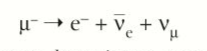
- A muon decays into an electron and an antineutrino
- An antimuon decays into a positron and a neutrino
- The pion or pi meson can be positively/negatively charged or neutral, rest mass heavier than muon but less than proton
- A charged pion can decay into a muon and an antineutrino, or an antimuon and a neutrino
- A neutral pion decays into high-energy photons
- the kaon or K meson can also have any charge, it is heavier than a pion but lighter than a proton
- kaons are produced in twos through strong interaction
- Produced when protons moving at high speed crash into nuclei and each travel far away from the nucleus in which they originated
- kaons decay through the weak interaction
- A kaon can decay into pions, or a muon and an antineutrino, or an antimuon and a neutrino
- they are called strange particles
- kaons are produced in twos through strong interaction
- Pions, kaons and muons can also all be created by colliding protons together head-on at high speed
- KE is converted into mass in the creation of new particles
- Decays always observe the conservation rules for energy, momentum and charge
- A TV tube in a traditional TV is an accelerator, it accelerates electrons through a p.d. of around 5000V
- Electrons form a beam that hits the inside of the TV screen
- Magnetic fields produced by electromagnets deflect the beam so it scans the screen to create an image
- Electrons form a beam that hits the inside of the TV screen
- Cosmic rays are high-energy particles
Particle Sorting
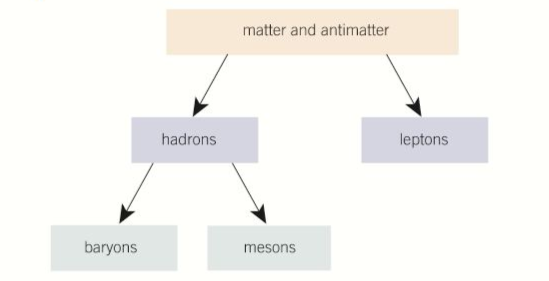
- Particles are divided into two groups, hadrons and leptons, according to whether or not they interact through the strong interaction
- Hadrons are particles and antiparticles that can interact through the strong interaction (protons, neutrons, pions and kaons
- Leptons are particles and antiparticles that do not interact through the strong interaction (electrons, muons and neutrinos
- Leptons interact through the weak, gravitational and, if charged, electromagnetic interaction
- Hadrons interact through all four fundamental interactions
- Apart from the proton, which is stable, hadrons tend to decay through the weak interaction
- Total energy of particles and antiparticles before = rest energy + kinetic energy
- Total energy of new particles and antiparticles = rest energy + kinetic energy
- rest energy of products = total energy before - EK of products
- 1 GeV = 1000 MeV
- When kaons are created, short-lived particles with greater rest masses than protons may also be produced
- They are created through the strong interaction so must be hadrons
- However, in comparison with kaons, they decay into protonsas well as into pions
- Consequently, hadrons are divided into two groups
- Baryons are protons and all other hadrons that decay into protons either directly or indirectly
- Mesons are hadrons that do not include protonsin their decay products, ie pions and kaons
- Baryons and mesons are composed of smaller particles called quarks and antiquarks
- Consequently, hadrons are divided into two groups
- However, in comparison with kaons, they decay into protonsas well as into pions
- They are created through the strong interaction so must be hadrons
- Particles are divided into two groups, hadrons and leptons, according to whether or not they interact through the strong interaction
Leptons at work
- Leptons and antileptons can interact to produce hadrons
- eg. when electrons and positrons annihilate hadrons will be produced
- This also produces a quark and a corresponding antiquark, which move in opposite directions, producing a shower of hadrons in each direction
- Neutrinos travel just below the speed of light and interact with very little
- Neutrinos and antineutrinos produced by in beta decays are different to those produced by muon decays
- therefore, we have muon-flavoured neutrinos and electron-flavoured neutrinos
- ie. neutrinos and antineutrinos from muon and antimuon decays create only muons and no electrons when they interact with protons and neutrons
- Neutrinos and antineutrinos produced by in beta decays are different to those produced by muon decays
- Leptons can change into other leptons through the weak interaction and can be produced or annihilated in particle-antiparticle interactions
- In an interaction between a lepton and a hadron, a neutrino or antineutrino can change into a charged lepton
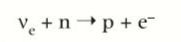
- An electron neutrino can interact with a neutron to produce a proton and an electron
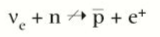
- However, even though charge is conserved, an electron neutrino and a neutron could not change into an antiproton and a positron
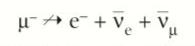
- This is because lepton number has not been conserved in the second equation
- However, even though charge is conserved, an electron neutrino and a neutron could not change into an antiproton and a positron
- An electron neutrino can interact with a neutron to produce a proton and an electron
- In muon decay the muon changes into a muon neutrino
- An electron is created to conserve charge and a corresponding antineutrino is created to conserve lepton number
- However, a muon cannot decay into a muon antineutrino, an electron and an electron antineutrino as lepton number would not be conserved
- An electron is created to conserve charge and a corresponding antineutrino is created to conserve lepton number
- In an interaction between a lepton and a hadron, a neutrino or antineutrino can change into a charged lepton
- Leptons appear to be fundamental particles
- A muon can only change into a muon neutrino, not a muon antineutrino
- Similarly, an electron can only be created with an electron antineutrino
- Leptons and antileptons can interact to produce hadrons
Quarks and antiquarks
- strange particles that decay into pions only were referred as kaons
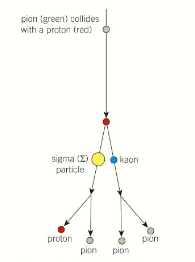
- other strange particles, eg. the sigma particle, were found to all have greater rest masses than the proton
- strange particles are created in twos
- other strange particles, eg. the sigma particle, were found to all have greater rest masses than the proton
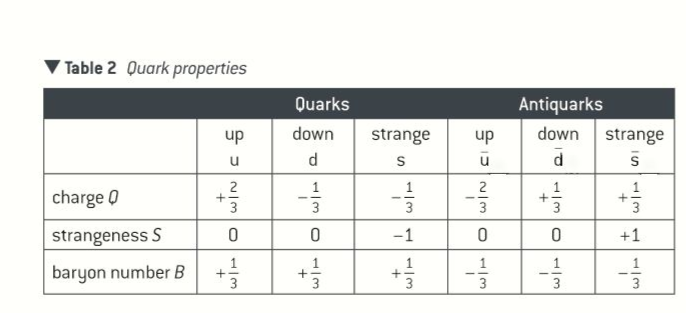
- hadrons are composed of quarks and antiquarks
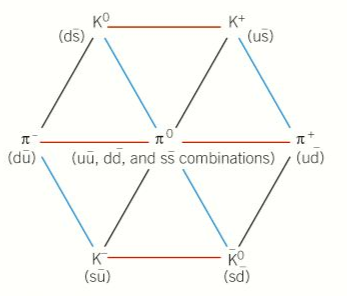
- mesons are hadrons, each consisting of a quark and an antiquark
- a neutral pion can be any quark-antiquark pair
- each pair of charged mesons is a particle-antiparticle pair
- there are two uncharged kaons
- antiparticle of any meson is a quark-antiquark pair, therefore another meson
- there are two uncharged kaons
- each pair of charged mesons is a particle-antiparticle pair
- a neutral pion can be any quark-antiquark pair
- baryons and antibaryons are hadrons that consist of three quarks for a baryon or three antiquarks for an antibaryon
- neutron is the udd combination
- proton is the uud combination
- antiproton is the equivalent antiquarks
- the proton is the only stable baryon
- a free neutron decays into a proton, releasing an electron and an electron atineutrino, as in B- decay
- proton is the uud combination
- neutron is the udd combination
- in B- decay, a neutron in a neutron-rich nucleus changes into a proton and other products
- in quark terms, a down quark changes to an up quark
- in B+ decay, a proton in a proton-rich nucleus changes into a neutron, releasing a positron and an electron neutrino
- In quark terms, an up quark changes to a down quark
- strange particles that decay into pions only were referred as kaons
Conservation rules
- conservation of energy and conservation of charge apply to all changes in science
- Conservation of energy includes the rest energy of the particles involved
- conservation of lepton numbers
- in any change the total lepton number for each lepton branch before the change is equal to the total lepton number for that branch after the change
- eg. when an antimuon decays, it changesinto a positron, an electron neutrino, and a muon antneutrino
- conservation of strangeness
- strangeness is always conserved during the strong interaction
- eg. a neutral kaon and a strange baryon called the neutral lambda particle are produced when a negative pion collides with a proton
- however, strangeness is not necessarily conserved when the weak interaction is involved
- in weak interactions, strangeness can be changed by +/- 1
- In any reaction, the total baryon number is conserved
- conservation of energy and conservation of charge apply to all changes in science
Bilder und Dateien der Mindmap


Informationen
- Beschreibung
- Mindmap am Quarks and Leptons, erstellt von Tom Day am 30/12/2018.
- Erstellt von
- Tom Day
- Aufrufe
- 2
- Bewertung