
Particle Physics
315 resources created by 237 users
This Particle Physics page on GoConqr gathers community-made mind maps, flashcards, quizzes and notes, from the Standard Model and quarks to leptons, hadrons and Feynman diagrams. It's built for school students revising a topic, and for teachers after ready-made material, with university students and professional candidates dipping in only now and then. There are over 300 resources here, including more than 10 quizzes and over 180 mind maps, mostly at secondary level. Open a mind map first, then test yourself.
Select topic
- Atomic Structure and Subatomic Particles23
- The Standard Model and Particle Classification52
- Quarks, Leptons and Hadrons53
- Matter and Antimatter31
- Fundamental Forces and Particle Interactions27
- Conservation Laws in Particle Interactions6
- Radioactive Decay and Particle Interactions23
- Particle Accelerators and Detectors8
Top Particle Physics resources
-
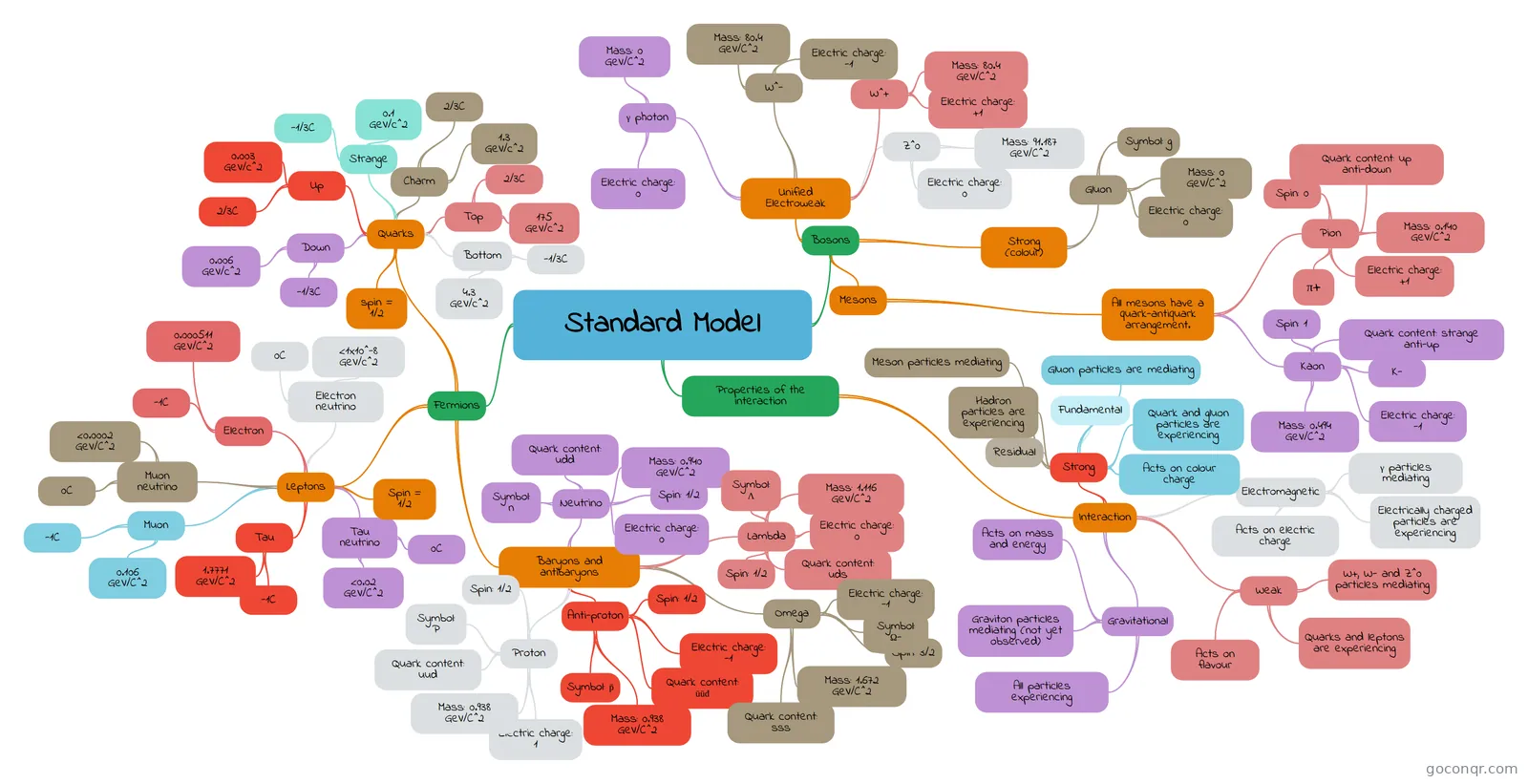 Mind map Standard Model
-
11 cardsAS AQA Physics Unit 2 Define a Lepton
-
11 cardsAQA AS Level Physics Unit 1 The K+ kaon is a strange particle. Give one characteristic of a strange particle that makes it different fr...
-
6 questionsParticles and antiparticles What do particles and antiparticles have in common?
-
9 questionsLepton Numbers Quiz in the Assigning of Lepton Numbers
-
Mind map Particle Physics
-
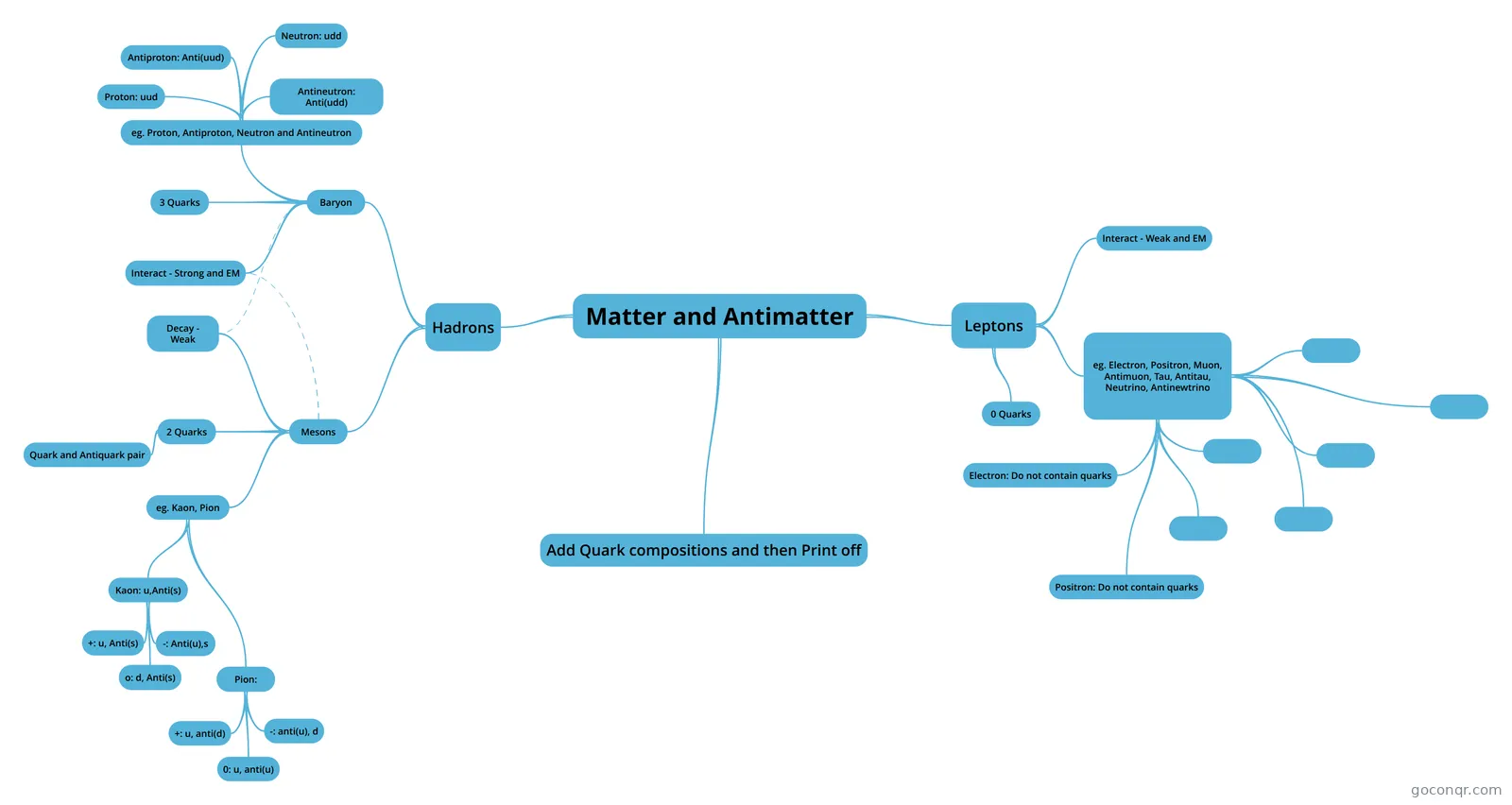 Mind map Matter and Antimatter Physics mindmap of Matter and Antimatter groups
-
Mind map Physics Section 1 - Particles and Radiation Physics Section 1 - Particles and Radiation revision mind map
Quizzes
See all 13 quizzes-
6 questionsParticles and antiparticles What do particles and antiparticles have in common?
-
9 questionsLepton Numbers Quiz in the Assigning of Lepton Numbers
-
114 questionsParticles and Radiation What is in the nucleus of the atom?
-
3 questionsW3
-
5 questionsFundamental Particle Interactions Quiz Select The 4 Fundamental Forces
-
8 questionsParticles - #1 Which of the following particles is a lepton?
-
4 questionsAyelet's genius physics quiz What evidence shows that cathode rays are waves?
-
12 questionsPhysics Unit 1 Each particle-antiparticle are is produced by two photons
Mind maps
See all 187 mind mapsFlashcards
See all 94 flashcards-
11 cardsAS AQA Physics Unit 2 Define a Lepton
-
11 cardsAQA AS Level Physics Unit 1 The K+ kaon is a strange particle. Give one characteristic of a strange particle that makes it different fr...
-
69 cardsA level Physics What is the charge and mass of a proton?
-
37 cardsAS Physics Radioactivity Alpha particle scattering experiment
-
18 cardsParticles And Nuclides What was the plum pudding model of the atom?
-
10 cardsParticle interactions and where they happen. What is a force and how can we measure it?
-
97 cardsPARTICLE PHYSICS Evidence for the existence of atoms: Brownian motion
-
123 cardsThings I have learnt from doing past papers Gravitational force between two spheres in contact?
Flowcharts
Notes
See all 18 notes-
Unit 4 The Standard Model Quarks Up Down Strange Charm Bottom Top Proton - UUD - SleepyNeutron - DDU - Happy
-
The Particle Zoo
-
Chapter 7 Atomic, nuclear and particle physics Photons and energy states All electromagnetic radiation, including light, travels in small packets called photons. We call quantum to smallest possible quantity of anything: They are discrete (can't be split, the oppo...
-
3.2.1 Particles
-
2.1 Kinetic Theory 2.1.1 States of Matter A molecule is one or more atoms , joined together by chemical bonds, capable of existing as a unit. We think of matter as existing in three states, solid liquid and gas. The molecular structure ...
-
Unit 1: Section 1 - Particles and Radiation Unit 1: Section 1 – Particles and Radiation Atomic Structure Atoms are made up of protons, neutrons and electrons. The nucleus contains protons and neutrons known as nucleons. Orbiting the nucleus are the electrons. &...
-
Topic 7.3 Lesson 2 - Exchange Particles & Feynman Diagrams Sub-topic 7. 3 Lesson 2: Fundamental Forces, Exchange Particles & Feynman Diagrams Textbook References: Tsokos (6th Edition) pp 302 - 306; Oxford Text: pp 298 - 302 Syllabus Outcomes Covered in This Lesson: Understand...
-
Untitled The constituents of the atom are protons, neutrons and electrons. Protons+Neutrons=Nucleons, found in the nucleus of atoms. The nucleus is surrounded by empty space in which there are electrons. Specific ChargeSC=Q/MS...
Slides
Topics in Particle Physics
More Physics topics
About Particle Physics
GoConqr OriginalWhat the resources cover
The page is built around the particle zoo. The mind map Standard Model lays out fermions and bosons, then quarks (up, down, strange, charm, bottom, top) and leptons, with masses and charges attached. Matter and Antimatter splits hadrons into baryons and mesons, and notes that they interact through the strong and electromagnetic forces while decay is weak.
Other resources go further. The flashcards AS AQA Physics Unit 2 ask you to define a lepton and a hadron, sort particles into leptons, baryons and mesons, and say what must be conserved in all reactions. There are also notes on exchange particles and Feynman diagrams, and on the Higgs boson.
Where to start
- Open the mind map Standard Model for the big picture.
- Read the notes Particles and antiparticles and Classification of particles.
- Work through the flashcards Classifying particles and Quarks.
- Move on to the Feynman diagram and Higgs boson notes once the basics feel steady.
Using quizzes and maps together
Maps show how the ideas connect. Quizzes show what you have not yet remembered. Try the quiz Particles and antiparticles, which asks about pair production and what you get when energy becomes mass. Then try Lepton Numbers, which asks for the lepton number of an electron, a muon, a neutrino and their antiparticles. Wrong answers tell you which map to reopen.
Many resources are written with A-level Physics, GCSE Physics or IB Physics in mind, so check that a set matches your course before you rely on it. Flashcards such as AQA AS Level Physics Unit 1 include exam-style questions, for example on strange particles such as the K+ kaon.
Where it sits
Particle Physics belongs to the strand Atomic, Nuclear and Modern Physics within Physics. It sits beside other atomic and nuclear topics, so you can move on from here when you are ready.
Pick one map, take one quiz, and then make your own flashcards for the particles that keep catching you out.
Frequently asked questions
Which resource should I open first?
Start with the mind map Standard Model. It shows fermions and bosons, the six quarks and the leptons in one view, with masses and charges. After that, the notes Particles and antiparticles and Classification of particles fill in the detail before you try a quiz.
What do the quizzes test?
Particles and antiparticles asks about pair production and turning energy into mass. Lepton Numbers asks for the lepton number of particles such as the electron, muon, neutrino and their antiparticles. Others cover quarks and particles and quantum phenomena. Use them to spot gaps, then revisit the maps.
Which exams do these resources suit?
Most resources are secondary level, and the listed ones mention A-level Physics, GCSE Physics and IB Physics. Some are labelled with exam-board unit names, so check the title and contents against your own course before relying on a set.
Are the resources free to use?
Yes. Every resource listed here is free to open, study and take, with no account needed. They were made by GoConqr users, not by GoConqr itself. A free account also saves your quiz scores and lets you make your own quizzes, mind maps, flashcards and notes.
Is this useful for teachers?
Yes. Teachers can pick from over 180 mind maps, plus flashcard decks, notes and quizzes, as ready-made material. A map such as Matter and Antimatter works well for a class discussion, and a quiz such as Lepton Numbers makes a quick check afterwards.
What if I cannot find what I need?
Browse the flashcard decks and notes on related topics, such as Pair Production and annihilation, Bosons, Fermions or Particle detectors and particle accelerators. If a topic is still missing, you can make your own map or flashcards and build the set you want.