
Mindmap
2.1 Algorithms
Inhalt der Mindmap
2.1 Algorithms
Computational Thinking
- The use of computers to solve problems
Abstraction
- Representing 'Real World' Problems using a computer using variables and symbols and removing unnecessary elements from the problem.
Decomposition
- breaking down a large problem into smaller more manageable sub-problems
- Easier problems
- they can be created independent of the other problems
- they can be tested independently
- Can be combined to produce the full problem
- breaking down a large problem into smaller more manageable sub-problems
Algorithmic Thinking
- Identifying the steps involved in solving a problem
Linear Search
- Each item in the list is checked in order
- Does not need to be in order
- check the first value
- Move to and check the next value
- Repeat until you have checked all the elements and not found the value you are looking for
- Move to and check the next value
- check the first value
- Does not need to be in order
- Each item in the list is checked in order
Binary Search
- An ordered list is divided in 2 with each comparison
- Needs to be in order
- Take the middle value
- Compare to the value you are looking for
- If it is larger than the one you are looking for - take the values to the left of the middle value
- Opposite direction if the value is smaller
- An ordered list is divided in 2 with each comparison
Bubble Sort
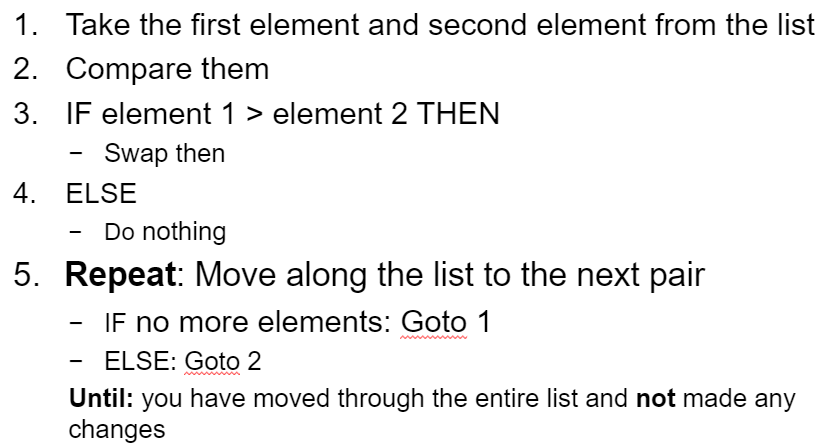
- Moving through a list repeatedly, swapping elements that are in the wrong order
Merge Sort
- A list is split into individual lists, these are then combined (2 lists at a time)
- 2.) Split a list into individual lists 2.) Merge the lists in pairs, putting the smallest first 3.) Merge the lists 4.) Keep merging until it is in order
List
- A set of data
Merging lists
- 1.) Split all elements into individual lists. 2.) Compare the first element in both lists 3.) put the smallest into a new list 4.) Compare the next element of list 1 with the second element of the 2nd list 5.) put the smallest into a new list 6.) repeat until merged
Insertion sort
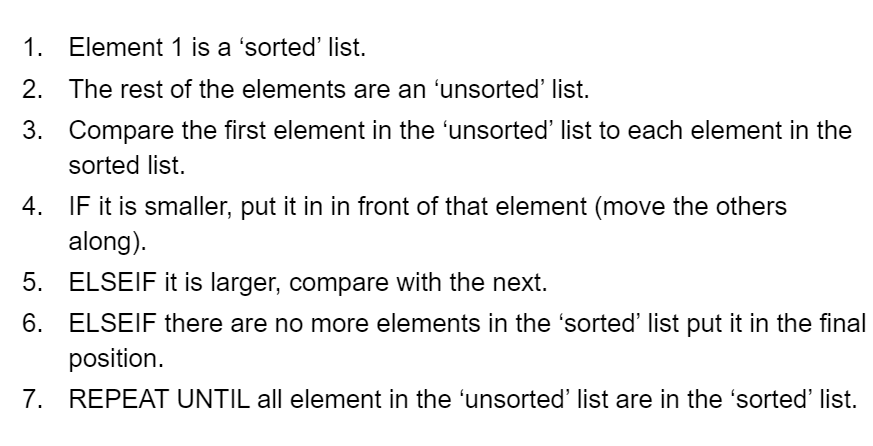
- Each items is take in turn, compare to the items in a sorted list and placed into the correct position
Ordered List
- Elements are arranged in sequence
Unordered List
- Unarranged elements
Algorithm
- the series of steps to solve a problem or perform an action
Flowchart
- A diagram that shows the inputs, and outputs and processes
- Can be used to represent an Algorithm
- It shows the data that is input and output
- It shows the processes (Actions) that take place
- it shows the decisions and repetitions that take place
- Lines are used to show the flow of control
- Set shapes are used to represent different functions
Process
- An action that takes place
Pseudocode
- Simplified programming code that is not language specific, used to design algorithms.
- Means 'Fake Code'
- Its part way between English sentences, and programming code
- It is language neutural
Dry Run
- Walking through an algorithm which sample data, running each step manually.
Trace table
- A table that follows the values of variables to check for accuracy
Bilder und Dateien der Mindmap
Informationen
- Beschreibung
- Mindmap am 2.1 Algorithms, erstellt von Anthony Petrou am 09/01/2019.
- Erstellt von
- Anthony Petrou
- Aufrufe
- 2
- Bewertung