
Mindmap
Flipping Pancakes
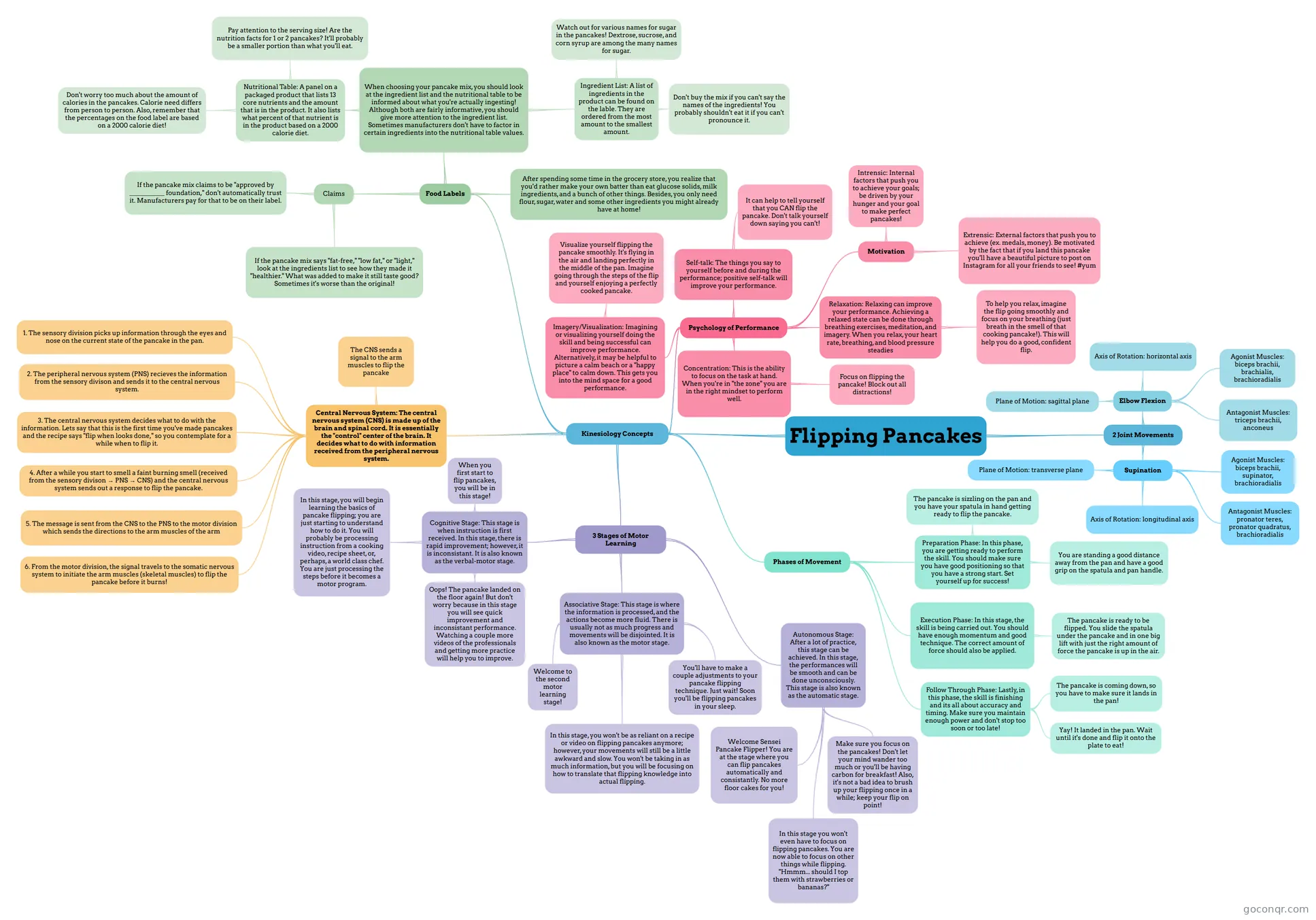
Mind map: Flipping pancakes
Inhalt der Mindmap
Flipping Pancakes
2 Joint Movements
- Supination
- Plane of Motion: transverse plane
- Axis of Rotation: longitudinal axis
- Agonist Muscles: biceps brachii, supinator, brachioradialis
- Antagonist Muscles: pronator teres, pronator quadratus, brachioradialis
- Elbow Flexion
- Plane of Motion: sagittal plane
- Axis of Rotation: horizontal axis
- Agonist Muscles: biceps brachii, brachialis, brachioradialis
- Antagonist Muscles: triceps brachii, anconeus
- Supination
Kinesiology Concepts
- Central Nervous System: The central nervous system (CNS) is made up of the brain and spinal cord. It is essentially the "control" center of the brain. It decides what to do with information received from the peripheral nervous system.
- 1. The sensory division picks up information through the eyes and nose on the current state of the pancake in the pan.
- The CNS sends a signal to the arm muscles to flip the pancake
- 2. The peripheral nervous system (PNS) recieves the information from the sensory divison and sends it to the central nervous system.
- 3. The central nervous system decides what to do with the information. Lets say that this is the first time you've made pancakes and the recipe says "flip when looks done," so you contemplate for a while when to flip it.
- 4. After a while you start to smell a faint burning smell (received from the sensory divison → PNS → CNS) and the central nervous system sends out a response to flip the pancake.
- 5. The message is sent from the CNS to the PNS to the motor division which sends the directions to the arm muscles of the arm
- 6. From the motor division, the signal travels to the somatic nervous system to initiate the arm muscles (skeletal muscles) to flip the pancake before it burns!
- 3 Stages of Motor Learning
- Cognitive Stage: This stage is when instruction is first received. In this stage, there is rapid improvement; however, it is inconsistant. It is also known as the verbal-motor stage.
- When you first start to flip pancakes, you will be in this stage!
- In this stage, you will begin learning the basics of pancake flipping; you are just starting to understand how to do it. You will probably be processing instruction from a cooking video, recipe sheet, or, perhaps, a world class chef. You are just processing the steps before it becomes a motor program.
- Oops! The pancake landed on the floor again! But don't worry because in this stage you will see quick improvement and inconsistant performance. Watching a couple more videos of the professionals and getting more practice will help you to improve.
- Associative Stage: This stage is where the information is processed, and the actions become more fluid. There is usually not as much progress and movements will be disjointed. It is also known as the motor stage.
- Welcome to the second motor learning stage!
- In this stage, you won't be as reliant on a recipe or video on flipping pancakes anymore; however, your movements will still be a little awkward and slow. You won't be taking in as much information, but you will be focusing on how to translate that flipping knowledge into actual flipping.
- You'll have to make a couple adjustments to your pancake flipping technique. Just wait! Soon you'll be flipping pancakes in your sleep.
- Autonomous Stage: After a lot of practice, this stage can be achieved. In this stage, the performances will be smooth and can be done unconsciously. This stage is also known as the automatic stage.
- Welcome Sensei Pancake Flipper! You are at the stage where you can flip pancakes automatically and consistantly. No more floor cakes for you!
- In this stage you won't even have to focus on flipping pancakes. You are now able to focus on other things while flipping. "Hmmm... should I top them with strawberries or bananas?"
- Make sure you focus on the pancakes! Don't let your mind wander too much or you'll be having carbon for breakfast! Also, it's not a bad idea to brush up your flipping once in a while; keep your flip on point!
- Cognitive Stage: This stage is when instruction is first received. In this stage, there is rapid improvement; however, it is inconsistant. It is also known as the verbal-motor stage.
- Food Labels
- When choosing your pancake mix, you should look at the ingredient list and the nutritional table to be informed about what you're actually ingesting! Although both are fairly informative, you should give more attention to the ingredient list. Sometimes manufacturers don't have to factor in certain ingredients into the nutritional table values.
- Ingredient List: A list of ingredients in the product can be found on the lable. They are ordered from the most amount to the smallest amount.
- Watch out for various names for sugar in the pancakes! Dextrose, sucrose, and corn syrup are among the many names for sugar.
- Don't buy the mix if you can't say the names of the ingredients! You probably shouldn't eat it if you can't pronounce it.
- Nutritional Table: A panel on a packaged product that lists 13 core nutrients and the amount that is in the product. It also lists what percent of that nutrient is in the product based on a 2000 calorie diet.
- Pay attention to the serving size! Are the nutrition facts for 1 or 2 pancakes? It'll probably be a smaller portion than what you'll eat.
- Don't worry too much about the amount of calories in the pancakes. Calorie need differs from person to person. Also, remember that the percentages on the food label are based on a 2000 calorie diet!
- Ingredient List: A list of ingredients in the product can be found on the lable. They are ordered from the most amount to the smallest amount.
- Claims
- If the pancake mix claims to be "approved by ___________ foundation," don't automatically trust it. Manufacturers pay for that to be on their label.
- If the pancake mix says "fat-free," "low fat," or "light," look at the ingredients list to see how they made it "healthier." What was added to make it still taste good? Sometimes it's worse than the original!
- After spending some time in the grocery store, you realize that you'd rather make your own batter than eat glucose solids, milk ingredients, and a bunch of other things. Besides, you only need flour, sugar, water and some other ingredients you might already have at home!
- When choosing your pancake mix, you should look at the ingredient list and the nutritional table to be informed about what you're actually ingesting! Although both are fairly informative, you should give more attention to the ingredient list. Sometimes manufacturers don't have to factor in certain ingredients into the nutritional table values.
- Phases of Movement
- Preparation Phase: In this phase, you are getting ready to perform the skill. You should make sure you have good positioning so that you have a strong start. Set yourself up for success!
- The pancake is sizzling on the pan and you have your spatula in hand getting ready to flip the pancake.
- You are standing a good distance away from the pan and have a good grip on the spatula and pan handle.
- Execution Phase: In this stage, the skill is being carried out. You should have enough momentum and good technique. The correct amount of force should also be applied.
- The pancake is ready to be flipped. You slide the spatula under the pancake and in one big lift with just the right amount of force the pancake is up in the air.
- Follow Through Phase: Lastly, in this phase, the skill is finishing and its all about accuracy and timing. Make sure you maintain enough power and don't stop too soon or too late!
- The pancake is coming down, so you have to make sure it lands in the pan!
- Yay! It landed in the pan. Wait until it's done and flip it onto the plate to eat!
- Preparation Phase: In this phase, you are getting ready to perform the skill. You should make sure you have good positioning so that you have a strong start. Set yourself up for success!
- Psychology of Performance
- Self-talk: The things you say to yourself before and during the performance; positive self-talk will improve your performance.
- It can help to tell yourself that you CAN flip the pancake. Don't talk yourself down saying you can't!
- Imagery/Visualization: Imagining or visualizing yourself doing the skill and being successful can improve performance. Alternatively, it may be helpful to picture a calm beach or a "happy place" to calm down. This gets you into the mind space for a good performance.
- Visualize yourself flipping the pancake smoothly. It's flying in the air and landing perfectly in the middle of the pan. Imagine going through the steps of the flip and yourself enjoying a perfectly cooked pancake.
- Relaxation: Relaxing can improve your performance. Achieving a relaxed state can be done through breathing exercises, meditation, and imagery. When you relax, your heart rate, breathing, and blood pressure steadies
- To help you relax, imagine the flip going smoothly and focus on your breathing (just breath in the smell of that cooking pancake!). This will help you do a good, confident flip.
- Concentration: This is the ability to focus on the task at hand. When you're in "the zone" you are in the right mindset to perform well.
- Focus on flipping the pancake! Block out all distractions!
- Motivation
- Extrensic: External factors that push you to achieve (ex. medals, money). Be motivated by the fact that if you land this pancake you'll have a beautiful picture to post on Instagram for all your friends to see! #yum
- Intrensic: Internal factors that push you to achieve your goals; be driven by your hunger and your goal to make perfect pancakes!
- Self-talk: The things you say to yourself before and during the performance; positive self-talk will improve your performance.
- Central Nervous System: The central nervous system (CNS) is made up of the brain and spinal cord. It is essentially the "control" center of the brain. It decides what to do with information received from the peripheral nervous system.
Informationen
- Beschreibung
- Mindmap am Flipping Pancakes, erstellt von Mika W am 16/01/2019.
- Erstellt von
- Mika W
- Aufrufe
- 22
- Bewertung