
Mindmap
Content and Language Integrated Learning (CLIL)
Inhalt der Mindmap
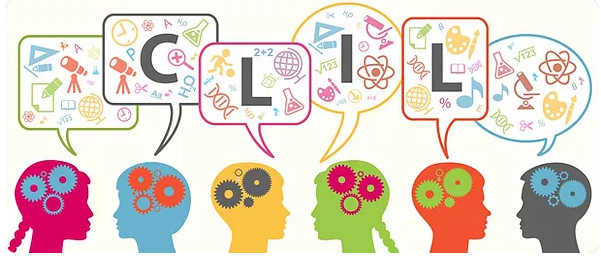
Content and Language Integrated Learning (CLIL)
Is a dual-focused educational in which and additional language is used for the learning and teaching of both content and language. The teaching and learning process. there is no focus not only on content, and not only on language.It is an innovative fusion of both.
- DESIGN
- Objectives
- The benefits of CLIL may be seen in terms of cultural awareness, internationalisation, language competence, preparation for both study and working life, and increased motivation. Some of the basic principles of CLIL are that in the CLIL classroom: ♪Language is used to learn as well as to communicate. ♪It is the subject matter which determines the language needed to learn.
- Types of activities
- 1. Describe and Draw
- The main objective of this activity is to spark active listening in the target language. This activity is easily adaptable to classes of any proficiency level.
- 2. Themed Collages
- This is a fun activity to teach any age range about different styles, genres and periods of art in the target language. It also requires engagement with authentic materials. This activity works particularly well for classes that are shy about their art skills or creative work, because there’s no drawing involved.
- 3. Artwork Presentations
- These presentations are intended to promote speaking and reading in the target language. The concept is straightforward: Students present on a piece of artwork to the rest of the class. Content: As an educator, you should identify and be clear with your students about what’s being taught and what the learning objectives are. Cognition: Students should think critically and creatively about the content at a level appropriate for them. Communication: In CLIL, the target language is both a vehicle for learning and the destination. Students should have enough target language concepts accessible to convey their ideas. Culture: CLIL requires engagement with the target language culture and an awareness of how other societies or communities are different or similar from the students’ own.
- 4. Adopt an Artist
- This activity builds on the artist presentation and works especially well with younger students who may be less inhibited to perform in front of others.
- 1. Describe and Draw
- Roles
- Techaer and students
- The respective roles of the teachers and students are central to CLIL, because its very nature to demand more student-centered. Students regularly acknowledge that CLIL courses are difficult, especially at the beginning. Moreover, it is certain that engaging with and appropriately cognitively challenging content requires a depth of procession which cannot be attained. When the teacher is simply in transmission mode.
- Techaer and students
- Materials
- 1. Text books
- Textbooks make teachers’ life easier because they are addressed to homogeneous groups of students (age, language level, emotional development). Besides, learners might feel very motivated and engaged by their visual richness (illustrations, audiovisual materials, games, etc.).
- 2. Authentic materials and realia
- They are materials that are highly visual, contextualized and culturally authentic. This concept includes: posters, advertisements, labels, schedules, tickets, place mats and more.
- 3. ICT (Information and Communication Technologies)
- Our students have grown up with new technologies and many readily make use of ICT as part of their normal experiences.
- 4. Collaborative material for practising routines with Scaffolding
- Students have a say when designingand creating their own teaching material.
- 5. Scaffolding and input materials
- Scaffolding and input materials are necessary through the different stages of a didactic sequence. Some good examples of these materials are: -- Real objects (realia), instruments and manipulatives. -- Vocabulary presentation through multisensorial media: videos, songs, picture flashcards, models, word lists, semi-scripts, annotated visuals, etc. -- Kinaesthetic activities or total physical response (TPR) to teach vocabulary, expressions or procedures. -- Slideshow presentations with demonstrations, pictures, diagrams, etc.
- 6. Scaffolding and problem-solving materials
- They can be any object applied to solving a problem or accomplishing a task. They can be adapted to all learning styles (spatial, kinaesthetic, interpersonal and intrapersonal intelligences, auditory and logical reasoning). Besides, they give students a realistic understanding of concepts, making it easier for them to communicate and interact with their classmates, their teacher or their parents.
- 1. Text books
- Objectives
- PROCEDURE
- Techniques
- 1. Repetition
- Repeat the crucial words and phrases giving students multiple chances to get the definition and usage right. They’ll be forced to use context and their critical thinking skills in order to figure out the meaning of certain words. By using the same words repeatedly and in different contexts. Repetition, in different pronunciation speeds, allows the students to fully learn the sounds of the language.
- 2. Animated gesturing
- Use your whole body to convey nuanced meaning to your students. Even your eyes can speak, they all help convey meaning. Be expansive in your actions. Exaggerate things, your facial expressions and movements. Maintain the interest and attention of your class. Move around, gesturing away.
- 3. Use of visual aids and props
- Teach a concept using images that feature interesting elements, exploding colors and relatable characters. If showing pictures isn’t enough, get the actual thing! If you can demonstrate how to use the prop, then you most probably have just conducted a class that won’t be forgotten any time soon.
- 4. Pre-teaching vocabulary
- Isolate vocabulary that you want students to remember. Pre-teach vocabulary ahead of the main lesson. Pre-teaching vocabulary gives your students a leg up by offering words and concepts in manageable pieces before actually embedding them in the main lesson.
- 5. Language lesson sidebar
- You can go ahead and do a quick and painless language lesson as a sidebar. By storytelling session. Mini-lessons where doing this will allow students to concentrate on your story and not get tripped up by a grammar rule that can be explained very quickly.
- 6. Direct translation
- This is a scaffolding as well as a time-saving teaching technique, but in instances when you feel giving a direct translation would get students unstuck, then do it. It would still be much better for students to discover for themselves the meanings of words and concepts, because the brain retains the information it has worked for much better.
- 7. Show and tell
- This has become a classic classroom activity because it compels student engagement with both the subject and the language. Let the students experience what it’s like conversing, interacting and conveying a message in the target language. As much as possible, don’t interrupt the presentation even if you hear wrong use of grammar.
- 8. Role playing
- This activity has the dual purpose of serving as language practice and, at the same time, apprising you, the teacher, of what students have learned.
- 1. Repetition
- Techniques
- DESIGN
REFERENCES
- Coyle,Do(Ed).(2010). CLIL content language integrated learning. Cambridge. Cambridge University Press Wiseman, Joanna. (2018).Pearson . Pearson English. _what is content and language integrated?This text was recovered from:_https://www.english.com/blog/content-and-language-integrated-learning/ Strawbridge,Jackie (2019). Fluent U.General educator blog. 4 CLIL Art activities for any foreign language classroom this text was recovered from: https://www.fluentu.com/blog/educator/clil-art/ Stevie, D. (2019). Fluent U. General educator blog. _8 teaching techniques for the CLIL teacher's soul. This text was recovered from: https://www.fluentu.com/blog/educator/clil-teaching/ Generalitat Valenciana Conselleria d'Educació, I. C. (s.f.). Cefire específic Plurilingüisme. This text was recovered from: http://cefire.edu.gva.es/pluginfile.php/869807/mod_resource/content/3/Unit%204.%20CLIL%20materials%20and%20resources.pdf Steve Darn, I. U. (2006). British Council. This text was recovered from : CLIL: A lesson framework: https://www.teachingenglish.org.uk/article/clil-a-lesson-framework
Bilder und Dateien der Mindmap



Informationen
- Beschreibung
- Mindmap am Content and Language Integrated Learning (CLIL), erstellt von Yesshare M am 11/02/2019.
- Erstellt von
- Yesshare M
- Aufrufe
- 6
- Bewertung