
Mindmap
Geography (rocks)
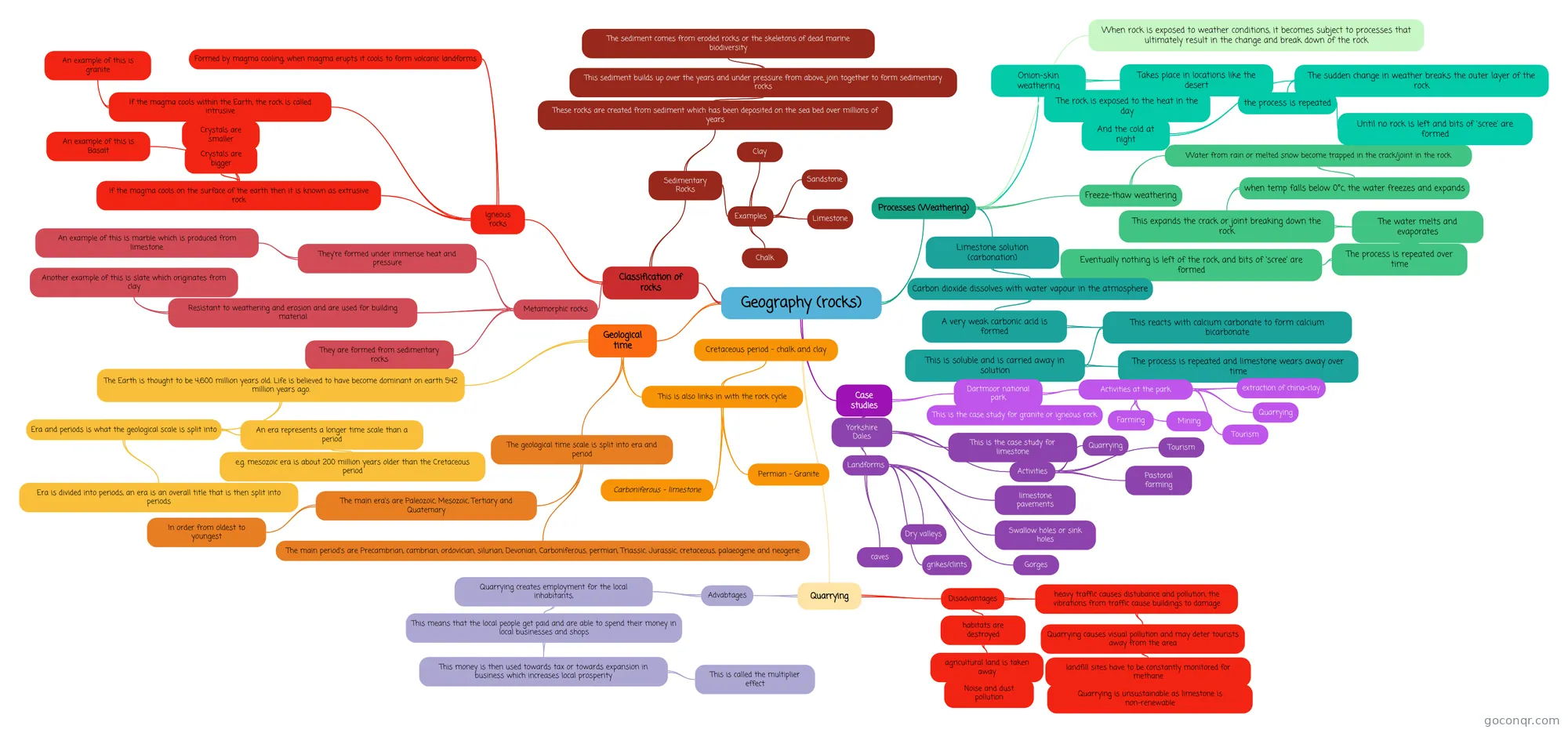
Mind map: Geography rocks
Inhalt der Mindmap
Geography (rocks)
Classification of rocks
- Igneous rocks
- Formed by magma cooling, when magma erupts it cools to form volcanic landforms
- If the magma cools within the Earth, the rock is called intrusive
- An example of this is granite
- Crystals are smaller
- If the magma cools on the surface of the earth then it is known as extrusive rock
- An example of this is Basalt
- Crystals are bigger
- Metamorphic rocks
- They're formed under immense heat and pressure
- An example of this is marble which is produced from limestone.
- Resistant to weathering and erosion and are used for building material
- Another example of this is slate which originates from clay
- They are formed from sedimentary rocks
- They're formed under immense heat and pressure
- Sedimentary Rocks
- These rocks are created from sediment which has been deposited on the sea bed over millions of years
- This sediment builds up over the years and under pressure from above, join together to form sedimentary rocks
- The sediment comes from eroded rocks or the skeletons of dead marine biodiversity
- This sediment builds up over the years and under pressure from above, join together to form sedimentary rocks
- Examples
- Sandstone
- Limestone
- Chalk
- Clay
- These rocks are created from sediment which has been deposited on the sea bed over millions of years
- Igneous rocks
Geological time
- The Earth is thought to be 4,600 million years old. Life is believed to have become dominant on earth 542 million years ago.
- Era and periods is what the geological scale is split into
- An era represents a longer time scale than a period
- e.g. mesozoic era is about 200 million years older than the Cretaceous period
- Era is divided into periods, an era is an overall title that is then split into periods
- An era represents a longer time scale than a period
- Era and periods is what the geological scale is split into
- The geological time scale is split into era and period
- The main era's are Paleozoic, Mesozoic, Tertiary and Quatemary
- In order from oldest to youngest
- The main period's are Precambrian, cambrian, ordovician, silurian, Devonian, Carboniferous, permian, Triassic, Jurassic, cretaceous, palaeogene and neogene
- The main era's are Paleozoic, Mesozoic, Tertiary and Quatemary
- This is also links in with the rock cycle
- Cretaceous period - chalk and clay
- Permian - Granite
- Carboniferous - limestone
- The Earth is thought to be 4,600 million years old. Life is believed to have become dominant on earth 542 million years ago.
Processes (Weathering)
- Freeze-thaw weathering
- Water from rain or melted snow become trapped in the crack/joint in the rock
- when temp falls below 0°c, the water freezes and expands
- This expands the crack or joint breaking down the rock
- The water melts and evaporates
- The process is repeated over time
- Eventually nothing is left of the rock, and bits of 'scree' are formed
- The process is repeated over time
- The water melts and evaporates
- This expands the crack or joint breaking down the rock
- when temp falls below 0°c, the water freezes and expands
- Water from rain or melted snow become trapped in the crack/joint in the rock
- When rock is exposed to weather conditions, it becomes subject to processes that ultimately result in the change and break down of the rock
- Limestone solution (carbonation)
- Carbon dioxide dissolves with water vapour in the atmosphere
- A very weak carbonic acid is formed
- This reacts with calcium carbonate to form calcium bicarbonate
- This is soluble and is carried away in solution
- The process is repeated and limestone wears away over time
- This is soluble and is carried away in solution
- This reacts with calcium carbonate to form calcium bicarbonate
- A very weak carbonic acid is formed
- Carbon dioxide dissolves with water vapour in the atmosphere
- Onion-skin weathering
- Takes place in locations like the desert
- The rock is exposed to the heat in the day
- And the cold at night
- The sudden change in weather breaks the outer layer of the rock
- the process is repeated
- Until no rock is left and bits of 'scree' are formed
- the process is repeated
- The sudden change in weather breaks the outer layer of the rock
- And the cold at night
- The rock is exposed to the heat in the day
- Takes place in locations like the desert
- Freeze-thaw weathering
Case studies
- Dartmoor national park
- This is the case study for granite or igneous rock
- Activities at the park
- extraction of china-clay
- Quarrying
- Tourism
- Farming
- Mining
- Yorkshire Dales
- This is the case study for limestone
- Activities
- Quarrying
- Tourism
- Pastoral farming
- Landforms
- Swallow holes or sink holes
- limestone pavements
- grikes/clints
- Gorges
- Dry valleys
- caves
- Dartmoor national park
Quarrying
- Advabtages
- Quarrying creates employment for the local inhabitants,
- This means that the local people get paid and are able to spend their money in local businesses and shops
- This money is then used towards tax or towards expansion in business which increases local prosperity
- This is called the multiplier effect
- This money is then used towards tax or towards expansion in business which increases local prosperity
- This means that the local people get paid and are able to spend their money in local businesses and shops
- Quarrying creates employment for the local inhabitants,
- Disadvantages
- habitats are destroyed
- agricultural land is taken away
- Noise and dust pollution
- agricultural land is taken away
- heavy traffic causes distubance and pollution, the vibrations from traffic cause buildings to damage
- Quarrying causes visual pollution and may deter tourists away from the area
- landfill sites have to be constantly monitored for methane
- Quarrying is unsustainable as limestone is non-renewable
- landfill sites have to be constantly monitored for methane
- Quarrying causes visual pollution and may deter tourists away from the area
- habitats are destroyed
- Advabtages
Informationen
- Beschreibung
- Mindmap am Geography (rocks), erstellt von aman.shahid am 29/11/2014.
- Erstellt von
- aman.shahid
- Aufrufe
- 10
- Bewertung