
Mindmap
3.1 The periodic table
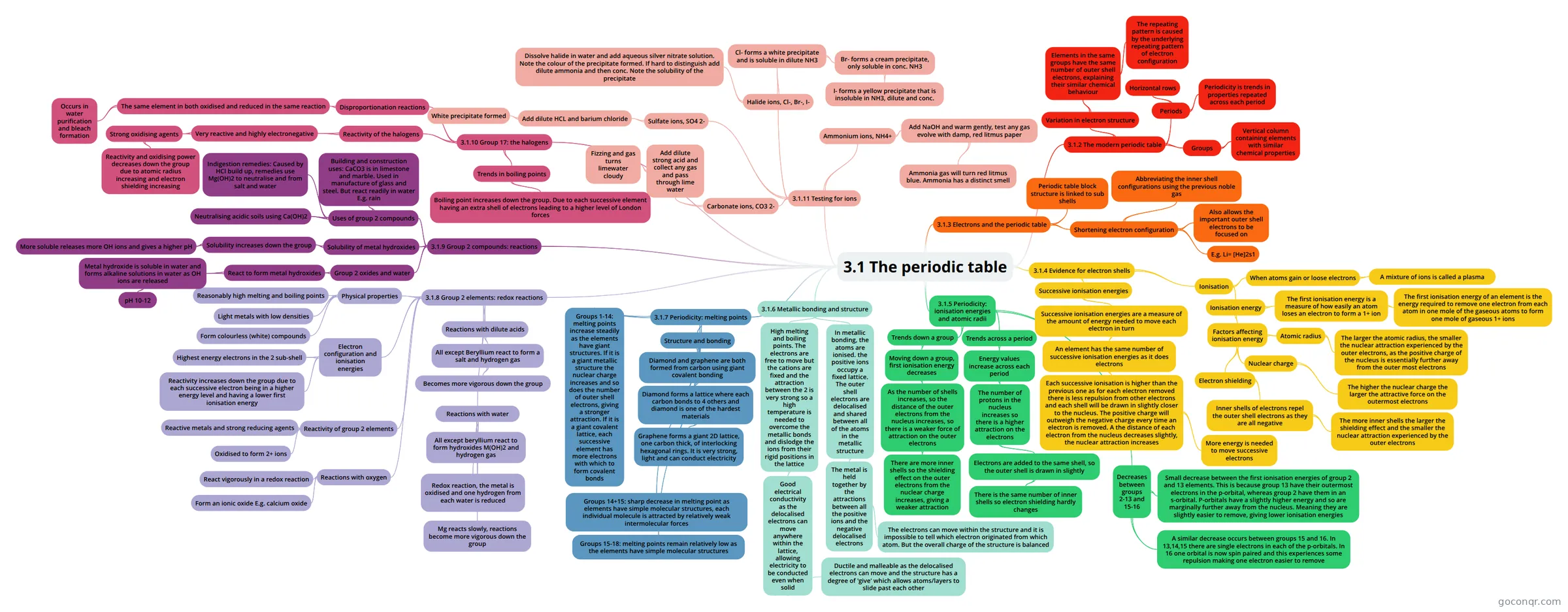
Mind map: The periodic table
Inhalt der Mindmap
3.1 The periodic table
3.1.2 The modern periodic table
- Periods
- Horizontal rows
- Periodicity is trends in properties repeated across each period
- Groups
- Vertical column containing elements with similar chemical properties
- Variation in electron structure
- Elements in the same groups have the same number of outer shell electrons, explaining their similar chemical behaviour
- The repeating pattern is caused by the underlying repeating pattern of electron configuration
- Elements in the same groups have the same number of outer shell electrons, explaining their similar chemical behaviour
- Periods
3.1.3 Electrons and the periodic table
- Periodic table block structure is linked to sub shells
- Shortening electron configuration
- Abbreviating the inner shell configurations using the previous noble gas
- Also allows the important outer shell electrons to be focused on
- E.g. Li= [He]2s1
3.1.4 Evidence for electron shells
- Ionisation
- When atoms gain or loose electrons
- A mixture of ions is called a plasma
- Ionisation energy
- The first ionisation energy is a measure of how easily an atom loses an electron to form a 1+ ion
- The first ionisation energy of an element is the energy required to remove one electron from each atom in one mole of the gaseous atoms to form one mole of gaseous 1+ ions
- Factors affecting ionisation energy
- Atomic radius
- The larger the atomic radius, the smaller the nuclear attraction experienced by the outer electrons, as the positive charge of the nucleus is essentially further away from the outer most electrons
- Nuclear charge
- The higher the nuclear charge the larger the attractive force on the outermost electrons
- Electron shielding
- Inner shells of electrons repel the outer shell electrons as they are all negative
- The more inner shells the larger the shielding effect and the smaller the nuclear attraction experienced by the outer electrons
- Inner shells of electrons repel the outer shell electrons as they are all negative
- Atomic radius
- The first ionisation energy is a measure of how easily an atom loses an electron to form a 1+ ion
- When atoms gain or loose electrons
- Successive ionisation energies
- Successive ionisation energies are a measure of the amount of energy needed to move each electron in turn
- An element has the same number of successive ionisation energies as it does electrons
- Each successive ionisation is higher than the previous one as for each electron removed there is less repulsion from other electrons and each shell will be drawn in slightly closer to the nucleus. The positive charge will outweigh the negative charge every time an electron is removed. A the distance of each electron from the nucleus decreases slightly, the nuclear attraction increases
- More energy is needed to move successive electrons
- Each successive ionisation is higher than the previous one as for each electron removed there is less repulsion from other electrons and each shell will be drawn in slightly closer to the nucleus. The positive charge will outweigh the negative charge every time an electron is removed. A the distance of each electron from the nucleus decreases slightly, the nuclear attraction increases
- An element has the same number of successive ionisation energies as it does electrons
- Successive ionisation energies are a measure of the amount of energy needed to move each electron in turn
- Ionisation
3.1.5 Periodicity: ionisation energies and atomic radii
- Trends across a period
- Energy values increase across each period
- The number of protons in the nucleus increases so there is a higher attraction on the electrons
- Electrons are added to the same shell, so the outer shell is drawn in slightly
- There is the same number of inner shells so electron shielding hardly changes
- Electrons are added to the same shell, so the outer shell is drawn in slightly
- The number of protons in the nucleus increases so there is a higher attraction on the electrons
- Energy values increase across each period
- Decreases between groups 2-13 and 15-16
- Small decrease between the first ionisation energies of group 2 and 13 elements. This is because group 13 have their outermost electrons in the p-orbital, whereas group 2 have them in an s-orbital. P-orbitals have a slightly higher energy and so are marginally further away from the nucleus. Meaning they are slightly easier to remove, giving lower ionisation energies
- A similar decrease occurs between groups 15 and 16. In 13,14,15 there are single electrons in each of the p-orbitals. In 16 one orbital is now spin paired and this experiences some repulsion making one electron easier to remove
- Trends down a group
- Moving down a group, first ionisation energy decreases
- As the number of shells increases, so the distance of the outer electrons from the nucleus increases, so there is a weaker force of attraction on the outer electrons
- There are more inner shells so the shielding effect on the outer electrons from the nuclear charge increases, giving a weaker attraction
- As the number of shells increases, so the distance of the outer electrons from the nucleus increases, so there is a weaker force of attraction on the outer electrons
- Moving down a group, first ionisation energy decreases
- Trends across a period
3.1.6 Metallic bonding and structure
- In metallic bonding, the atoms are ionised. the positive ions occupy a fixed lattice. The outer shell electrons are delocalised and shared between all of the atoms in the metallic structure
- The metal is held together by the attractions between all the positive ions and the negative delocalised electrons
- The electrons can move within the structure and it is impossible to tell which electron originated from which atom. But the overall charge of the structure is balanced
- The metal is held together by the attractions between all the positive ions and the negative delocalised electrons
- High melting and boiling points. The electrons are free to move but the cations are fixed and the attraction between the 2 is very strong so a high temperature is needed to overcome the metallic bonds and dislodge the ions from their rigid positions in the lattice
- Good electrical conductivity as the delocalised electrons can move anywhere within the lattice, allowing electricity to be conducted even when solid
- Ductile and malleable as the delocalised electrons can move and the structure has a degree of 'give' which allows atoms/layers to slide past each other
- Good electrical conductivity as the delocalised electrons can move anywhere within the lattice, allowing electricity to be conducted even when solid
- In metallic bonding, the atoms are ionised. the positive ions occupy a fixed lattice. The outer shell electrons are delocalised and shared between all of the atoms in the metallic structure
3.1.7 Periodicity: melting points
- Groups 1-14: melting points increase steadily as the elements have giant structures. If it is a giant metallic structure the nuclear charge increases and so does the number of outer shell electrons, giving a stronger attraction. If it is a giant covalent lattice, each successive element has more electrons with which to form covalent bonds
- Groups 14+15: sharp decrease in melting point as elements have simple molecular structures, each individual molecule is attracted by relatively weak intermolecular forces
- Groups 15-18: melting points remain relatively low as the elements have simple molecular structures
- Structure and bonding
- Diamond and graphene are both formed from carbon using giant covalent bonding
- Diamond forms a lattice where each carbon bonds to 4 others and diamond is one of the hardest materials
- Graphene forms a giant 2D lattice, one carbon thick, of interlocking hexagonal rings. It is very strong, light and can conduct electricity
- Diamond forms a lattice where each carbon bonds to 4 others and diamond is one of the hardest materials
- Diamond and graphene are both formed from carbon using giant covalent bonding
3.1.8 Group 2 elements: redox reactions
- Physical properties
- Reasonably high melting and boiling points
- Light metals with low densities
- Form colourless (white) compounds
- Electron configuration and ionisation energies
- Highest energy electrons in the 2 sub-shell
- Reactivity increases down the group due to each successive electron being in a higher energy level and having a lower first ionisation energy
- Reactivity of group 2 elements
- Reactive metals and strong reducing agents
- Oxidised to form 2+ ions
- Reactions with oxygen
- React vigorously in a redox reaction
- Form an ionic oxide E.g. calcium oxide
- Reactions with water
- All except beryllium react to form hydroxides M(OH)2 and hydrogen gas
- Mg reacts slowly, reactions become more vigorous down the group
- Redox reaction, the metal is oxidised and one hydrogen from each water is reduced
- Reactions with dilute acids
- All except Beryllium react to form a salt and hydrogen gas
- Becomes more vigorous down the group
- All except Beryllium react to form a salt and hydrogen gas
- Physical properties
3.1.9 Group 2 compounds: reactions
- Group 2 oxides and water
- React to form metal hydroxides
- Metal hydroxide is soluble in water and forms alkaline solutions in water as OH ions are released
- pH 10-12
- Metal hydroxide is soluble in water and forms alkaline solutions in water as OH ions are released
- React to form metal hydroxides
- Solubility of metal hydroxides
- Solubility increases down the group
- More soluble releases more OH ions and gives a higher pH
- Solubility increases down the group
- Uses of group 2 compounds
- Neutralising acidic soils using Ca(OH)2
- Indigestion remedies: Caused by HCl build up, remedies use Mg(OH)2 to neutralise and from salt and water
- Building and construction uses: CaCO3 is in limestone and marble. Used in manufacture of glass and steel. But react readily in water E.g. rain
- Group 2 oxides and water
3.1.10 Group 17: the halogens
- Trends in boiling points
- Boiling point increases down the group. Due to each successive element having an extra shell of electrons leading to a higher level of London forces
- Reactivity of the halogens
- Very reactive and highly electronegative
- Strong oxidising agents
- Reactivity and oxidising power decreases down the group due to atomic radius increasing and electron shielding increasing
- Strong oxidising agents
- Very reactive and highly electronegative
- Disproportionation reactions
- The same element in both oxidised and reduced in the same reaction
- Occurs in water purification and bleach formation
- The same element in both oxidised and reduced in the same reaction
- Trends in boiling points
3.1.11 Testing for ions
- Carbonate ions, CO3 2-
- Add dilute strong acid and collect any gas and pass through lime water
- Fizzing and gas turns limewater cloudy
- Add dilute strong acid and collect any gas and pass through lime water
- Sulfate ions, SO4 2-
- Add dilute HCL and barium chloride
- White precipitate formed
- Add dilute HCL and barium chloride
- Halide ions, Cl-, Br-, I-
- Dissolve halide in water and add aqueous silver nitrate solution. Note the colour of the precipitate formed. If hard to distinguish add dilute ammonia and then conc. Note the solubility of the precipitate
- Cl- forms a white precipitate and is soluble in dilute NH3
- Br- forms a cream precipitate, only soluble in conc. NH3
- I- forms a yellow precipitate that is insoluble in NH3, dilute and conc.
- Br- forms a cream precipitate, only soluble in conc. NH3
- Ammonium ions, NH4+
- Add NaOH and warm gently, test any gas evolve with damp, red litmus paper
- Ammonia gas will turn red litmus blue. Ammonia has a distinct smell
- Add NaOH and warm gently, test any gas evolve with damp, red litmus paper
- Carbonate ions, CO3 2-
Informationen
- Beschreibung
- A level Chemistry Mindmap am 3.1 The periodic table, erstellt von lucia elliott am 24/03/2019.
- Erstellt von
- lucia elliott
- Aufrufe
- 4
- Tags
- Bewertung