
Mindmap
Population Genetics
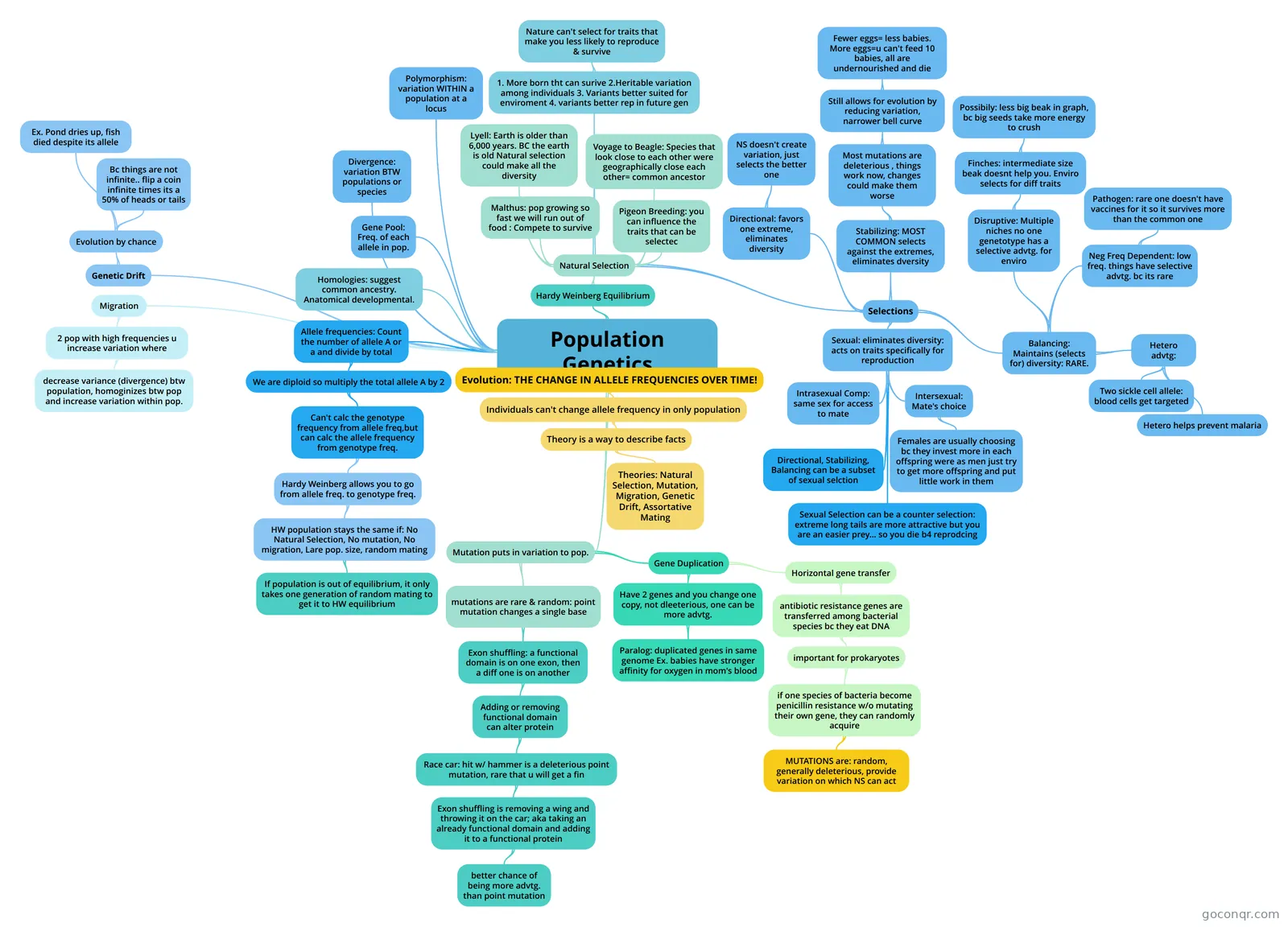
Mind map: Population genetics
Inhalt der Mindmap
Population Genetics
Evolution: THE CHANGE IN ALLELE FREQUENCIES OVER TIME!
- Individuals can't change allele frequency in only population
- Theory is a way to describe facts
- Theories: Natural Selection, Mutation, Migration, Genetic Drift, Assortative Mating
- Theory is a way to describe facts
- Individuals can't change allele frequency in only population
Homologies: suggest common ancestry. Anatomical developmental.
Polymorphism: variation WITHIN a population at a locus
Divergence: variation BTW populations or species
Gene Pool: Freq. of each allele in pop.
Allele frequencies: Count the number of allele A or a and divide by total
- We are diploid so multiply the total allele A by 2
- Can't calc the genotype frequency from allele freq,but can calc the allele frequency from genotype freq.
- Hardy Weinberg allows you to go from allele freq. to genotype freq.
- HW population stays the same if: No Natural Selection, No mutation, No migration, Lare pop. size, random mating
- If population is out of equilibrium, it only takes one generation of random mating to get it to HW equilibrium
- HW population stays the same if: No Natural Selection, No mutation, No migration, Lare pop. size, random mating
- Hardy Weinberg allows you to go from allele freq. to genotype freq.
- Can't calc the genotype frequency from allele freq,but can calc the allele frequency from genotype freq.
- We are diploid so multiply the total allele A by 2
Hardy Weinberg Equilibrium
- Natural Selection
- Malthus: pop growing so fast we will run out of food : Compete to survive
- Lyell: Earth is older than 6,000 years. BC the earth is old Natural selection could make all the diversity
- Voyage to Beagle: Species that look close to each other were geographically close each other= common ancestor
- Pigeon Breeding: you can influence the traits that can be selectec
- 1. More born tht can surive 2.Heritable variation among individuals 3. Variants better suited for enviroment 4. variants better rep in future gen
- Nature can't select for traits that make you less likely to reproduce & survive
- Selections
- Directional: favors one extreme, eliminates diversity
- NS doesn't create variation, just selects the better one
- Stabilizing: MOST COMMON selects against the extremes, eliminates dversity
- Most mutations are deleterious , things work now, changes could make them worse
- Still allows for evolution by reducing variation, narrower bell curve
- Fewer eggs= less babies. More eggs=u can't feed 10 babies, all are undernourished and die
- Still allows for evolution by reducing variation, narrower bell curve
- Most mutations are deleterious , things work now, changes could make them worse
- Balancing: Maintains (selects for) diversity: RARE.
- Disruptive: Multiple niches no one genetotype has a selective advtg. for enviro
- Finches: intermediate size beak doesnt help you. Enviro selects for diff traits
- Possibily: less big beak in graph, bc big seeds take more energy to crush
- Finches: intermediate size beak doesnt help you. Enviro selects for diff traits
- Neg Freq Dependent: low freq. things have selective advtg. bc its rare
- Pathogen: rare one doesn't have vaccines for it so it survives more than the common one
- Hetero advtg:
- Two sickle cell allele: blood cells get targeted
- Hetero helps prevent malaria
- Disruptive: Multiple niches no one genetotype has a selective advtg. for enviro
- Sexual: eliminates diversity: acts on traits specifically for reproduction
- Intrasexual Comp: same sex for access to mate
- Intersexual: Mate's choice
- Females are usually choosing bc they invest more in each offspring were as men just try to get more offspring and put little work in them
- Directional, Stabilizing, Balancing can be a subset of sexual selction
- Sexual Selection can be a counter selection: extreme long tails are more attractive but you are an easier prey... so you die b4 reprodcing
- Directional: favors one extreme, eliminates diversity
- Natural Selection
Mutation puts in variation to pop.
- mutations are rare & random: point mutation changes a single base
- Exon shuffling: a functional domain is on one exon, then a diff one is on another
- Adding or removing functional domain can alter protein
- Race car: hit w/ hammer is a deleterious point mutation, rare that u will get a fin
- Exon shuffling is removing a wing and throwing it on the car; aka taking an already functional domain and adding it to a functional protein
- better chance of being more advtg. than point mutation
- Exon shuffling is removing a wing and throwing it on the car; aka taking an already functional domain and adding it to a functional protein
- Race car: hit w/ hammer is a deleterious point mutation, rare that u will get a fin
- Adding or removing functional domain can alter protein
- Exon shuffling: a functional domain is on one exon, then a diff one is on another
- Gene Duplication
- Have 2 genes and you change one copy, not dleeterious, one can be more advtg.
- Paralog: duplicated genes in same genome Ex. babies have stronger affinity for oxygen in mom's blood
- Horizontal gene transfer
- antibiotic resistance genes are transferred among bacterial species bc they eat DNA
- important for prokaryotes
- if one species of bacteria become penicillin resistance w/o mutating their own gene, they can randomly acquire
- MUTATIONS are: random, generally deleterious, provide variation on which NS can act
- if one species of bacteria become penicillin resistance w/o mutating their own gene, they can randomly acquire
- important for prokaryotes
- antibiotic resistance genes are transferred among bacterial species bc they eat DNA
- Have 2 genes and you change one copy, not dleeterious, one can be more advtg.
- mutations are rare & random: point mutation changes a single base
Migration
- 2 pop with high frequencies u increase variation where
- decrease variance (divergence) btw population, homoginizes btw pop and increase variation within pop.
- 2 pop with high frequencies u increase variation where
Genetic Drift
- Evolution by chance
- Ex. Pond dries up, fish died despite its allele
- Bc things are not infinite.. flip a coin infinite times its a 50% of heads or tails
- Evolution by chance
Informationen
- Beschreibung
- Mindmap am Population Genetics, erstellt von mafriyie am 06/12/2014.
- Erstellt von
- mafriyie
- Aufrufe
- 9
- Bewertung
Mehr zu Population Genetics and Evolutionary Mechanisms