
Mindmap
Formation of Relationships
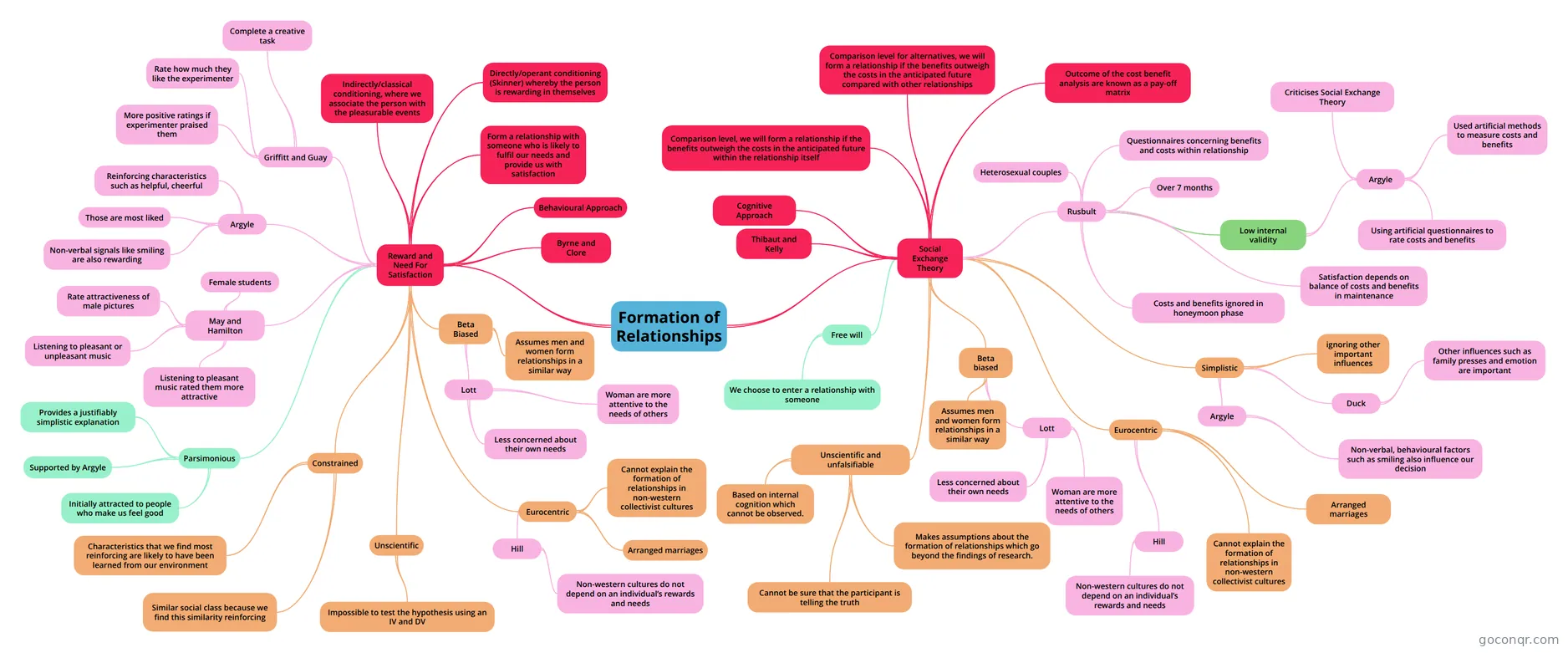
Mind map: Formation of relationships
Inhalt der Mindmap
Formation of Relationships
Reward and Need For Satisfaction
- Byrne and Clore
- Behavioural Approach
- Form a relationship with someone who is likely to fulfil our needs and provide us with satisfaction
- Directly/operant conditioning (Skinner) whereby the person is rewarding in themselves
- Indirectly/classical conditioning, where we associate the person with the pleasurable events
- Griffitt and Guay
- Complete a creative task
- Rate how much they like the experimenter
- More positive ratings if experimenter praised them
- Argyle
- Reinforcing characteristics such as helpful, cheerful
- Those are most liked
- Non-verbal signals like smiling are also rewarding
- May and Hamilton
- Female students
- Rate attractiveness of male pictures
- Listening to pleasant or unpleasant music
- Listening to pleasant music rated them more attractive
- Parsimonious
- Provides a justifiably simplistic explanation
- Supported by Argyle
- Initially attracted to people who make us feel good
- Constrained
- Characteristics that we find most reinforcing are likely to have been learned from our environment
- Similar social class because we find this similarity reinforcing
- Beta Biased
- Assumes men and women form relationships in a similar way
- Lott
- Woman are more attentive to the needs of others
- Less concerned about their own needs
- Eurocentric
- Cannot explain the formation of relationships in non-western collectivist cultures
- Arranged marriages
- Hill
- Non-western cultures do not depend on an individual’s rewards and needs
- Unscientific
- Impossible to test the hypothesis using an IV and DV
Social Exchange Theory
- Thibaut and Kelly
- Cognitive Approach
- Comparison level, we will form a relationship if the benefits outweigh the costs in the anticipated future within the relationship itself
- Comparison level for alternatives, we will form a relationship if the benefits outweigh the costs in the anticipated future compared with other relationships
- Outcome of the cost benefit analysis are known as a pay-off matrix
- Rusbult
- Heterosexual couples
- Questionnaires concerning benefits and costs within relationship
- Over 7 months
- Satisfaction depends on balance of costs and benefits in maintenance
- Costs and benefits ignored in honeymoon phase
- Low internal validity
- Argyle
- Criticises Social Exchange Theory
- Using artificial questionnaires to rate costs and benefits
- Used artificial methods to measure costs and benefits
- Argyle
- Free will
- We choose to enter a relationship with someone
- Simplistic
- ignoring other important influences
- Duck
- Other influences such as family presses and emotion are important
- Argyle
- Non-verbal, behavioural factors such as smiling also influence our decision
- Unscientific and unfalsifiable
- Cannot be sure that the participant is telling the truth
- Makes assumptions about the formation of relationships which go beyond the findings of research.
- Based on internal cognition which cannot be observed.
- Eurocentric
- Cannot explain the formation of relationships in non-western collectivist cultures
- Arranged marriages
- Hill
- Non-western cultures do not depend on an individual’s rewards and needs
- Beta biased
- Assumes men and women form relationships in a similar way
- Lott
- Woman are more attentive to the needs of others
- Less concerned about their own needs
Informationen
- Beschreibung
- Mindmap am Formation of Relationships, erstellt von paigeehawkinsx am 06/12/2014.
- Erstellt von
- paigeehawkinsx
- Aufrufe
- 12
- Bewertung
Mehr zu Relationship formation and attraction