
Relationships
856 resources created by 414 users
This Psychology page on GoConqr gathers community-made mind maps, flashcards, quizzes, slides and notes on Relationships, from the formation of romantic relationships to breakdown, sexual selection and parental investment. It's built for school students, university students and professional candidates revising a topic, plus teachers after ready-made material. There are over 800 resources here, including more than 40 quizzes and over 500 mind maps, mostly at secondary level with a good share for university. Pick a theory, test yourself with a quiz, then make your own set.
Select topic
- Sexual selection and partner preferences115
- Childhood experiences and adult relationships25
- Relationship formation and attraction184
- Relationship maintenance100
- Love and friendship5
- Conflict in relationships8
- Relationship breakdown78
- Cultural influences on relationships32
- Virtual relationships20
- Parasocial relationships and celebrity attraction29
Top Relationships resources
-
50 cardsRelationships What do evolutionary psychologists believe about relationships?
-
Mind map UNIT 3 RELATIONSHIPS (PART A)
-
34 cardsRELATIONSHIPS RESEARCH Kerckhoff and Davis (1962) The Filter Model - Relationship Formation
-
42 questionsPSY204 Attraction Urge to form connections and make contact with other people.
-
17 questionsBuss AO1 revision Why is mate preference of particular interest to Evolutionary Psychologists?
-
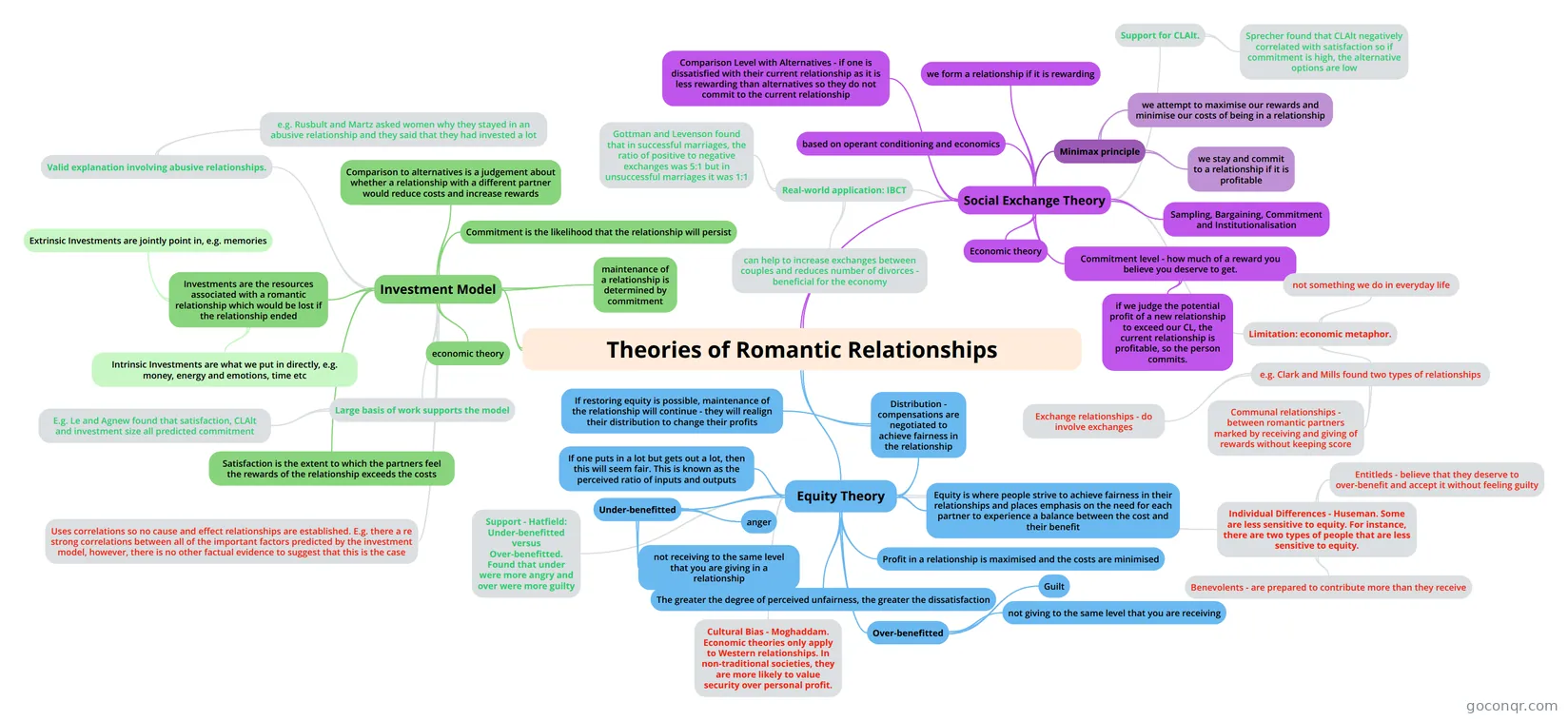 Mind map Theories of Romantic Relationships
-
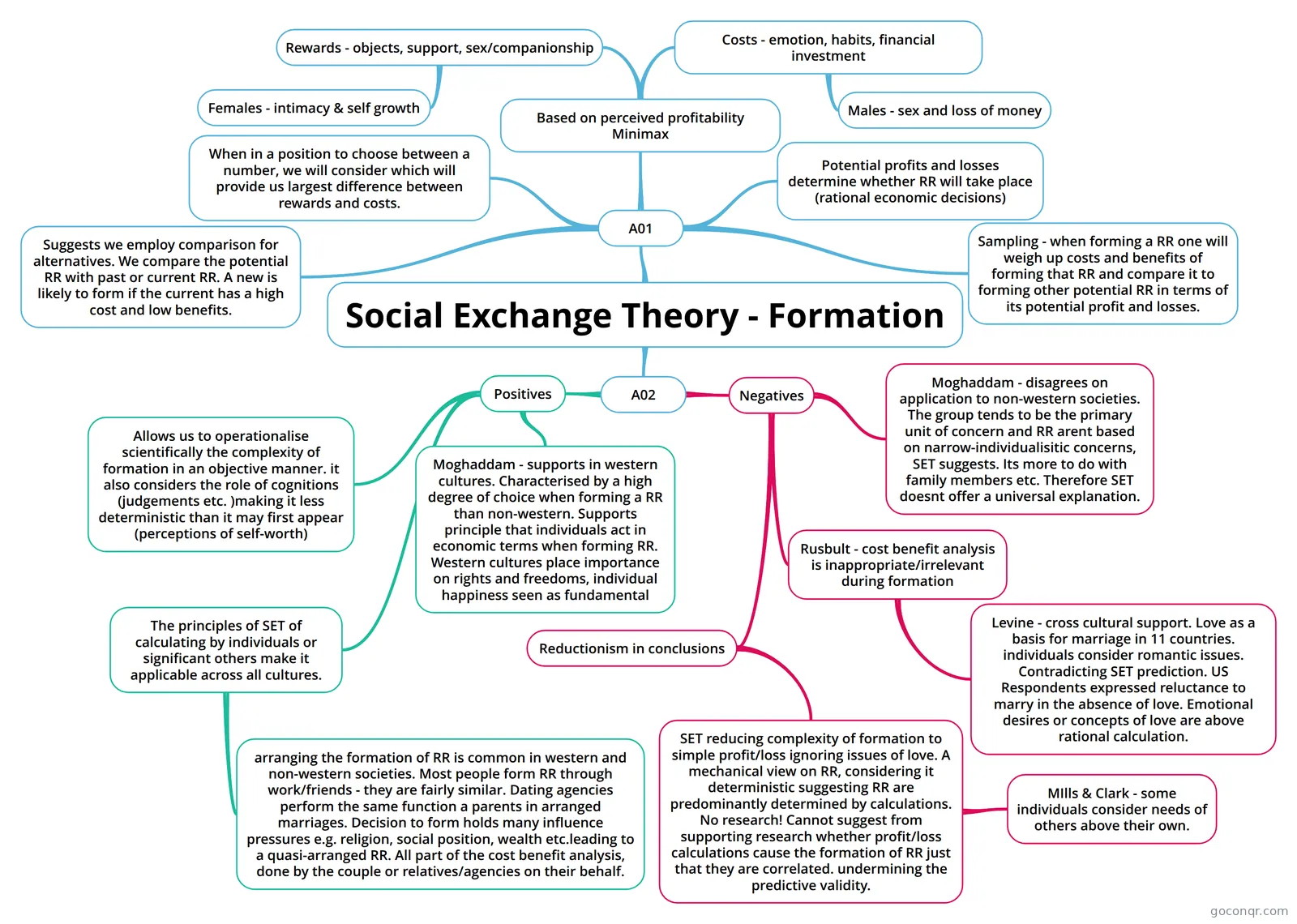 Mind map Social Exchange Theory - Formation A01 and A02 descriptions
-
Mind map Byrne and Clore's Reward/ Need Satisfaction Theory, 1970 Mindmap on Byrne and Clore's 1970 Reward/ Need satisfaction Theory. One of the two theories on formation of...
Quizzes
See all 42 quizzes-
42 questionsPSY204 Attraction Urge to form connections and make contact with other people.
-
17 questionsBuss AO1 revision Why is mate preference of particular interest to Evolutionary Psychologists?
-
8 questionsReasons for relationship breakdown AQA PSY4 Relationships
-
43 questionsHuman Relationships What evolutionary function does guilt serve?
-
78 questionsRelationships How did Betzig (1989) investigate martial breakdown?
-
66 questionsPerspectives on Relationships In relationships, we as individuals do not really care about fairness in relationships, as long as personal...
-
14 questionsRelationships quiz What is sexual selection?
-
29 questionsRelationships The Matching Hypothesis states that...
Mind maps
See all 529 mind maps-
UNIT 3 RELATIONSHIPS (PART A)
-
Theories of Romantic Relationships
-
Social Exchange Theory - Formation A01 and A02 descriptions
-
Byrne and Clore's Reward/ Need Satisfaction Theory, 1970 Mindmap on Byrne and Clore's 1970 Reward/ Need satisfaction Theory. One of the two theories on formation of...
-
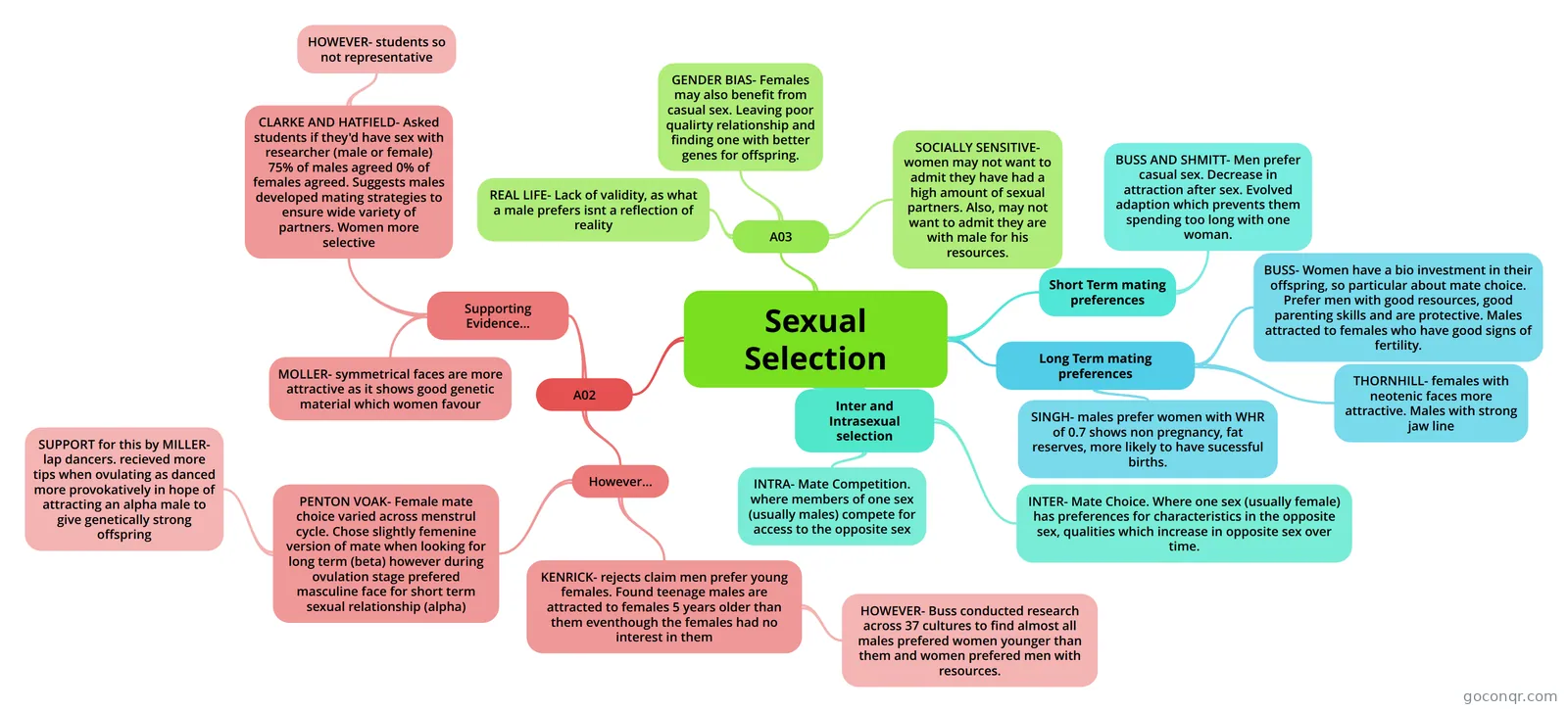 Sexual Selection
-
Reinforcement/reward need satisfaction theory
-
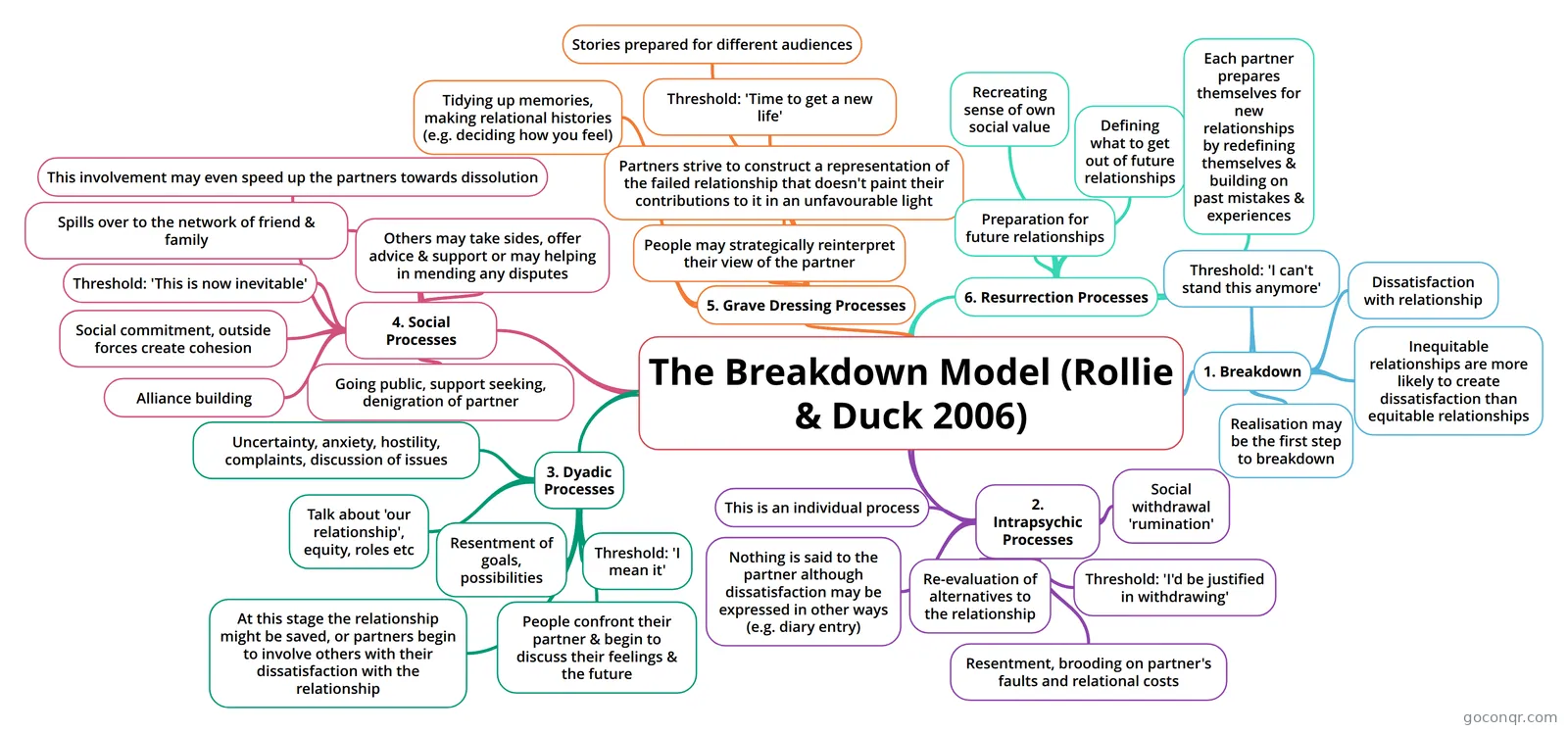 The Breakdown Model (Rollie & Duck 2006) Mind map of Rollie and Duck's (2006) model of relationship breakdown for AQA A A2 Psychology PSYA3
-
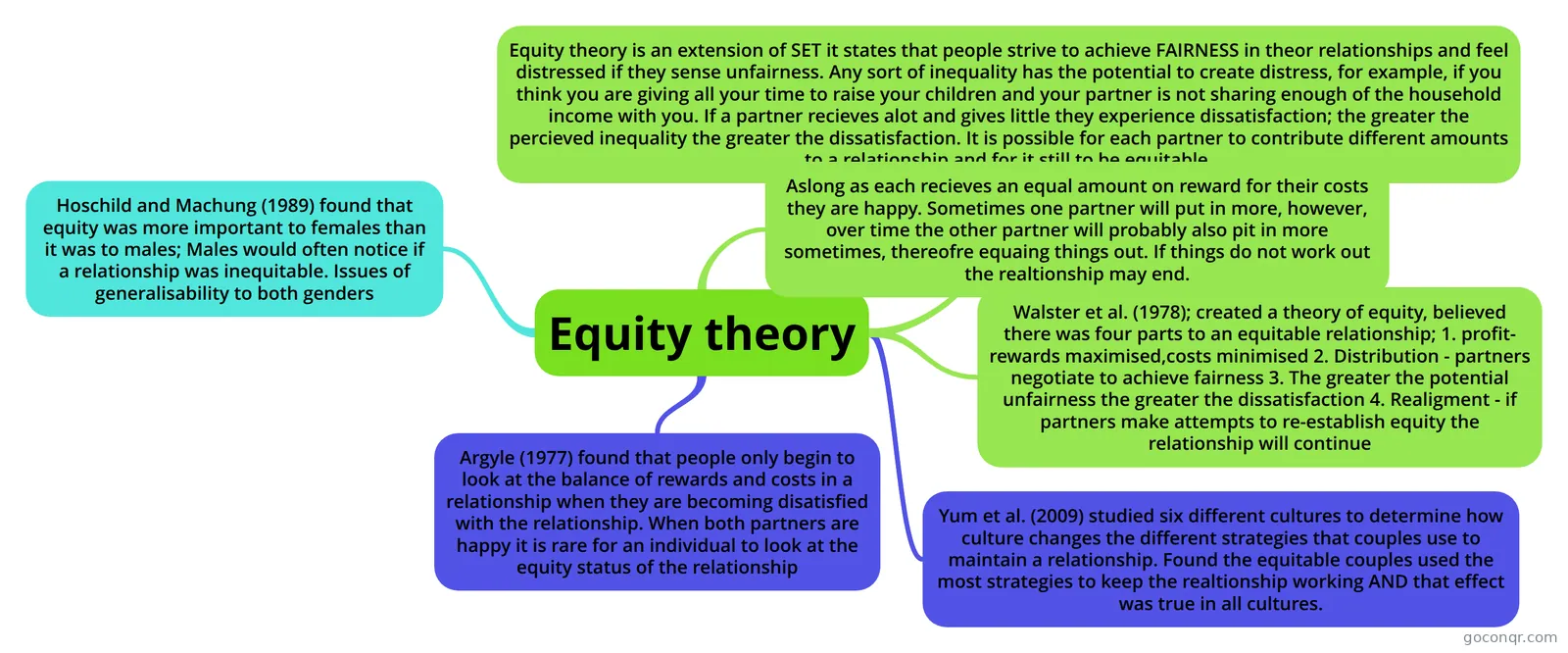 Equity theory
Flashcards
See all 206 flashcards-
50 cardsRelationships What do evolutionary psychologists believe about relationships?
-
34 cardsRELATIONSHIPS RESEARCH Kerckhoff and Davis (1962) The Filter Model - Relationship Formation
-
35 cardsRelationships Partner preference - Sexual selection
-
13 cardsPara-social Relationships
-
87 cardsRelationships What are the two theories in the formation of relationships?
-
85 cardsUntitled outline the A01 for the matching hypothesis
-
110 cardsPsychology A2 Relationships- Katie and Derek Story Do not shuffle these cards as they are part of a story telling process and part of the quiz.
-
79 cardsrelationships -what is meant by sexual selection and what are the components? -what is meant by human reproductive behavior?
Flowcharts
See all 33 flowchartsNotes
See all 33 notes-
Biological Approach: Explain relationship formation (5 marks) Biological Approach: Explain relationship formation (5 marks)Specifically Parent and Infant relationshipsEvolutionary influences & NeurotransmittersEvolutionary Influences Adaptive behaviour Evolutionary theory of att...
-
Human Relations Section 3 Frustration is the feeling you get when events beyond your control keep you from reaching a goal. As you're surely aware, frustration occurs in everyone's life. Some frustrations are small, like jumping into the ...
-
Relationships revision Relationship formation: socio biological theory - suggests that men want women with a nubile shape and youthful features because this is signs of fertility - selfish gene theory - they just want to survive and pass on...
-
SEXUAL SELECTION & HUMAN REPRODUCTIVE BEHAVIOUR - created from Mind Map INTER preference of certain qualities in the opposite sex determines the areas in which the other sex must compete these are indicators of 'good genes' or 'good parents' and humans are preprogrammed to attend to displ...
-
Formation - created from Mind Map REWARD/NEED SATISFACTION THEORY attraction to those satisfying & gratifying to be with. seek rewarding stimuli & avoid punishing stimuli. (produce positive or negative feelings) rewards reflect our unmet needs. mutual...
-
Relationships IDA points Relationship Formation Reward/Need Satisfaction Theory: Most of the studies into RNS theory are lab studies, which reduces their mundane realism and means they are less generalisable to everyday life. For example, man...
-
RELATIONSHIPS A01 NON - WESTERN CULTURES Less urban Areas Less choice of who they interact with Family and economic status of group main concern Group goals and Interests are consistant with formation of romantic relationships Lasts lo...
-
MAINTENANCE - created from Mind Map SOCIAL EXCHANGE maximise rewards & minimise costs, make a profit companionship, care effort, financial investment reward - costs = outcome. commitment to a relationship depends on the profitability of this outcom...
Slides
See all 13 slidesTopics in Relationships
More Psychology topics
About Relationships
GoConqr OriginalWhat this unit covers
The Relationships unit sits in the Social Psychology strand of Psychology. The resources follow the shape of an A-level style course, and some also mention IB. They move through formation, maintenance and breakdown of romantic relationships, then on to evolutionary ideas and the influence of childhood and culture.
Where to start
Begin with the mind map Theories of Romantic Relationships. It sets out Social Exchange Theory, Equity Theory and the Investment Model side by side. Then open the mind map UNIT 3 RELATIONSHIPS (PART A), which covers the matching hypothesis and the reward/need satisfaction model.
- Read the overview maps to see the whole unit.
- Move to the slides on formation, maintenance and breakdown of relationships for fuller explanations.
- Use the flashcards on relationship research to learn studies such as Kerckhoff and Davis and Byrne and Clore.
Going deeper
For evolutionary topics, try the mind map Sexual Selection. It separates inter and intrasexual selection and short and long term mating preferences. The slides on sexual selection and human reproductive behaviour add points on physical attractiveness, body symmetry and waist-to-hip ratio. For breakdown, the mind map The Breakdown Model (Rollie & Duck 2006) walks through its stages, from breakdown to resurrection processes.
There are also notes on cultural influences, parental investment and the influence of childhood attachments on adult relationships. These are handy when you want to practise essay-style answers.
Using quizzes and maps together
Study a map first, then take a quiz on the same topic. The quiz Reasons for relationship breakdown pairs well with the breakdown maps, and Buss AO1 revision suits the sexual selection material. Check any answers you missed against the map, then note them down.
Next step
Choose one theory today, work through its map and a quiz, and see which parts need another look. When you are ready, you can build a set of your own.
Frequently asked questions
Which resource should I open first?
Start with the mind map Theories of Romantic Relationships. It lays out Social Exchange Theory, Equity Theory and the Investment Model in one place, so you can see how the main explanations compare before moving into detail.
What do the mind maps cover?
The mind maps cover formation, maintenance and breakdown of romantic relationships, plus sexual selection, parental investment, attractiveness and cultural differences. There are also maps on essay questions, such as discussing theories of the breakdown of romantic relationships.
Are there quizzes for revision?
Yes, there are more than 40 quizzes. Examples include Reasons for relationship breakdown, Buss AO1 revision and a quiz on formation, maintenance and breakdown studies. They work well after you have read a map on the same topic.
Which levels and exams do these suit?
Most resources are at secondary level, with a sizeable group for university students. The listed resources mention A-level Psychology and IB. Teachers can use the maps, slides and notes as ready-made material for lessons.
Are the resources free, and who made them?
Every resource listed here is free to open, study and take, with no account needed. They were made by GoConqr users, not by GoConqr itself. A free account also saves your quiz scores and lets you create your own quizzes, maps, flashcards and notes.
What if I can't find the topic I need?
Try the neighbouring resources first, since topics overlap. Formation notes and flashcards often cite the studies you need. You can also make your own mind map or flashcards for the missing topic and use the existing material as a guide.