
Mindmap
MEMORY - L4
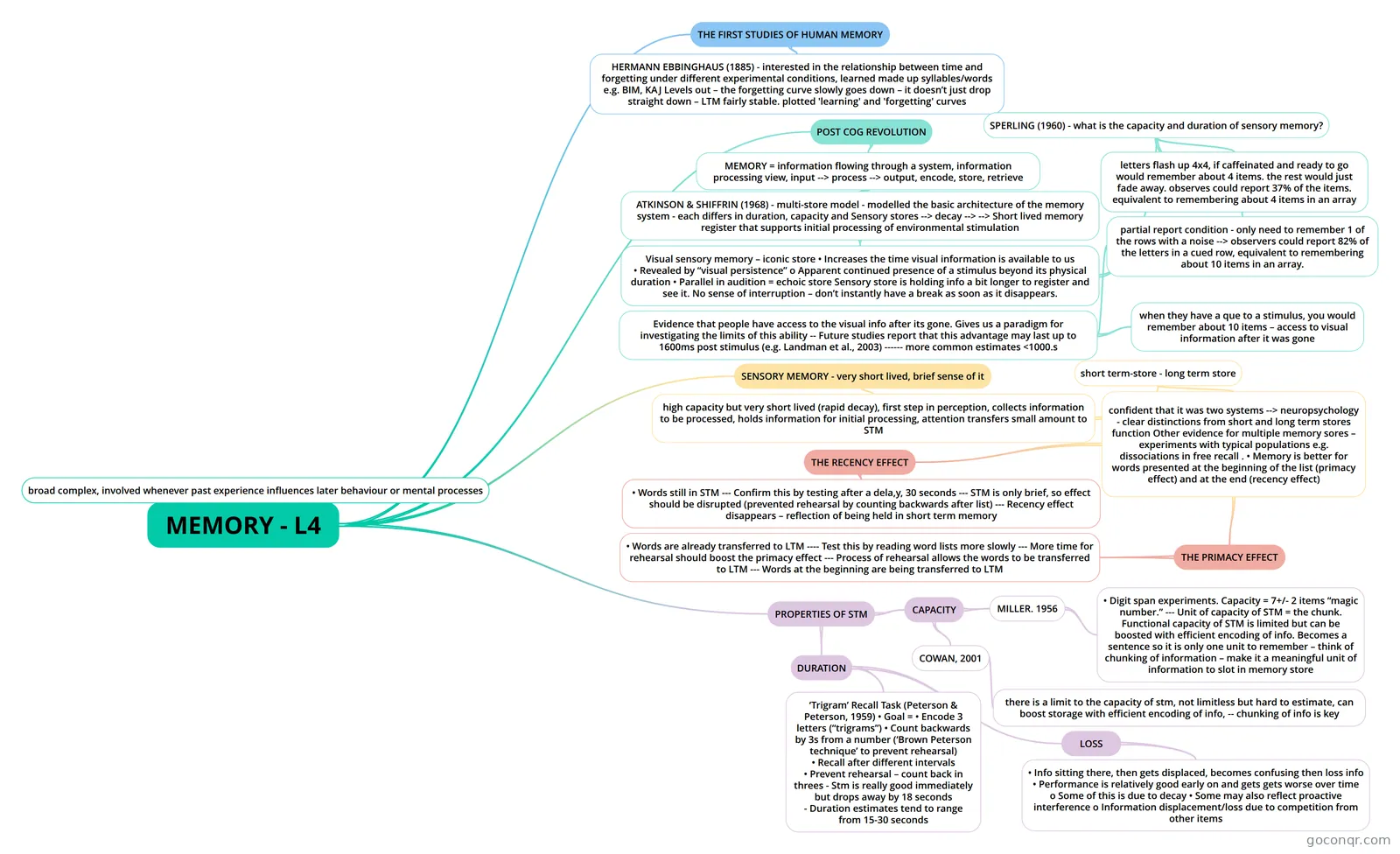
Mind map: Memory - L4
Inhalt der Mindmap
MEMORY - L4
broad complex, involved whenever past experience influences later behaviour or mental processes
THE FIRST STUDIES OF HUMAN MEMORY
- HERMANN EBBINGHAUS (1885) - interested in the relationship between time and forgetting under different experimental conditions, learned made up syllables/words e.g. BIM, KAJ Levels out – the forgetting curve slowly goes down – it doesn’t just drop straight down – LTM fairly stable. plotted 'learning' and 'forgetting' curves
POST COG REVOLUTION
- MEMORY = information flowing through a system, information processing view, input --> process --> output, encode, store, retrieve
- ATKINSON & SHIFFRIN (1968) - multi-store model - modelled the basic architecture of the memory system - each differs in duration, capacity and Sensory stores --> decay --> --> Short lived memory register that supports initial processing of environmental stimulation
- Visual sensory memory – iconic store • Increases the time visual information is available to us • Revealed by “visual persistence” o Apparent continued presence of a stimulus beyond its physical duration • Parallel in audition = echoic store Sensory store is holding info a bit longer to register and see it. No sense of interruption – don’t instantly have a break as soon as it disappears.
- SPERLING (1960) - what is the capacity and duration of sensory memory?
- letters flash up 4x4, if caffeinated and ready to go would remember about 4 items. the rest would just fade away. observes could report 37% of the items. equivalent to remembering about 4 items in an array
- partial report condition - only need to remember 1 of the rows with a noise --> observers could report 82% of the letters in a cued row, equivalent to remembering about 10 items in an array.
- Evidence that people have access to the visual info after its gone. Gives us a paradigm for investigating the limits of this ability -- Future studies report that this advantage may last up to 1600ms post stimulus (e.g. Landman et al., 2003) ------ more common estimates <1000.s
- when they have a que to a stimulus, you would remember about 10 items – access to visual information after it was gone
- Evidence that people have access to the visual info after its gone. Gives us a paradigm for investigating the limits of this ability -- Future studies report that this advantage may last up to 1600ms post stimulus (e.g. Landman et al., 2003) ------ more common estimates <1000.s
- SPERLING (1960) - what is the capacity and duration of sensory memory?
- Visual sensory memory – iconic store • Increases the time visual information is available to us • Revealed by “visual persistence” o Apparent continued presence of a stimulus beyond its physical duration • Parallel in audition = echoic store Sensory store is holding info a bit longer to register and see it. No sense of interruption – don’t instantly have a break as soon as it disappears.
- ATKINSON & SHIFFRIN (1968) - multi-store model - modelled the basic architecture of the memory system - each differs in duration, capacity and Sensory stores --> decay --> --> Short lived memory register that supports initial processing of environmental stimulation
- MEMORY = information flowing through a system, information processing view, input --> process --> output, encode, store, retrieve
SENSORY MEMORY - very short lived, brief sense of it
- high capacity but very short lived (rapid decay), first step in perception, collects information to be processed, holds information for initial processing, attention transfers small amount to STM
- short term-store - long term store
- confident that it was two systems --> neuropsychology - clear distinctions from short and long term stores function Other evidence for multiple memory sores – experiments with typical populations e.g. dissociations in free recall . • Memory is better for words presented at the beginning of the list (primacy effect) and at the end (recency effect)
- THE RECENCY EFFECT
- • Words still in STM --- Confirm this by testing after a dela,y, 30 seconds --- STM is only brief, so effect should be disrupted (prevented rehearsal by counting backwards after list) --- Recency effect disappears – reflection of being held in short term memory
- THE PRIMACY EFFECT
- • Words are already transferred to LTM ---- Test this by reading word lists more slowly --- More time for rehearsal should boost the primacy effect --- Process of rehearsal allows the words to be transferred to LTM --- Words at the beginning are being transferred to LTM
- THE RECENCY EFFECT
- confident that it was two systems --> neuropsychology - clear distinctions from short and long term stores function Other evidence for multiple memory sores – experiments with typical populations e.g. dissociations in free recall . • Memory is better for words presented at the beginning of the list (primacy effect) and at the end (recency effect)
- short term-store - long term store
- high capacity but very short lived (rapid decay), first step in perception, collects information to be processed, holds information for initial processing, attention transfers small amount to STM
PROPERTIES OF STM
- CAPACITY
- MILLER. 1956
- • Digit span experiments. Capacity = 7+/- 2 items “magic number.” --- Unit of capacity of STM = the chunk. Functional capacity of STM is limited but can be boosted with efficient encoding of info. Becomes a sentence so it is only one unit to remember – think of chunking of information – make it a meaningful unit of information to slot in memory store
- COWAN, 2001
- there is a limit to the capacity of stm, not limitless but hard to estimate, can boost storage with efficient encoding of info, -- chunking of info is key
- MILLER. 1956
- DURATION
- ‘Trigram’ Recall Task (Peterson & Peterson, 1959) • Goal = • Encode 3 letters (“trigrams”) • Count backwards by 3s from a number (‘Brown Peterson technique’ to prevent rehearsal) • Recall after different intervals • Prevent rehearsal – count back in threes - Stm is really good immediately but drops away by 18 seconds - Duration estimates tend to range from 15-30 seconds
- LOSS
- • Info sitting there, then gets displaced, becomes confusing then loss info • Performance is relatively good early on and gets gets worse over time o Some of this is due to decay • Some may also reflect proactive interference o Information displacement/loss due to competition from other items
- CAPACITY
Informationen
- Beschreibung
- psych - cog Mindmap am MEMORY - L4, erstellt von Jessica Doering am 14/04/2019.
- Erstellt von
- Jessica Doering
- Aufrufe
- 0
- Bewertung