
Mindmap
Alternative Dispute Resolution
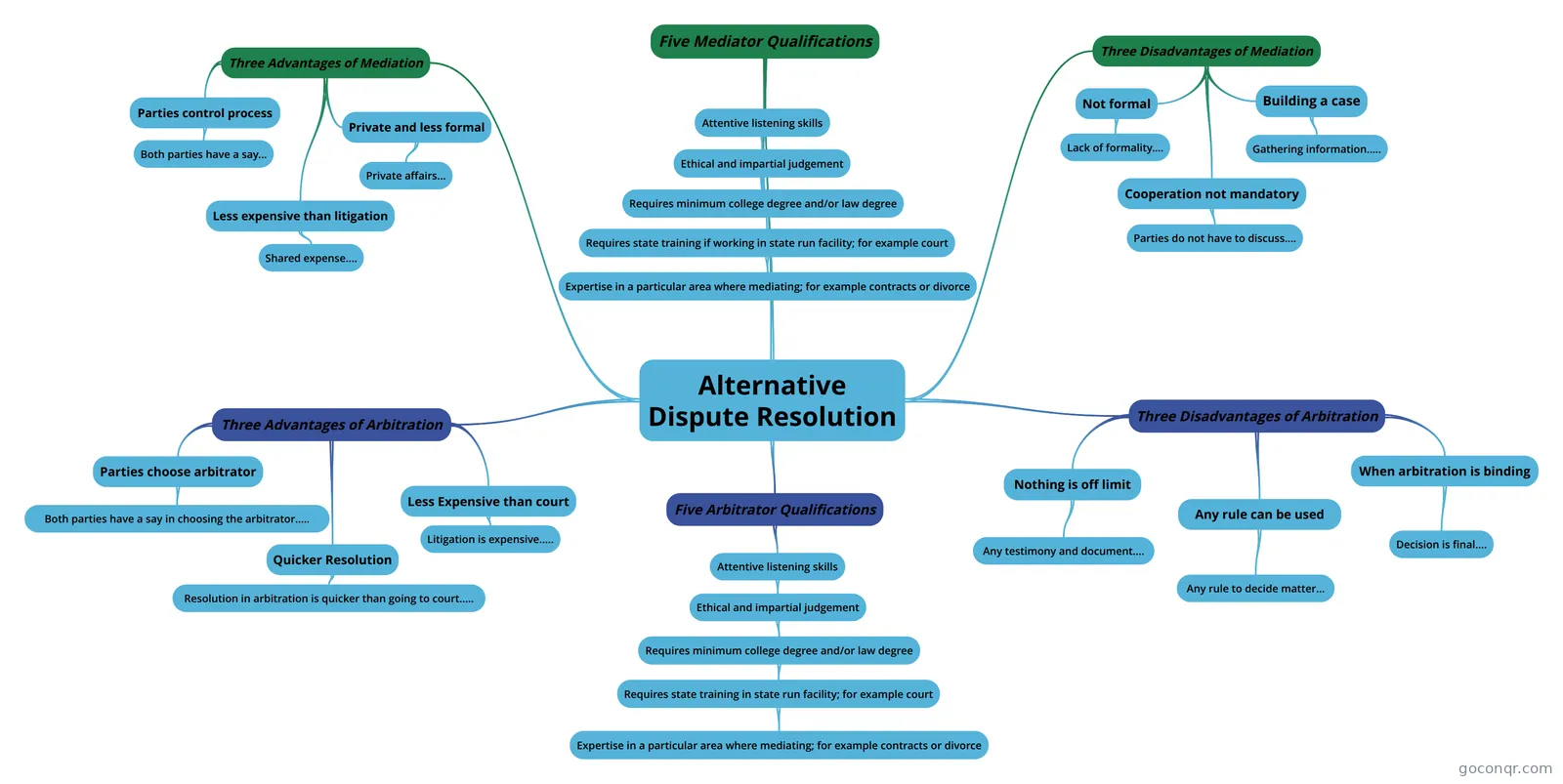
Mind map: Alternative dispute resolution
Inhalt der Mindmap
Alternative Dispute Resolution
Five Mediator Qualifications
- Legal Studies Master’s Degrees. (2017). Retrieved from https://legalstudiesms.com/what-is-legal-studies/ New York State Unified Court System. (n.d.). Retrieved from http://www.nycourts.gov/
- Requires minimum college degree and/or law degree
- Attentive listening skills
- Ethical and impartial judgement
- Requires state training if working in state run facility; for example court
- Expertise in a particular area where mediating; for example contracts or divorce
- Requires state training if working in state run facility; for example court
- Ethical and impartial judgement
- Attentive listening skills
Five Arbitrator Qualifications
- American Arbitration Association. (2019). Retrieved from https://www.adr.org/
- Attentive listening skills
- Ethical and impartial judgement
- Requires minimum college degree and/or law degree
- Requires state training in state run facility; for example court
- Expertise in a particular area where mediating; for example contracts or divorce
- Requires state training in state run facility; for example court
- Requires minimum college degree and/or law degree
- Ethical and impartial judgement
Three Advantages of Arbitration
- Allen, Allen, Allen, & Allen Corporation. (n.d.). Retrieved from https://www.allenandallen.com
- Parties choose arbitrator
- Both parties have a say in choosing the arbitrator.....
- Both parties have a say in choosing the arbitrator. This is important to note because the individual chosen to arbitrate should be familiar with the subject being disputed. An example of this may be choosing a real estate attorney to arbitrate a property dispute.
- Both parties have a say in choosing the arbitrator.....
- Quicker Resolution
- Resolution in arbitration is quicker than going to court.....
- Resolution in arbitration is quicker than going to court. The arbitrator can streamline the process and directly get to the heart of the matter which many times is money. While the arbitrator can suggest resolutions, he or she does have the authority to rule in one party's favor which generally leads to settlements. The arbitrator can also introduce other issues to expedite a settlement.
- Resolution in arbitration is quicker than going to court.....
- Less Expensive than court
- Litigation is expensive.....
- Court costs, such as filing fees, and attorney fees can be expensive. Arbitration is usually one day and can be accomplished without all of the objections lawyers make while in court. Both parties simply present their case which can be by paperwork or verbally.
- Litigation is expensive.....
Three Disadvantages of Arbitration
- Allen, Allen, Allen, & Allen Corporation. (n.d.). Retrieved from https://www.allenandallen.com
- Nothing is off limit
- Any testimony and document....
- An arbitrator can allow any testimony and documents to be shown. Judges have to abide by the rules of evidence. Arbitrators can accept anything that either party provides to court.
- Any testimony and document....
- Any rule can be used
- A judge must follow the law and decide the case as the law allows. An arbitrator can use any standard they believe is fair regardless of the law.
- Any rule to decide matter...
- When arbitration is binding
- Decision is final....
- The decision is final when the arbitration is binding. No appeal is allowed. This is risky as one party may be put in a bad financial situation without any recourse. For example, binding arbitration is becoming popular with credit card companies. When arbitration is not binding, the party seeking appeal must prove there was bias towards the decision made. This can become expensive.
- Decision is final....
Three Advantages of Mediation
- Gary Cash Mediation. (2016). Retrieved from https://garycashmediation.com
- Parties control process
- Both parties have a say...
- Both parties have a say, can negotiate, and reach a mutually agreed upon settlement. Both parties have the choice as to whether or not to cooperate to discuss issues. In a courtroom, the judge decides the issues, what issues are discussed, and the judge must agree to any settlement. In essence, judge controls the process, not the parties. The judge’s control of the process can lead to a drawn-out process whereas with mediation, both parties may speed up the process.
- Both parties have a say...
- Private and less formal
- Private affairs...
- Mediations are private affairs that can be held in an office or a conference room. These sessions are not open to the public and the only individuals in the room are both parties and the mediator. Anyone else can only be present with the permission of both parties. The mediator need not follow any set procedure, unlike a courtroom, and can allow both parties to speak open and freely.
- Private affairs...
- Less expensive than litigation
- Shared expense....
- hen individuals go to court, they incur filing fees, attorney fees, and investigative fees. The parties may also have to pay for expert witnesses depending upon the type of case it is. These expenses are not needed when both parties agree to mediation. The mediation process usually only involves both parties and the mediator. The only cost incurred is the fee of the mediator, which is usually shared evenly between the parties.
- Shared expense....
Three Disadvantages of Mediation
- Disadvantages of Mediation: Everything you need to know. (n.d.). Retrieved from https://www.upcounsel.com/disadvantages-of-mediation
- Cooperation not mandatory
- Parties do not have to discuss....
- The mediator can introduce issues to be discussed, but unless both parties want to discuss the issue(s), nothing will be resolved. In court, a judge may work with one party and make rulings to favor that party. It is not important the other party participate as the judge can make their ruling and move forward. In mediation, nothing gets done unless both parties want to resolve.
- Parties do not have to discuss....
- Not formal
- Lack of formality....
- If all parties are speaking at once, nothing will be accomplished. While the mediator can attempt to control parties, they do not have any power to compel either party to do anything. A judge may hold a party in contempt and fine a party if they do not follow a judge’s ruling.
- Lack of formality....
- Building a case
- Gathering information.....
- A party may agree to mediation just to obtain information about the arguments, strategy, and overall plans of the other party, knowing the intent is to never settle in mediation. Rather, mediation is used to build a case for litigation. In mediation, a party may make statements that would show what their position would be if the parties were in court. This is like playing poker and the other player knows what cards you have.
- Gathering information.....
Informationen
- Beschreibung
- Mindmap am Alternative Dispute Resolution, erstellt von Suzanne Verdi am 06/05/2019.
- Erstellt von
- Suzanne Verdi
- Aufrufe
- 0
- Bewertung
Mehr zu Comparing Mediation, Arbitration and Litigation