
Mindmap
Honors Chemistry
Inhalt der Mindmap
Honors Chemistry
Unit One
- Lesson 2
- Chemistry in Society
- Chemists study matter and its interaction
- Examine how diff. types of matter interact
- Study material see types of matter they are made of (elements
- structure/shape of parts of materials (atoms & molecules
- How material interacts with other forms of matter and under what condition those can occur
- Make new materials or products from various substances through chemical reactions
- How material interacts with other forms of matter and under what condition those can occur
- structure/shape of parts of materials (atoms & molecules
- Study material see types of matter they are made of (elements
- Chlorofluorocarbons- used as coolants in AC, fridges, propellant in spray cans.
- F. Sherwood Rowland= CFC's react with ozone in upper atomosphere= creates a whole in the ozone layer
- Examine how diff. types of matter interact
- Chemists study matter and its interaction
- 5 Specialty Areas
- Inorganic Chem
- Studies compounds that DON'T contain carbon
- 18th century studied nature of matter (mainly non carbon materials
- Described elements, their properties, and what happened when elements reacted with each other
- Antoine Lavoisier: Amount of matter was same before and after a chemical reaction
- Joseph Priestly: discovered Oxygen
- John Dalton: proposed theory that matter is made of atoms. developed early table of elements
- Joseph Priestly: discovered Oxygen
- Antoine Lavoisier: Amount of matter was same before and after a chemical reaction
- Described elements, their properties, and what happened when elements reacted with each other
- 18th century studied nature of matter (mainly non carbon materials
- Studies compounds that DON'T contain carbon
- Organic Chemistry
- Studies compounds that DO contain carbon
- Biochemistry
- Studies compounds within living things
- Friedrich Wohler= made first artificial O compound- Urea-from inorganic sodium cyanate.
- Oil industry developed-- Chemists create new compounds.
- Plastics/fuels from materials from oil, coal, and natural gas
- Used info/techniques of O chemists study carbon compounds in living things. understand reactions in body
- Create medicine, improve health
- Used info/techniques of O chemists study carbon compounds in living things. understand reactions in body
- Plastics/fuels from materials from oil, coal, and natural gas
- Oil industry developed-- Chemists create new compounds.
- Friedrich Wohler= made first artificial O compound- Urea-from inorganic sodium cyanate.
- Studies compounds within living things
- Phyisical Chemistry
- Studies the phyiscs of chemistry
- Includes aspects of energy & its interaction with matter
- Study energies involved in chem reactions (thermodynamics), speed of reactions (kinetics), behavior of gasses, electricity in chem reactions (electrochemistry), reactions of radioactive materials (nuclear chem)
- Josiah Gibbs= studied role of energy in chemical reactions
- Study energies involved in chem reactions (thermodynamics), speed of reactions (kinetics), behavior of gasses, electricity in chem reactions (electrochemistry), reactions of radioactive materials (nuclear chem)
- Includes aspects of energy & its interaction with matter
- Studies the phyiscs of chemistry
- Analytical chemistry
- Studies the physical and chemical properties of matter including composition and structure
- 1912 Fritz Haber created process combined nitrogen from air with hydrogen at higher temp/pressure to make ammonia
- Carl Bosch= created industrial scale to enable large amounts of ammonia cheaply and efficiently
- Used as fertilizer
- Carl Bosch= created industrial scale to enable large amounts of ammonia cheaply and efficiently
- 1912 Fritz Haber created process combined nitrogen from air with hydrogen at higher temp/pressure to make ammonia
- Investigate chemicals in substances, structure, physical/chemical properties
- Drug tests, blood analysis, quality control methods
- Studies the physical and chemical properties of matter including composition and structure
- Inorganic Chem
- Lesson 3
- Matter
- Matter has mass and volume; energy is the ability to cause change
- Energy= something that causes change
- Ex. Thermal energy, light energy, and sound energy
- Diff types of energy
- Mechanical
- radiant or light (electromagnetic)
- sound energy
- electrical
- Chemical
- often defined as the ability to do work
- Energy= something that causes change
- Exists in phases
- Solid
- Definite Shape-occupies definite amount of space or fixed volume
- liquid
- Not have definite shape but occupies fixed volume
- gas
- Expands to any size/shape
- NO FIXED VOLUME
- Expands to any size/shape
- Plasma
- Electrons are not attached to molecules like in gas
- Electrons are free to move
- Makes up sun, lightning, found in neon and fluorescent lights
- Free moving electrons so they can conduct electricity and can be controlled by electric charges.
- Electrons are free to move
- Electrons are not attached to molecules like in gas
- Solid
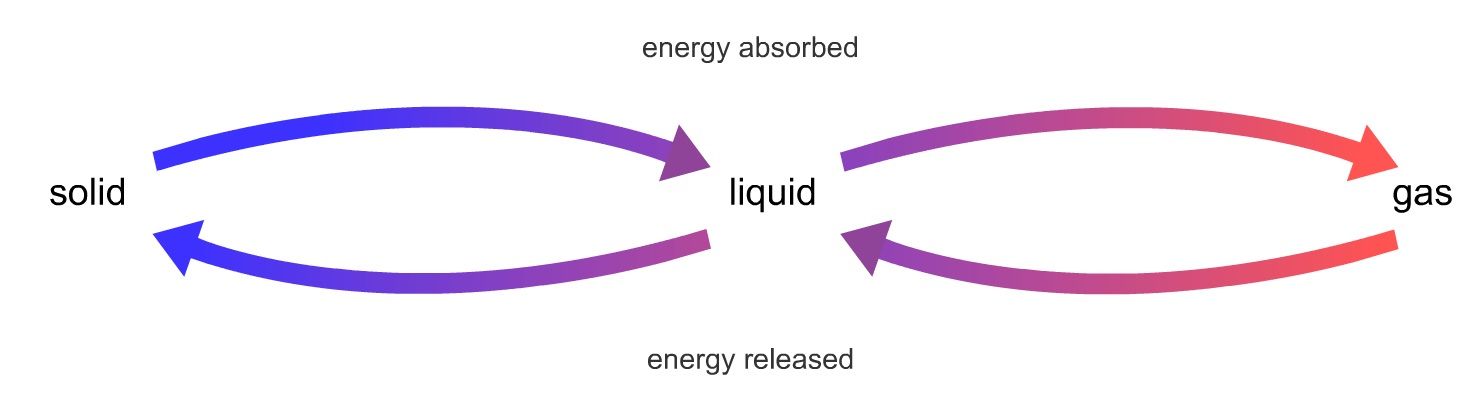
- Matter can change states
- Changes accompanied by energy changes
- State changes involve adding or absorbing energy
- Adding or removing energy changes the movement of molecules and can change the state of matter
- Ice
- water molecules weakly attracted to each other, held in crystalline structure
- the molecules don't have much energy so they only vibrate not move.
- Ice heated= thermal energy=molecules vibrate faster=breaks attractions=ice melts into a liquid
- Liquid heated=molecules move faster=liquid boils=added heat energy= water molecules break free= escape as vapor (gas_
- Ice heated= thermal energy=molecules vibrate faster=breaks attractions=ice melts into a liquid
- the molecules don't have much energy so they only vibrate not move.
- water molecules weakly attracted to each other, held in crystalline structure
- Ice
- Adding or removing energy changes the movement of molecules and can change the state of matter
- State changes involve adding or absorbing energy
- Changes accompanied by energy changes
- Matter has mass and volume; energy is the ability to cause change
- Matter
- Chemistry in Society
- Lesson 2
Bilder und Dateien der Mindmap
Informationen
- Beschreibung
- Mindmap am Honors Chemistry, erstellt von Sonyam am 17/01/2015.
- Erstellt von
- Sonyam
- Aufrufe
- 5
- Bewertung