
Introduction to Chemistry
154 resources created by 150 users
This Introduction to Chemistry page on GoConqr gathers community-made quizzes, mind maps, flashcards and notes, from atomic structure and ionic bonding to key terms, branches of chemistry and the states of matter. It's built for school students revising a topic, university students and professional candidates filling gaps, and teachers after ready-made material. There are over 800 resources here, including more than 120 quizzes, more than 280 mind maps and more than 300 flashcards, spanning secondary and university study. Pick a resource, try a quiz to find your gaps, then make your own.
Top Introduction to Chemistry resources
-
70 cardsAQA Chemistry Unit 2 Draw a sodium Ion
-
94 questionsExam 2 What is the valence shell?
-
50 questionsChemistry Exam 1 Which term best describes the following? There is only one correct answer. Diamond (consisting of only carb...
-
62 cardsChemistry Keywords A list of all junior cert Chemistry keywords.
-
26 cardsKey definitions in GCSE Chemistry What is an atom
-
13 cardsC3 revision flash cards RATE OF REACTION
-
22 cardsKey terms of chemistry Key terms you need to know the terms to be able to answer structured questions.
-
25 cardsIB Chem Flashcards Name for group 1 elements
Quizzes
See all 33 quizzes-
94 questionsExam 2 What is the valence shell?
-
50 questionsChemistry Exam 1 Which term best describes the following? There is only one correct answer. Diamond (consisting of only carb...
-
95 questionsChemistry Unit 1 Which of these activities might involve a chemist?
-
36 questionsChemistry Unit 1,2,3 Test What is chemistry?
-
6 questionsMatter Chemistry : Unit 01 : Q1
-
11 questionsScience Pre Test Saturated solution/soluble/solute/solvent
-
80 questionsHL Chemistry IB Revision Check all reasons why the theoretical yield may not be accurate.
-
20 questionsCEM 141 Final Exam Practice Which of the following statements about scientific theories are false?
Mind maps
See all 39 mind maps-
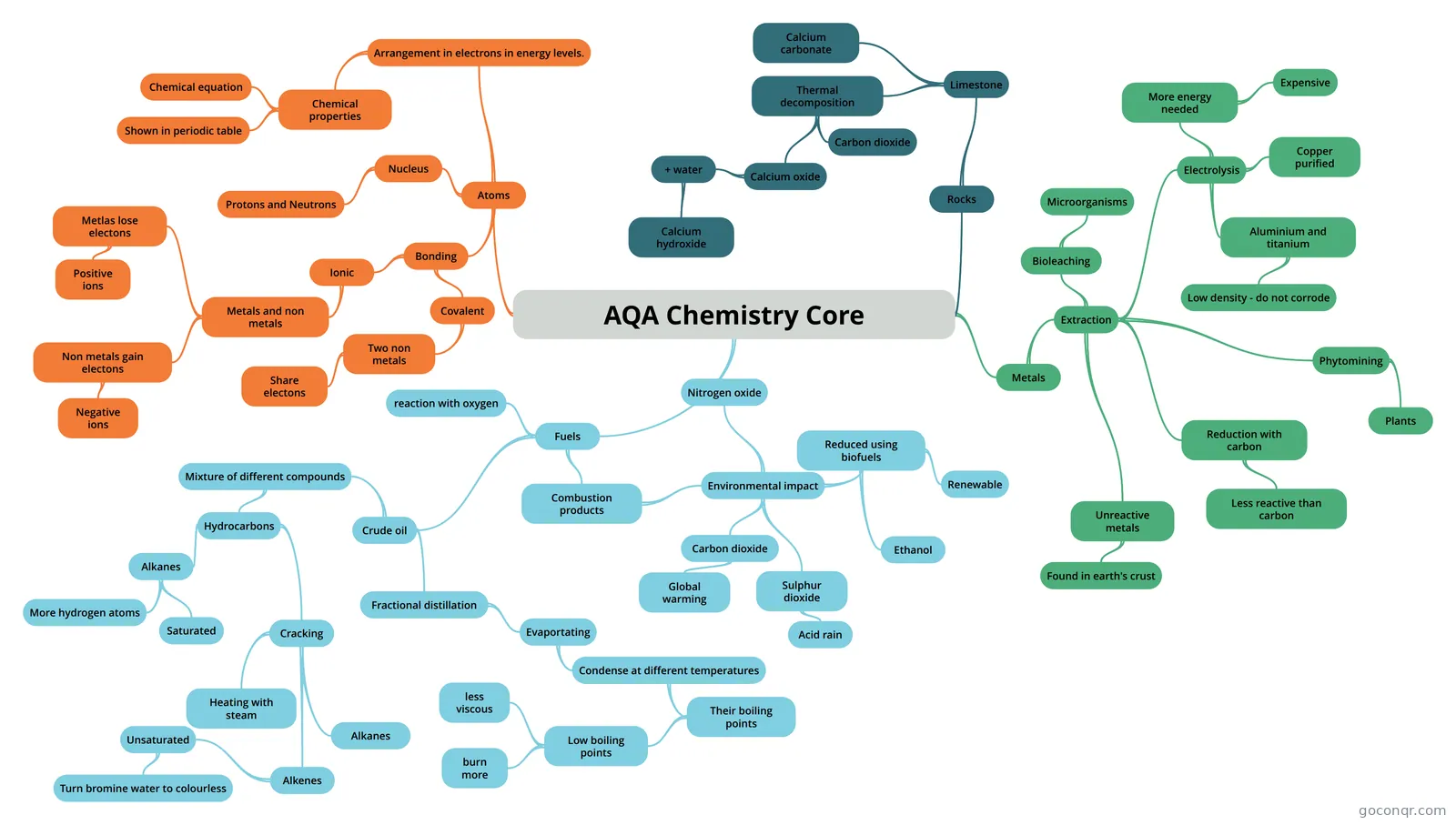 AQA Chemistry Core SCIENCE MINDMAP CHEMISTRY
-
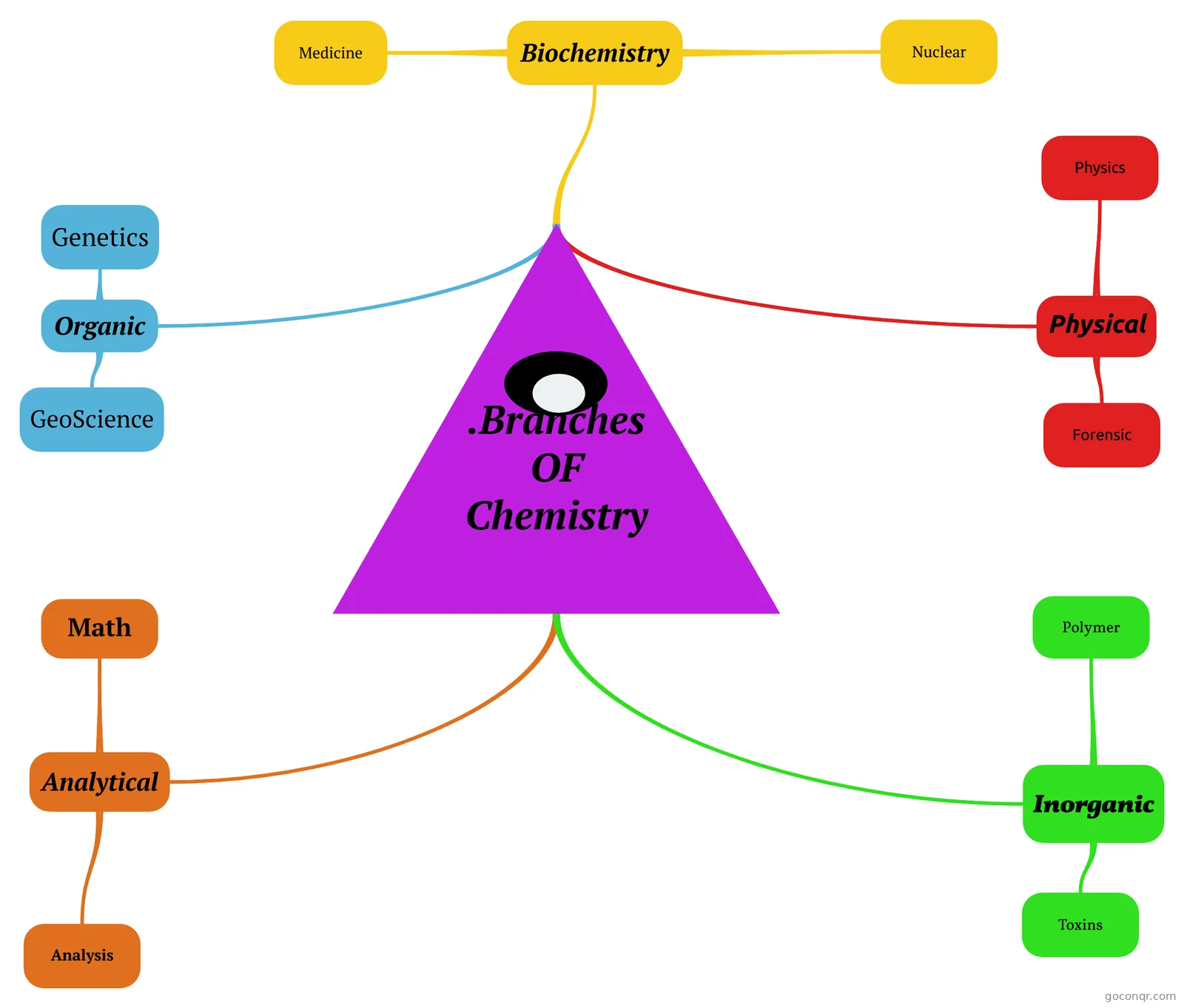 .Branches OF Chemistry I KNOW ...
-
 Topic 1:key concepts in chemistry A mind map on everything in topic 1 edexcel single science chemistry/triple science.
-
Chemistry 10
-
Chemistry C1
-
Chemistry 1 EDEXCEL triple science. Chemistry 1.
-
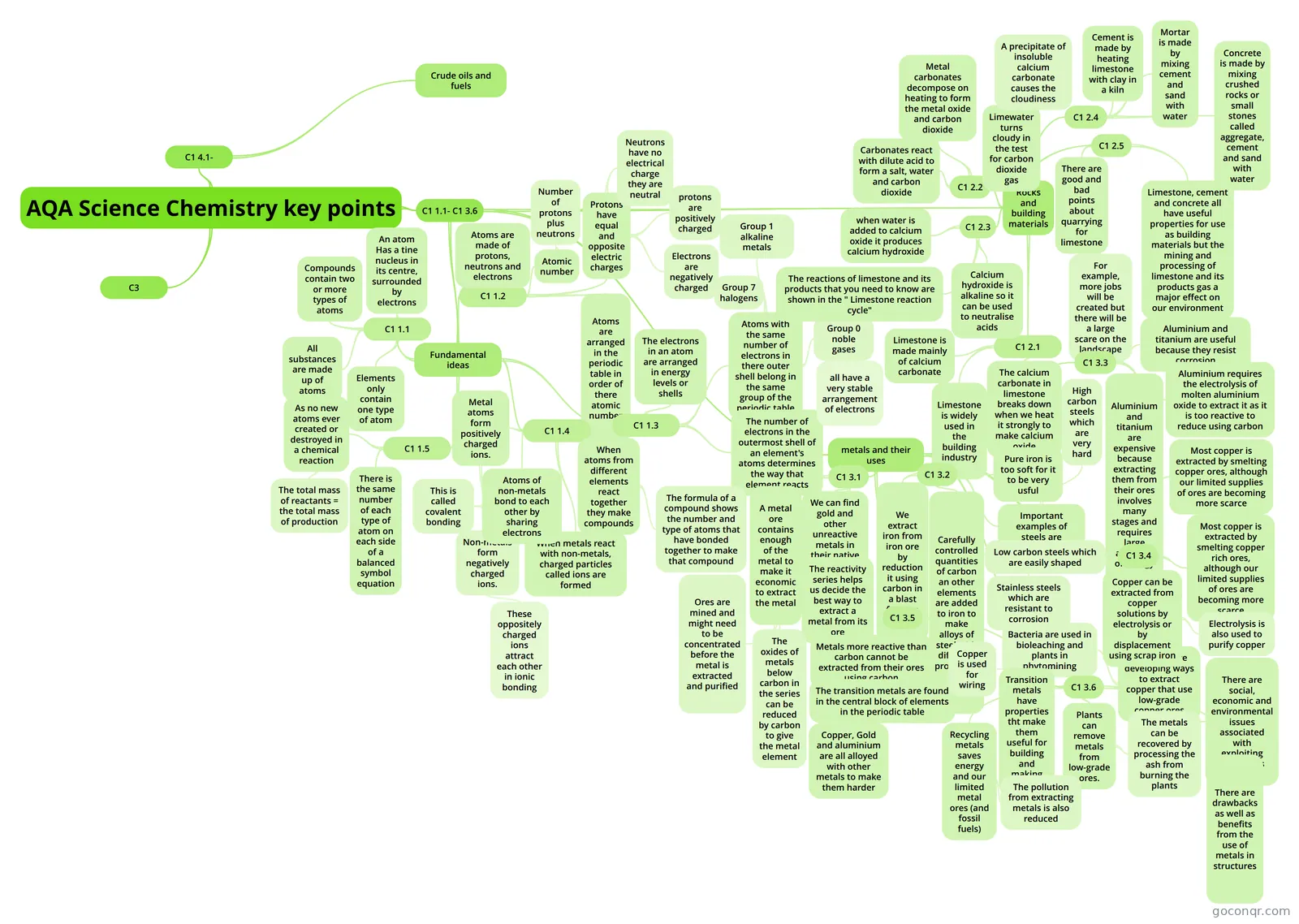 AQA Science Chemistry key points
-
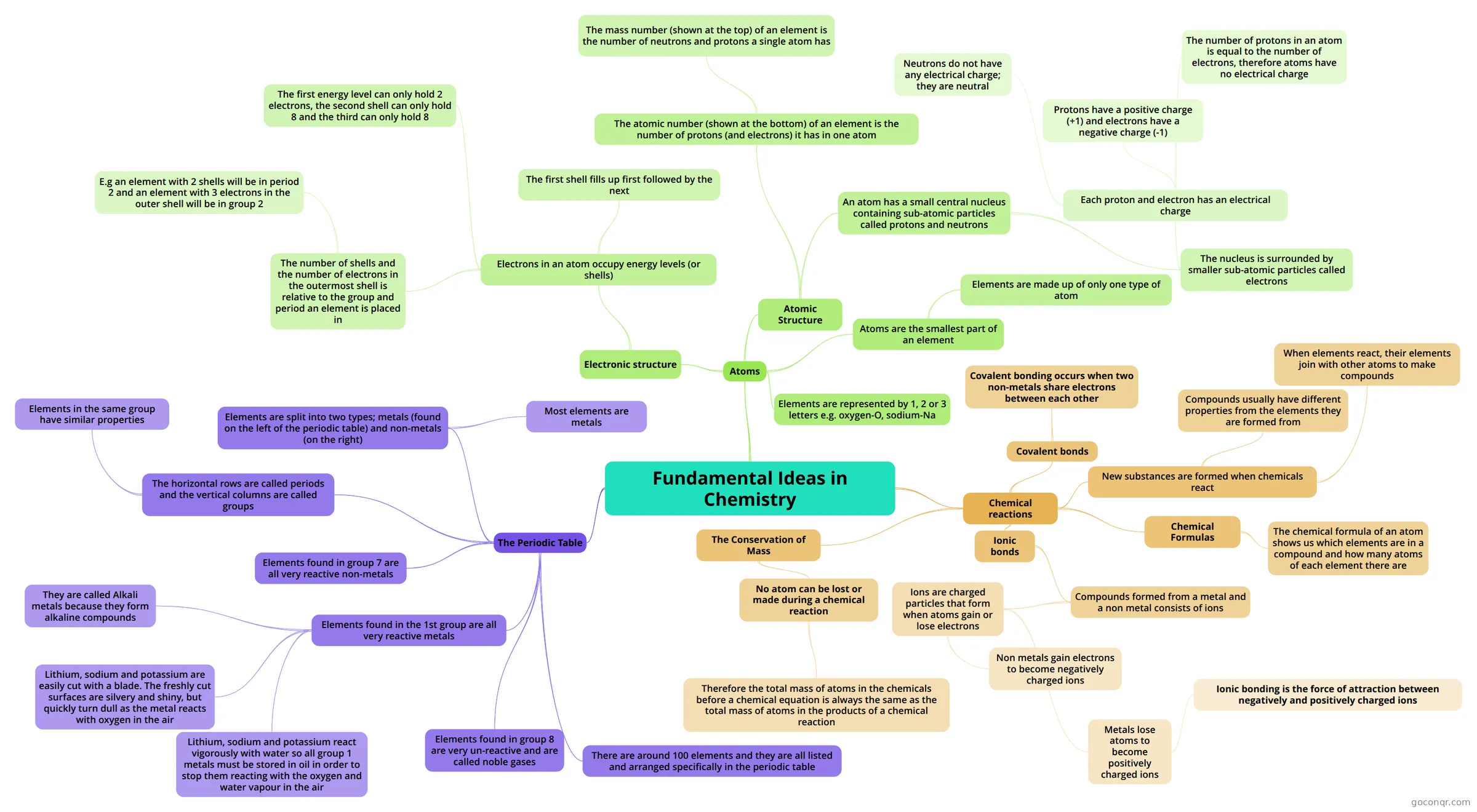 Fundamental Ideas in Chemistry
Flashcards
See all 70 flashcards-
70 cardsAQA Chemistry Unit 2 Draw a sodium Ion
-
62 cardsChemistry Keywords A list of all junior cert Chemistry keywords.
-
26 cardsKey definitions in GCSE Chemistry What is an atom
-
13 cardsC3 revision flash cards RATE OF REACTION
-
22 cardsKey terms of chemistry Key terms you need to know the terms to be able to answer structured questions.
-
25 cardsIB Chem Flashcards Name for group 1 elements
-
8 cardsMCAT Chemistry Study - Atomic Structure
-
5 cards5 branches of chemistry short descriptions of five fields within chemistry
Notes
See all 10 notes-
Chemistry 1A Book Notes Chapter 1 Chemical Foundations Overview of Chemistry Matter is composed of various types of atoms. One substance changes to another by re-organizing the way the atoms are attached to each other. Scientific method: Obs...
-
Chemistry Notes Chemistry: Introduction to Chemistry Pure Science vs. Applied Science pure science = “science” the search for facts about the natural world. In science, we often try to establish a cause-effect relationship. Wha...
-
GCSE core chemistry revision 1 FUNDAMENTAL IDEASATOMS, ELEMENTS AND COMPOUNDS all substances made up of atoms- substances made up of only one type of atom = elements symbols for elements are universal- put on a periodic table elements arranged in t...
-
The Foundations of Chemistry: Matter,Energy, and Measurements Chemistry the study of matter and the changes that matter undergoesMatter anything that has mass and occupies space made of small building blocks called atoms atoms combine to form molecules molecules can be represent...
-
Biochemistry BiochemistryBondsionic bonds-bonds formed between oppositely charged ions; one or more electrons is transferred to another atom covalent bonds- electrons are shared to gain a stable conformationisotope-atoms that have...
-
Chemistry: Chapter 1 - Introduction Chemistry:- Is the science of the composition, structure, properties and reactions of matter, especially of atomic and molecular systems.-Is the science dealing with the compositions of matter and the changes in compo...
-
Chemistry Keywords - Table Format CH-17 Solid liquids and gases Matter - Anything that occupies space and has mass. Evaporation - The changing of a liquid to a gas. Condensation - The changing of a gas back into its liquid state. Diffusion - The movem...
-
Chapter 1: The Study of Change Chemistry - is the study of matter and the changes it undergoes Matter - anything that occupies space and has mass - physical property - can be measure and observed without changing the composition ...
Slides
More Chemistry topics
About Introduction to Chemistry
GoConqr OriginalWhat the unit covers
This unit sits in the Foundations of Chemistry strand of the Chemistry subject. The resources start with the basics: atoms, elements, compounds, mixtures and the language used to describe them. Many are tied to exams the listed resources mention, such as GCSE Chemistry, AQA GCSE Chemistry, AS Chemistry, A-level Chemistry, AP Chemistry and MCAT.
Where to start
Begin with vocabulary. The Key terms of chemistry flashcards cover exothermic changes, physical and chemical properties, diffusion, isotopes and relative atomic mass. Chemistry Keywords adds matter, solids, liquids, gases, solute, solvent and solubility. If you are on a GCSE course, Key definitions in GCSE Chemistry asks what an atom is, what atomic number and mass number mean, and how an atom differs from an ion.
Moving on to bonding and structure
Next, try the AQA Chemistry Unit 2 flashcards. They ask you to draw a sodium ion and a water molecule, and to explain how ions form and what ionic compounds are. The AQA Chemistry Core mind map links protons, neutrons, the nucleus, electron arrangement and positive and negative ions. For university-level or MCAT-style work, the MCAT Chemistry Study - Atomic Structure deck covers electronegativity, the Pauli exclusion principle, the Aufbau principle and ionisation energy.
Using quizzes and maps together
- Read a mind map first to see how the ideas connect.
- Take a quiz such as Exam 2, which asks about the valence shell, ionic bonding and electronegativity.
- Note the questions you missed and go back to the matching flashcards.
- Retake the quiz a few days later.
For a wider check, MCAT Chemistry Practice Test and Chemistry Final Practice Test give longer practice.
Make it your own
Teachers can pick a ready-made deck or quiz for a class. Everyone can open these resources free, so choose one that matches your course and make a start. If a topic is missing, you can build your own set.
Frequently asked questions
Which resource should I open first?
Start with Key terms of chemistry or Chemistry Keywords. Both are flashcard decks that cover the core vocabulary, including elements, isotopes, matter, solutions and changes of state. Once the terms feel familiar, move to a mind map such as AQA Chemistry Core and then test yourself with a quiz.
What do the mind maps cover?
The mind maps range from broad overviews to specific topics. AQA Chemistry Core links protons, neutrons, the nucleus, electron arrangement and ions. Others include Elements, Compounds and Mixtures, Acids and Bases, and Atoms and Reactions. There are more than 280 mind maps on the page, so you can compare several.
Which exams and levels do these resources suit?
Most resources are secondary level, with a good share at university level. Listed resources mention GCSE Chemistry, AQA GCSE Chemistry, AS Chemistry, A-level Chemistry, AP Chemistry and MCAT. School students, university students, professional candidates and teachers can all find something to use.
Are the resources free to use?
Yes. Every resource on this page is free to open, study and take, with no account needed. They were made by GoConqr users, not by GoConqr itself. A free account also saves your quiz scores and lets you make your own quizzes, mind maps, flashcards and notes.
Which quizzes test the basics of bonding and atoms?
Exam 2 is a good choice, with questions on the valence shell, ionic bonding, valence electrons in bromine and the source of electronegativity. Matter and Branches of Chemistry are also quizzes on this page if you want to check the opening ideas first.
What if I cannot find my exam board or topic?
Browse by format. Flashcards, notes, slide sets and mind maps all appear here, and titles often name a board or course. If nothing matches closely, a nearby deck on definitions or key ideas still helps, and you can make your own set for the gap.