
Mindmap
P1- Waves/2
Inhalt der Mindmap
P1- Waves/2
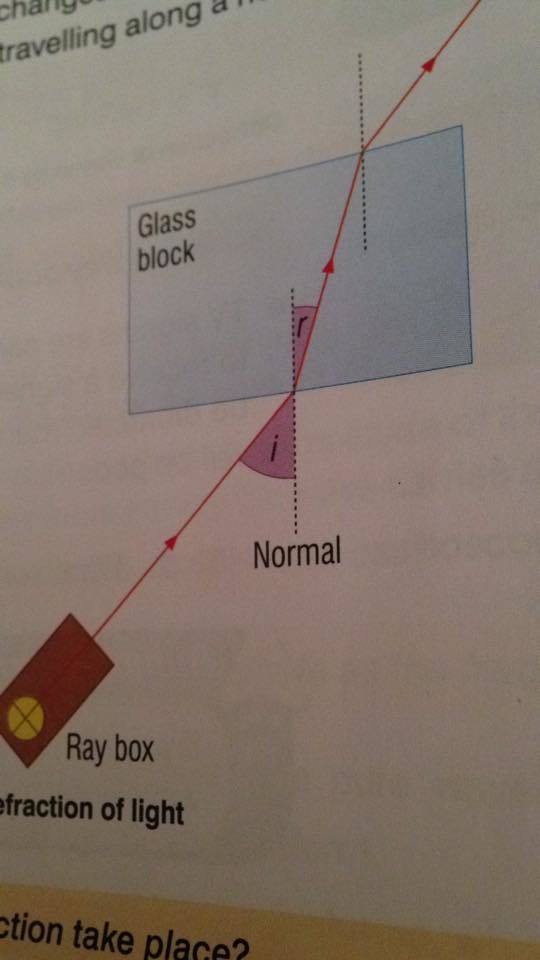
WAVE PROPERTIES: REFRACTION
- Waves change speed when they cross a boundary between different substances. The wavelength of the waves also changes, but the frequency stays the same.
- Refraction is a property of all waves, including light and sound. Eg a light ray refracts when it crosses a boundary between two substances such as air and glass, or air and water.
- The change in speed of the waves causes a change in direction.
- When light enters a dense substance, such as going from air to glass, it slows down and the ray changes direction towards the normal. However if the wave was travelling along a normal, then it will not change direction.
- Different colours of light have different wavelengths and are refracted by slightly different amounts. When a ray of white light is shone onto a triangular glass prism we can see this because a spectrum is produced. This is called a dispersion.
- Violet light is refracted the most.
- Red light is refracted the least.
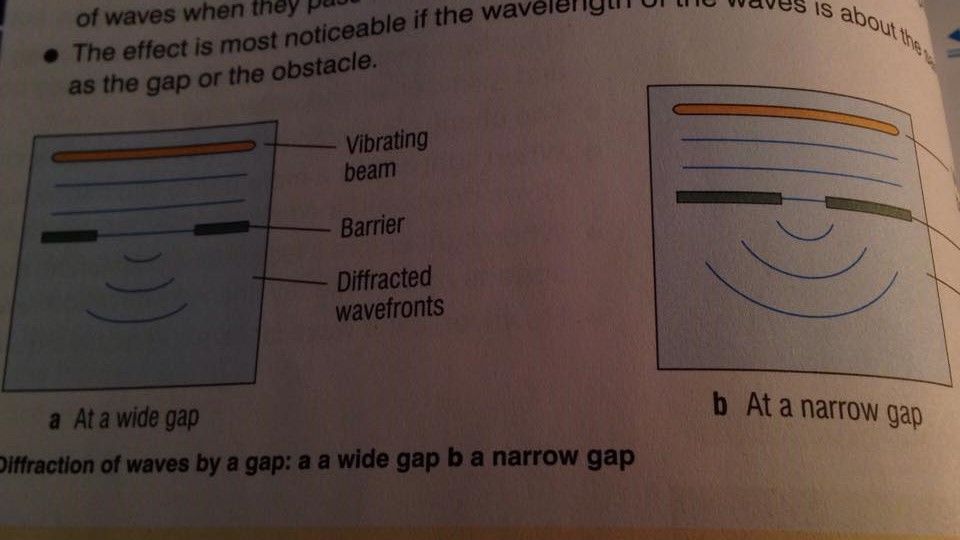
WAVE PROPERTIES: DIFFRACTION
- Diffraction is a property of all waves, including light and sound. It is the spreading of waves when they pass through a gap or round an obstacle.
- The effect is most noticeable if the wavelength of the waves is about the same size gap or the obstacle.
- TV signals are carried by radio waves. People living in hilly areas may not be able to receive a signal because it is blocked by a hill. Radio waves passing the hill will be diffracted round the hill. If they do not diffract enough, the radio and TV signal will be poor.
SOUND
- Sound is caused by mechanical vibrations in a substance, and travels as a wave.
- It can travel through liquids, solids and gases. Sound waves generally travel fastest in solids and slowest in gases.
- They can not travel through a vacuum.
- Sound waves are longitudinal waves. The direction of the vibrations is the same as the direction in which the wave travels.
- The range of frequencies that can be heard by the human ear is from 20Hz to 20,000Hz. The ability to hear the higher frequencies declines with age.
- Sound waves can be refracted to produce echoes. Only hard, flat surfaces such as flat walls and floors refract sound. Soft things like carpets absorb sounds. An empty room will sound different once carpets, curtains and furniture are put into in.
- Sound waves can be refracted from. Refraction takes place at the boundaries between layers of air at different temperatures. Sound waves can also be diffracted.
MUSICAL SOUNDS
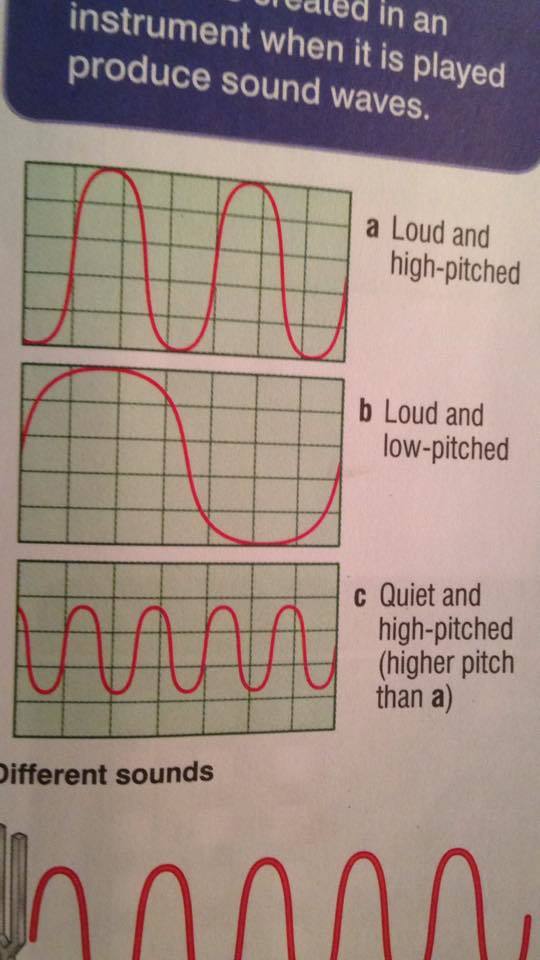
- The PITCH of a note depends on the frequency of the sound waves. The higher the frequency of the wave, the higher the pitch of the sound.
- The loudness of a sound depends on the amplitude of the sound waves. The greater the amplitude the more energy the wave carries and the louder the sound.
- Differences in waveform can be shown on a oscilloscope.
Bilder und Dateien der Mindmap
Informationen
- Beschreibung
- Mindmap am P1- Waves/2, erstellt von Olivia Wragg am 01/02/2015.
- Erstellt von
- Olivia Wragg
- Aufrufe
- 0
- Bewertung