
Mindmap
Functions of a Political Party
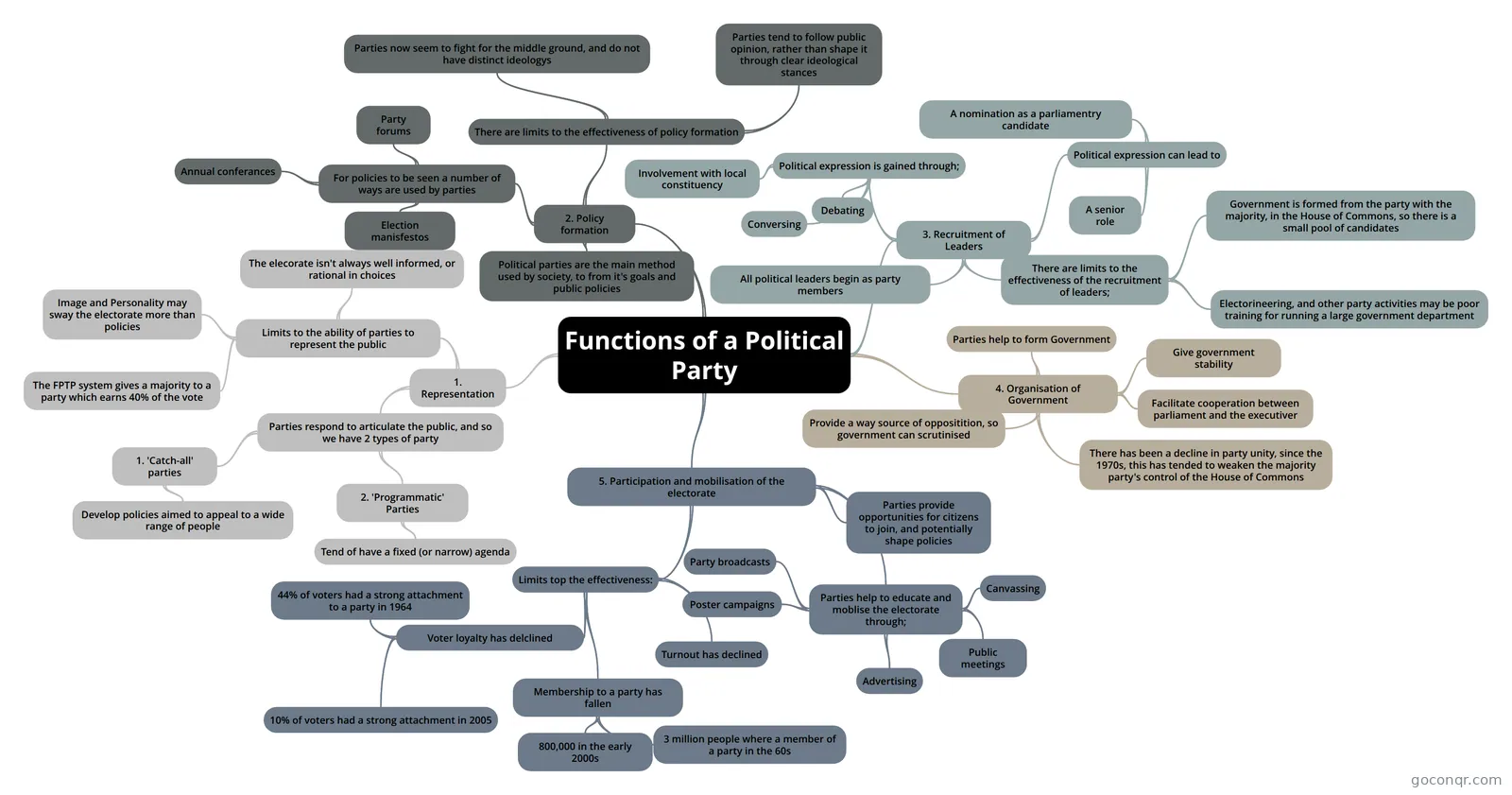
Mind map: functions of a political party
Inhalt der Mindmap
Functions of a Political Party
1. Representation
- Parties respond to articulate the public, and so we have 2 types of party
- 1. 'Catch-all' parties
- Develop policies aimed to appeal to a wide range of people
- 2. 'Programmatic' Parties
- Tend of have a fixed (or narrow) agenda
- 1. 'Catch-all' parties
- Limits to the ability of parties to represent the public
- The elecorate isn't always well informed, or rational in choices
- Image and Personality may sway the electorate more than policies
- The FPTP system gives a majority to a party which earns 40% of the vote
- Parties respond to articulate the public, and so we have 2 types of party
2. Policy formation
- Political parties are the main method used by society, to from it's goals and public policies
- For policies to be seen a number of ways are used by parties
- Party forums
- Annual conferances
- Election manisfestos
- There are limits to the effectiveness of policy formation
- Parties now seem to fight for the middle ground, and do not have distinct ideologys
- Parties tend to follow public opinion, rather than shape it through clear ideological stances
3. Recruitment of Leaders
- All political leaders begin as party members
- Political expression is gained through;
- Conversing
- Debating
- Involvement with local constituency
- Political expression can lead to
- A nomination as a parliamentry candidate
- A senior role
- There are limits to the effectiveness of the recruitment of leaders;
- Government is formed from the party with the majority, in the House of Commons, so there is a small pool of candidates
- Electorineering, and other party activities may be poor training for running a large government department
4. Organisation of Government
- Parties help to form Government
- Give government stability
- Facilitate cooperation between parliament and the executiver
- Provide a way source of oppositition, so government can scrutinised
- There has been a decline in party unity, since the 1970s, this has tended to weaken the majority party's control of the House of Commons
5. Participation and mobilisation of the electorate
- Parties provide opportunities for citizens to join, and potentially shape policies
- Parties help to educate and moblise the electorate through;
- Canvassing
- Public meetings
- Advertising
- Poster campaigns
- Party broadcasts
- Limits top the effectiveness:
- Voter loyalty has delclined
- 44% of voters had a strong attachment to a party in 1964
- 10% of voters had a strong attachment in 2005
- Turnout has declined
- Membership to a party has fallen
- 3 million people where a member of a party in the 60s
- 800,000 in the early 2000s
- Voter loyalty has delclined
Informationen
- Beschreibung
- Functions of a political party
- Erstellt von
- Phoebe Fletcher
- Aufrufe
- 547
- Tags
- Bewertung