
Mindmap
imperatives
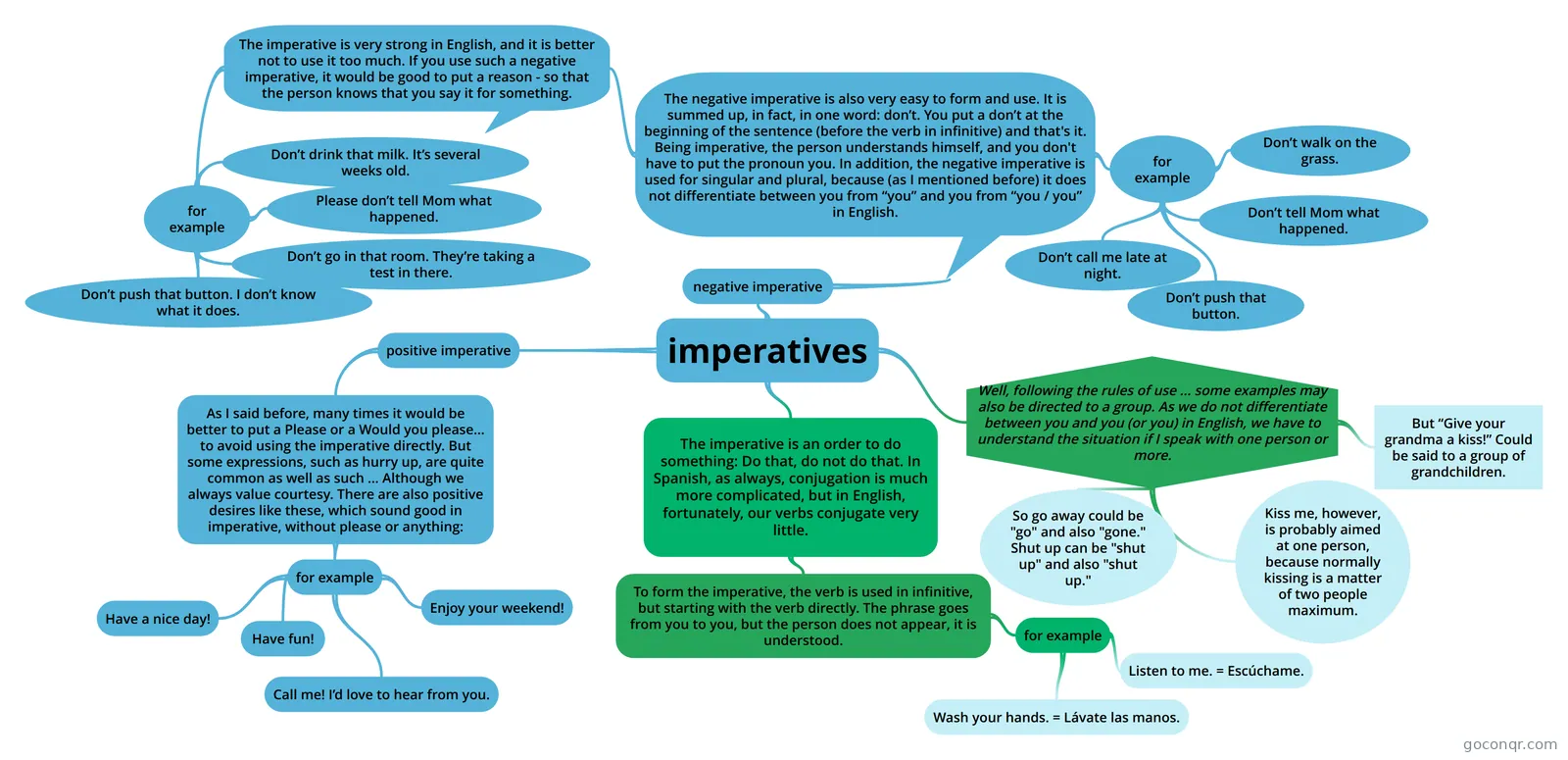
Mind map: imperatives
Inhalt der Mindmap
imperatives
The imperative is an order to do something: Do that, do not do that. In Spanish, as always, conjugation is much more complicated, but in English, fortunately, our verbs conjugate very little.
- To form the imperative, the verb is used in infinitive, but starting with the verb directly. The phrase goes from you to you, but the person does not appear, it is understood.
- for example
- Wash your hands. = Lávate las manos.
- Listen to me. = Escúchame.
- for example
- To form the imperative, the verb is used in infinitive, but starting with the verb directly. The phrase goes from you to you, but the person does not appear, it is understood.
Well, following the rules of use ... some examples may also be directed to a group. As we do not differentiate between you and you (or you) in English, we have to understand the situation if I speak with one person or more.
- So go away could be "go" and also "gone." Shut up can be "shut up" and also "shut up."
- Kiss me, however, is probably aimed at one person, because normally kissing is a matter of two people maximum.
- But “Give your grandma a kiss!” Could be said to a group of grandchildren.
positive imperative
- As I said before, many times it would be better to put a Please or a Would you please… to avoid using the imperative directly. But some expressions, such as hurry up, are quite common as well as such ... Although we always value courtesy. There are also positive desires like these, which sound good in imperative, without please or anything:
- for example
- Enjoy your weekend!
- Have a nice day!
- Have fun!
- Call me! I’d love to hear from you.
- for example
- As I said before, many times it would be better to put a Please or a Would you please… to avoid using the imperative directly. But some expressions, such as hurry up, are quite common as well as such ... Although we always value courtesy. There are also positive desires like these, which sound good in imperative, without please or anything:
negative imperative
- The negative imperative is also very easy to form and use. It is summed up, in fact, in one word: don’t. You put a don’t at the beginning of the sentence (before the verb in infinitive) and that's it. Being imperative, the person understands himself, and you don't have to put the pronoun you. In addition, the negative imperative is used for singular and plural, because (as I mentioned before) it does not differentiate between you from “you” and you from “you / you” in English.
- for example
- Don’t call me late at night.
- Don’t push that button.
- Don’t tell Mom what happened.
- Don’t walk on the grass.
- The imperative is very strong in English, and it is better not to use it too much. If you use such a negative imperative, it would be good to put a reason - so that the person knows that you say it for something.
- for example
- Don’t drink that milk. It’s several weeks old.
- Don’t push that button. I don’t know what it does.
- Don’t go in that room. They’re taking a test in there.
- Please don’t tell Mom what happened.
- for example
- for example
- The negative imperative is also very easy to form and use. It is summed up, in fact, in one word: don’t. You put a don’t at the beginning of the sentence (before the verb in infinitive) and that's it. Being imperative, the person understands himself, and you don't have to put the pronoun you. In addition, the negative imperative is used for singular and plural, because (as I mentioned before) it does not differentiate between you from “you” and you from “you / you” in English.
Informationen
- Beschreibung
- Mindmap am imperatives, erstellt von Oscar Cataño am 30/09/2019.
- Erstellt von
- Oscar Cataño
- Aufrufe
- 1
- Bewertung