
Mindmap
CH15-Motivating Employees
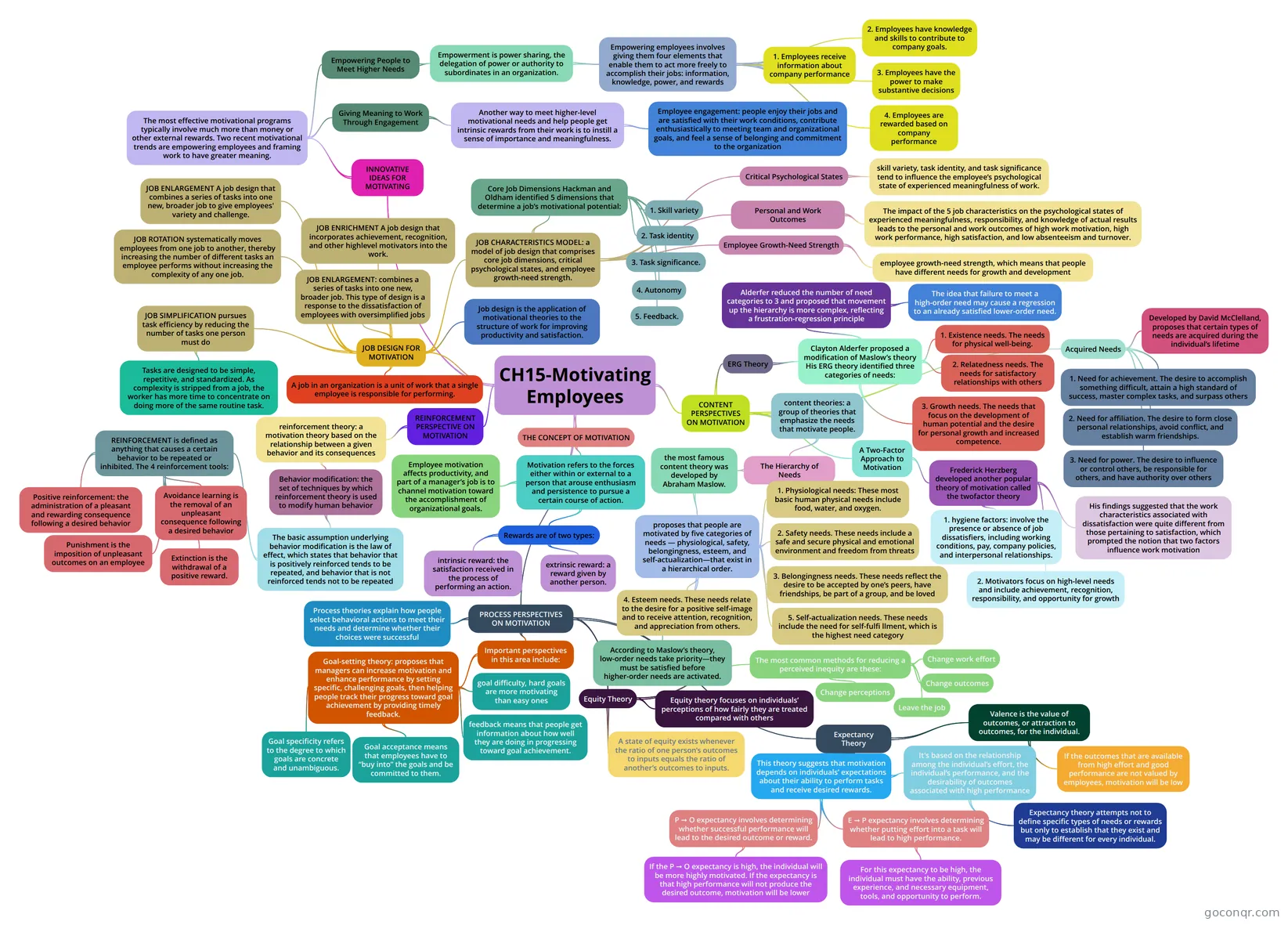
Mind map: Motivating employees
Inhalt der Mindmap
CH15-Motivating Employees
THE CONCEPT OF MOTIVATION
- Motivation refers to the forces either within or external to a person that arouse enthusiasm and persistence to pursue a certain course of action.
- Employee motivation affects productivity, and part of a manager’s job is to channel motivation toward the accomplishment of organizational goals.
- Rewards are of two types:
- intrinsic reward: the satisfaction received in the process of performing an action.
- extrinsic reward: a reward given by another person.
- Motivation refers to the forces either within or external to a person that arouse enthusiasm and persistence to pursue a certain course of action.
CONTENT PERSPECTIVES ON MOTIVATION
- content theories: a group of theories that emphasize the needs that motivate people.
- The Hierarchy of Needs
- the most famous content theory was developed by Abraham Maslow.
- proposes that people are motivated by five categories of needs — physiological, safety, belongingness, esteem, and self-actualization—that exist in a hierarchical order.
- 1. Physiological needs: These most basic human physical needs include food, water, and oxygen.
- 2. Safety needs. These needs include a safe and secure physical and emotional environment and freedom from threats
- 3. Belongingness needs. These needs reflect the desire to be accepted by one’s peers, have friendships, be part of a group, and be loved
- 4. Esteem needs. These needs relate to the desire for a positive self-image and to receive attention, recognition, and appreciation from others.
- 5. Self-actualization needs. These needs include the need for self-fulfi llment, which is the highest need category
- According to Maslow’s theory, low-order needs take priority—they must be satisfied before higher-order needs are activated.
- proposes that people are motivated by five categories of needs — physiological, safety, belongingness, esteem, and self-actualization—that exist in a hierarchical order.
- the most famous content theory was developed by Abraham Maslow.
- The Hierarchy of Needs
- ERG Theory
- Clayton Alderfer proposed a modification of Maslow’s theory His ERG theory identified three categories of needs:
- 1. Existence needs. The needs for physical well-being.
- 2. Relatedness needs. The needs for satisfactory relationships with others
- 3. Growth needs. The needs that focus on the development of human potential and the desire for personal growth and increased competence.
- Alderfer reduced the number of need categories to 3 and proposed that movement up the hierarchy is more complex, reflecting a frustration-regression principle
- The idea that failure to meet a high-order need may cause a regression to an already satisfied lower-order need.
- Clayton Alderfer proposed a modification of Maslow’s theory His ERG theory identified three categories of needs:
- A Two-Factor Approach to Motivation
- Frederick Herzberg developed another popular theory of motivation called the twofactor theory
- His findings suggested that the work characteristics associated with dissatisfaction were quite different from those pertaining to satisfaction, which prompted the notion that two factors influence work motivation
- 1. hygiene factors: involve the presence or absence of job dissatisfiers, including working conditions, pay, company policies, and interpersonal relationships.
- 2. Motivators focus on high-level needs and include achievement, recognition, responsibility, and opportunity for growth
- Frederick Herzberg developed another popular theory of motivation called the twofactor theory
- Acquired Needs
- Developed by David McClelland, proposes that certain types of needs are acquired during the individual’s lifetime
- 1. Need for achievement. The desire to accomplish something difficult, attain a high standard of success, master complex tasks, and surpass others
- 2. Need for affiliation. The desire to form close personal relationships, avoid conflict, and establish warm friendships.
- 3. Need for power. The desire to influence or control others, be responsible for others, and have authority over others
- content theories: a group of theories that emphasize the needs that motivate people.
PROCESS PERSPECTIVES ON MOTIVATION
- Process theories explain how people select behavioral actions to meet their needs and determine whether their choices were successful
- Important perspectives in this area include:
- Goal-setting theory: proposes that managers can increase motivation and enhance performance by setting specific, challenging goals, then helping people track their progress toward goal achievement by providing timely feedback.
- Goal specificity refers to the degree to which goals are concrete and unambiguous.
- goal difficulty, hard goals are more motivating than easy ones
- Goal acceptance means that employees have to “buy into” the goals and be committed to them.
- feedback means that people get information about how well they are doing in progressing toward goal achievement.
- Goal-setting theory: proposes that managers can increase motivation and enhance performance by setting specific, challenging goals, then helping people track their progress toward goal achievement by providing timely feedback.
- Equity Theory
- Equity theory focuses on individuals’ perceptions of how fairly they are treated compared with others
- A state of equity exists whenever the ratio of one person’s outcomes to inputs equals the ratio of another’s outcomes to inputs.
- The most common methods for reducing a perceived inequity are these:
- Change work effort
- Change outcomes
- Change perceptions
- Leave the job
- Expectancy Theory
- This theory suggests that motivation depends on individuals’ expectations about their ability to perform tasks and receive desired rewards.
- It's based on the relationship among the individual’s effort, the individual’s performance, and the desirability of outcomes associated with high performance
- Expectancy theory attempts not to define specific types of needs or rewards but only to establish that they exist and may be different for every individual.
- E ➞ P expectancy involves determining whether putting effort into a task will lead to high performance.
- For this expectancy to be high, the individual must have the ability, previous experience, and necessary equipment, tools, and opportunity to perform.
- P ➞ O expectancy involves determining whether successful performance will lead to the desired outcome or reward.
- If the P ➞ O expectancy is high, the individual will be more highly motivated. If the expectancy is that high performance will not produce the desired outcome, motivation will be lower
- It's based on the relationship among the individual’s effort, the individual’s performance, and the desirability of outcomes associated with high performance
- Valence is the value of outcomes, or attraction to outcomes, for the individual.
- If the outcomes that are available from high effort and good performance are not valued by employees, motivation will be low
- This theory suggests that motivation depends on individuals’ expectations about their ability to perform tasks and receive desired rewards.
REINFORCEMENT PERSPECTIVE ON MOTIVATION
- reinforcement theory: a motivation theory based on the relationship between a given behavior and its consequences
- Behavior modification: the set of techniques by which reinforcement theory is used to modify human behavior
- The basic assumption underlying behavior modification is the law of effect, which states that behavior that is positively reinforced tends to be repeated, and behavior that is not reinforced tends not to be repeated
- REINFORCEMENT is defined as anything that causes a certain behavior to be repeated or inhibited. The 4 reinforcement tools:
- Positive reinforcement: the administration of a pleasant and rewarding consequence following a desired behavior
- Avoidance learning is the removal of an unpleasant consequence following a desired behavior
- Punishment is the imposition of unpleasant outcomes on an employee
- Extinction is the withdrawal of a positive reward.
- REINFORCEMENT is defined as anything that causes a certain behavior to be repeated or inhibited. The 4 reinforcement tools:
- The basic assumption underlying behavior modification is the law of effect, which states that behavior that is positively reinforced tends to be repeated, and behavior that is not reinforced tends not to be repeated
- Behavior modification: the set of techniques by which reinforcement theory is used to modify human behavior
- reinforcement theory: a motivation theory based on the relationship between a given behavior and its consequences
JOB DESIGN FOR MOTIVATION
- A job in an organization is a unit of work that a single employee is responsible for performing.
- Job design is the application of motivational theories to the structure of work for improving productivity and satisfaction.
- JOB SIMPLIFICATION pursues task efficiency by reducing the number of tasks one person must do
- Tasks are designed to be simple, repetitive, and standardized. As complexity is stripped from a job, the worker has more time to concentrate on doing more of the same routine task.
- JOB ROTATION systematically moves employees from one job to another, thereby increasing the number of different tasks an employee performs without increasing the complexity of any one job.
- JOB ENLARGEMENT: combines a series of tasks into one new, broader job. This type of design is a response to the dissatisfaction of employees with oversimplified jobs
- JOB ENLARGEMENT A job design that combines a series of tasks into one new, broader job to give employees' variety and challenge.
- JOB ENRICHMENT A job design that incorporates achievement, recognition, and other highlevel motivators into the work.
- JOB CHARACTERISTICS MODEL: a model of job design that comprises core job dimensions, critical psychological states, and employee growth-need strength.
- Core Job Dimensions Hackman and Oldham identified 5 dimensions that determine a job’s motivational potential:
- 1. Skill variety
- 2. Task identity
- 3. Task significance.
- 4. Autonomy
- 5. Feedback.
- Critical Psychological States
- skill variety, task identity, and task significance tend to influence the employee’s psychological state of experienced meaningfulness of work.
- Personal and Work Outcomes
- The impact of the 5 job characteristics on the psychological states of experienced meaningfulness, responsibility, and knowledge of actual results leads to the personal and work outcomes of high work motivation, high work performance, high satisfaction, and low absenteeism and turnover.
- Employee Growth-Need Strength
- employee growth-need strength, which means that people have different needs for growth and development
- Core Job Dimensions Hackman and Oldham identified 5 dimensions that determine a job’s motivational potential:
INNOVATIVE IDEAS FOR MOTIVATING
- The most effective motivational programs typically involve much more than money or other external rewards. Two recent motivational trends are empowering employees and framing work to have greater meaning.
- Empowering People to Meet Higher Needs
- Empowerment is power sharing, the delegation of power or authority to subordinates in an organization.
- Empowering employees involves giving them four elements that enable them to act more freely to accomplish their jobs: information, knowledge, power, and rewards
- 1. Employees receive information about company performance
- 2. Employees have knowledge and skills to contribute to company goals.
- 3. Employees have the power to make substantive decisions
- 4. Employees are rewarded based on company performance
- Empowering employees involves giving them four elements that enable them to act more freely to accomplish their jobs: information, knowledge, power, and rewards
- Empowerment is power sharing, the delegation of power or authority to subordinates in an organization.
- Giving Meaning to Work Through Engagement
- Another way to meet higher-level motivational needs and help people get intrinsic rewards from their work is to instill a sense of importance and meaningfulness.
- Employee engagement: people enjoy their jobs and are satisfied with their work conditions, contribute enthusiastically to meeting team and organizational goals, and feel a sense of belonging and commitment to the organization
- Another way to meet higher-level motivational needs and help people get intrinsic rewards from their work is to instill a sense of importance and meaningfulness.
- Empowering People to Meet Higher Needs
- The most effective motivational programs typically involve much more than money or other external rewards. Two recent motivational trends are empowering employees and framing work to have greater meaning.
Informationen
- Beschreibung
- Mindmap am CH15-Motivating Employees, erstellt von Mariana Alanis am 05/10/2019.
- Erstellt von
- Mariana Alanis
- Aufrufe
- 0
- Bewertung