
Mindmap
SEXUAL SELECTION 2
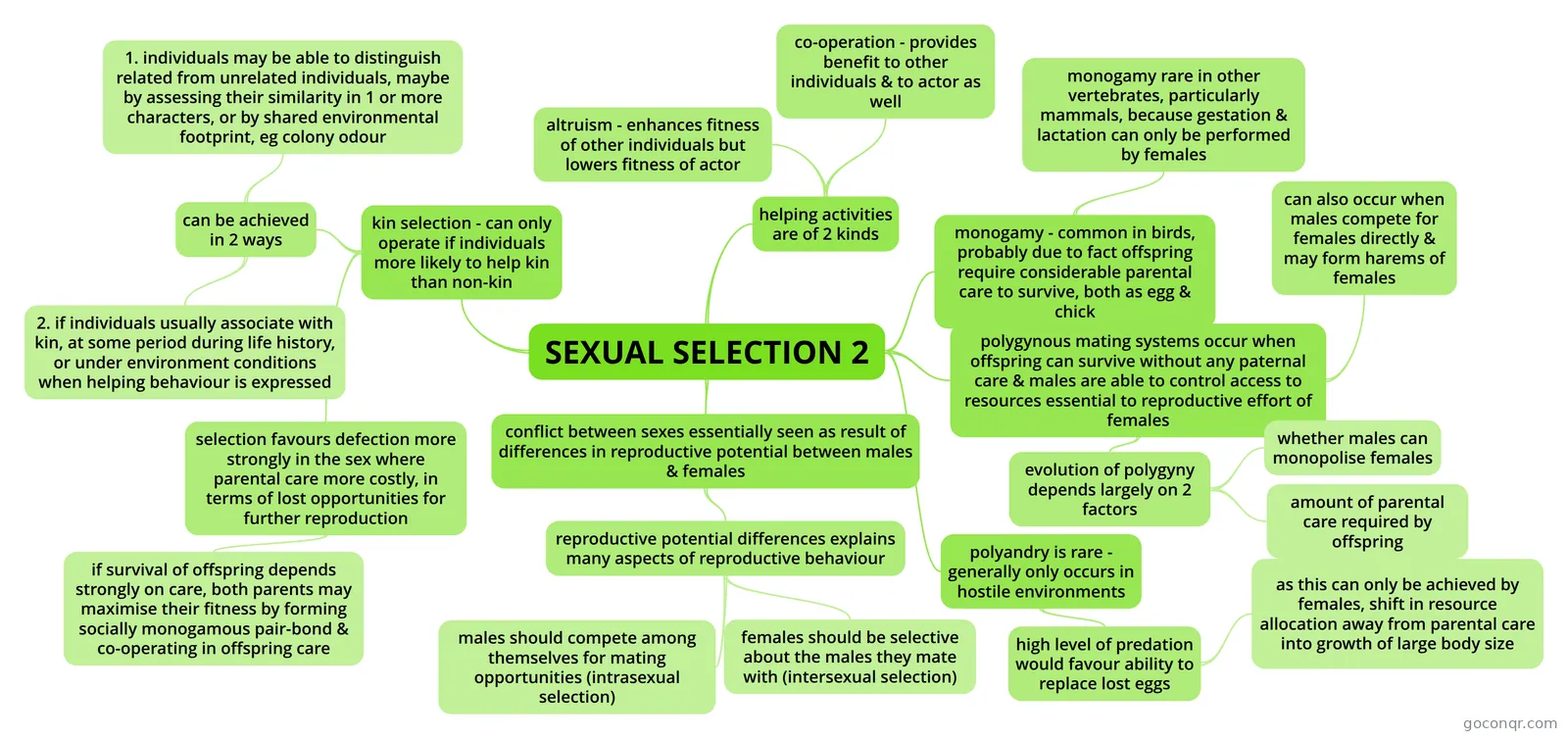
Mind map: sexual selection
Inhalt der Mindmap
SEXUAL SELECTION 2
conflict between sexes essentially seen as result of differences in reproductive potential between males & females
- reproductive potential differences explains many aspects of reproductive behaviour
- males should compete among themselves for mating opportunities (intrasexual selection)
- females should be selective about the males they mate with (intersexual selection)
- reproductive potential differences explains many aspects of reproductive behaviour
helping activities are of 2 kinds
- co-operation - provides benefit to other individuals & to actor as well
- altruism - enhances fitness of other individuals but lowers fitness of actor
kin selection - can only operate if individuals more likely to help kin than non-kin
- can be achieved in 2 ways
- 1. individuals may be able to distinguish related from unrelated individuals, maybe by assessing their similarity in 1 or more characters, or by shared environmental footprint, eg colony odour
- 2. if individuals usually associate with kin, at some period during life history, or under environment conditions when helping behaviour is expressed
- selection favours defection more strongly in the sex where parental care more costly, in terms of lost opportunities for further reproduction
- if survival of offspring depends strongly on care, both parents may maximise their fitness by forming socially monogamous pair-bond & co-operating in offspring care
- can be achieved in 2 ways
monogamy - common in birds, probably due to fact offspring require considerable parental care to survive, both as egg & chick
- monogamy rare in other vertebrates, particularly mammals, because gestation & lactation can only be performed by females
polygynous mating systems occur when offspring can survive without any paternal care & males are able to control access to resources essential to reproductive effort of females
- can also occur when males compete for females directly & may form harems of females
- evolution of polygyny depends largely on 2 factors
- whether males can monopolise females
- amount of parental care required by offspring
polyandry is rare - generally only occurs in hostile environments
- high level of predation would favour ability to replace lost eggs
- as this can only be achieved by females, shift in resource allocation away from parental care into growth of large body size
- high level of predation would favour ability to replace lost eggs
Informationen
- Beschreibung
- Mindmap am SEXUAL SELECTION 2, erstellt von tomking304 am 09/09/2013.
- Erstellt von
- tomking304
- Aufrufe
- 35
- Bewertung