
Mindmap
ORAL PRESENTATION
Inhalt der Mindmap
ORAL PRESENTATION
1. Getting started
- Contact with the audience, introduce yourself and you company, then you´ll tell the audience the purpose of your talk
- A map of your presentation.
- Greeting the audience - Calling for attention
- A signal that you're ready to start
- Introducing yourself and your company
- Mention the key elements of your company
- Abbreviations or acronyms must be explained
- Stating the purpose of a talk
- Why you are there, giving a short introduction to your subject. or use a rhetorical question.
- The overview - presenting the structure of the talk.
- Tell them what you're going to tell them; tell them; then tell them what you told them.
- choose a sequencer, select a verb that reflects the approach you intend to use, put the pieces together in a structure
- Tell them what you're going to tell them; tell them; then tell them what you told them.
- The overview - presenting the structure of the talk.
- Why you are there, giving a short introduction to your subject. or use a rhetorical question.
- Mention the key elements of your company
- Introducing yourself and your company
- A signal that you're ready to start
- Greeting the audience - Calling for attention
- A map of your presentation.
- Contact with the audience, introduce yourself and you company, then you´ll tell the audience the purpose of your talk
2. The Body of the Presentation
- Transitions
- Guide your audience through your talk by referring to the overview you presented at the beginning
- Road signs
- Some words act just like signs on the road.
- Restating the important ideas
- The ear is not as efficient as the eye and an audience is not always giving the speaker 100% of its attention.
- Using quotations
- If you think it is worthwhile to include a long quote in your presentation, you must take the time to read it clearly.
- Using examples
- Examples help you make your point by taking your audience from the abstract to the concrete
- Expressing opinion
- It is important to signal your opinion in contrast to another person's opinion or an opinion that is commonly held.
- "According to" is used only for another person's opinion
- Using numbers
- Give your listener approximations
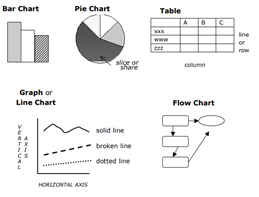
- Using charts, graphs, tables.
- They help the speaker make a point rapidly, and they help the listener retain the information.
- If you don't, the audience will stop listening to you while they try to decipher it alone.
- They help the speaker make a point rapidly, and they help the listener retain the information.
- Using charts, graphs, tables.
- Give your listener approximations
- It is important to signal your opinion in contrast to another person's opinion or an opinion that is commonly held.
- Expressing opinion
- Examples help you make your point by taking your audience from the abstract to the concrete
- Using examples
- If you think it is worthwhile to include a long quote in your presentation, you must take the time to read it clearly.
- Using quotations
- The ear is not as efficient as the eye and an audience is not always giving the speaker 100% of its attention.
- Restating the important ideas
- Some words act just like signs on the road.
- Road signs
- Guide your audience through your talk by referring to the overview you presented at the beginning
- Transitions
3. The Conclusion
- Signaling the conclusion
- Signal that you're arriving at the conclusion early on.
- Doing so leads to increased attention in the audience.
- You may want to refer to something you said at the beginning
- The final summary
- Tell them what you've told them. Review the main points. Recall the most important examples.
- Closing
- End with a strong statement and thank your audience. Pause before thanking the audience.
- Calling for questions
- Invite your audience to ask questions, you can suggest one or you can try humor.
- you can ask the person to repeat, you don't want to appear hostile and you don't want to start up a debate. You can put the question off, you don't want to appear hostile and you don't want to start up a debate. You can put the question off.
- If you don't know the answer you may say I wish I could answer that, but I can't. I'd have to go back to my lab for more data or something like that.
- you can ask the person to repeat, you don't want to appear hostile and you don't want to start up a debate. You can put the question off, you don't want to appear hostile and you don't want to start up a debate. You can put the question off.
- Invite your audience to ask questions, you can suggest one or you can try humor.
- Calling for questions
- End with a strong statement and thank your audience. Pause before thanking the audience.
- Closing
- Tell them what you've told them. Review the main points. Recall the most important examples.
- The final summary
- You may want to refer to something you said at the beginning
- Doing so leads to increased attention in the audience.
- Signal that you're arriving at the conclusion early on.
- Signaling the conclusion
4. In general
- Audience-friendly language
- use polite forms
- Instead of using "I" systematically, use "we,"
- Call on the audience or use the rhetorical question
- Visuals
- You must not expect the visuals to do the entire job for you.
- Put only information that is necessary
- Check your spelling
- You don't want to read to your audience
- The visual is an aid, not the primary focus.
- You don't want to read to your audience
- Check your spelling
- Put only information that is necessary
- You must not expect the visuals to do the entire job for you.
- Visuals
- Call on the audience or use the rhetorical question
- Instead of using "I" systematically, use "we,"
- use polite forms
- Audience-friendly language
5. Graphs and Charts
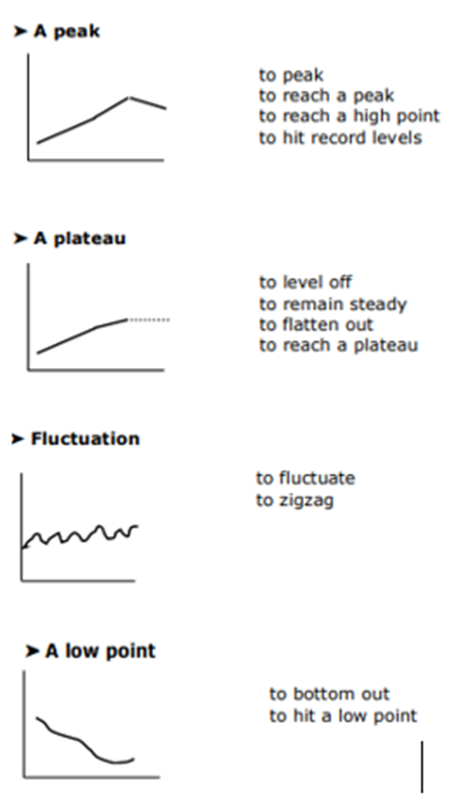
- Graphs and charts are tools
- Types
- Upward trends
- Downward Trends
- A verb or a noun?
- * climb, growth, increase, jump, rise, surge
- * decline, decrease, drop, fall, plunge
- * climb, growth, increase, jump, rise, surge
- to decrease, to go down, to decline, to fall gradually, steadily, constantly, slowly, slightly dramatically, sharply, drastically, significantly, rapidly to drop, to plunge, to dive – to take a nosedive, to plummet
- A verb or a noun?
- to increase, to rise, to go up, to climb, to grow gradually, steadily, constantly, slowly, slightly, sharply, significantly, dramatically to shoot up, to soar, to surge, to skyrocket, to jump, to boom
- Downward Trends
- Upward trends
- Types
- Graphs and charts are tools
VIDEO
- Set the theme
- Make your theme clear and consistent
- headline easier to make quota
- Clear transition
- passionate, presentation mode
- make the numbers meaningful one
- Presentation are easy on the eyes (visual and simple)
- Paint a simple picture that doesn't overwhelm
- treat it like a show
- Identify your memorable moment and build up to it
- rehearse
- One more thing, give your audience an added bonus to walk away with
- Strong conclusion
- One more thing, give your audience an added bonus to walk away with
- rehearse
- Identify your memorable moment and build up to it
- treat it like a show
- Paint a simple picture that doesn't overwhelm
- Presentation are easy on the eyes (visual and simple)
- make the numbers meaningful one
- passionate, presentation mode
- Clear transition
- headline easier to make quota
- Make your theme clear and consistent
- Set the theme
Bilder und Dateien der Mindmap
Informationen
- Beschreibung
- Mindmap am ORAL PRESENTATION, erstellt von ADRIANA GARCÍA MENÉNDEZ am 12/01/2020.
- Erstellt von
- ADRIANA GARCÍA MENÉNDEZ
- Aufrufe
- 3
- Bewertung