
Mindmap
Energy
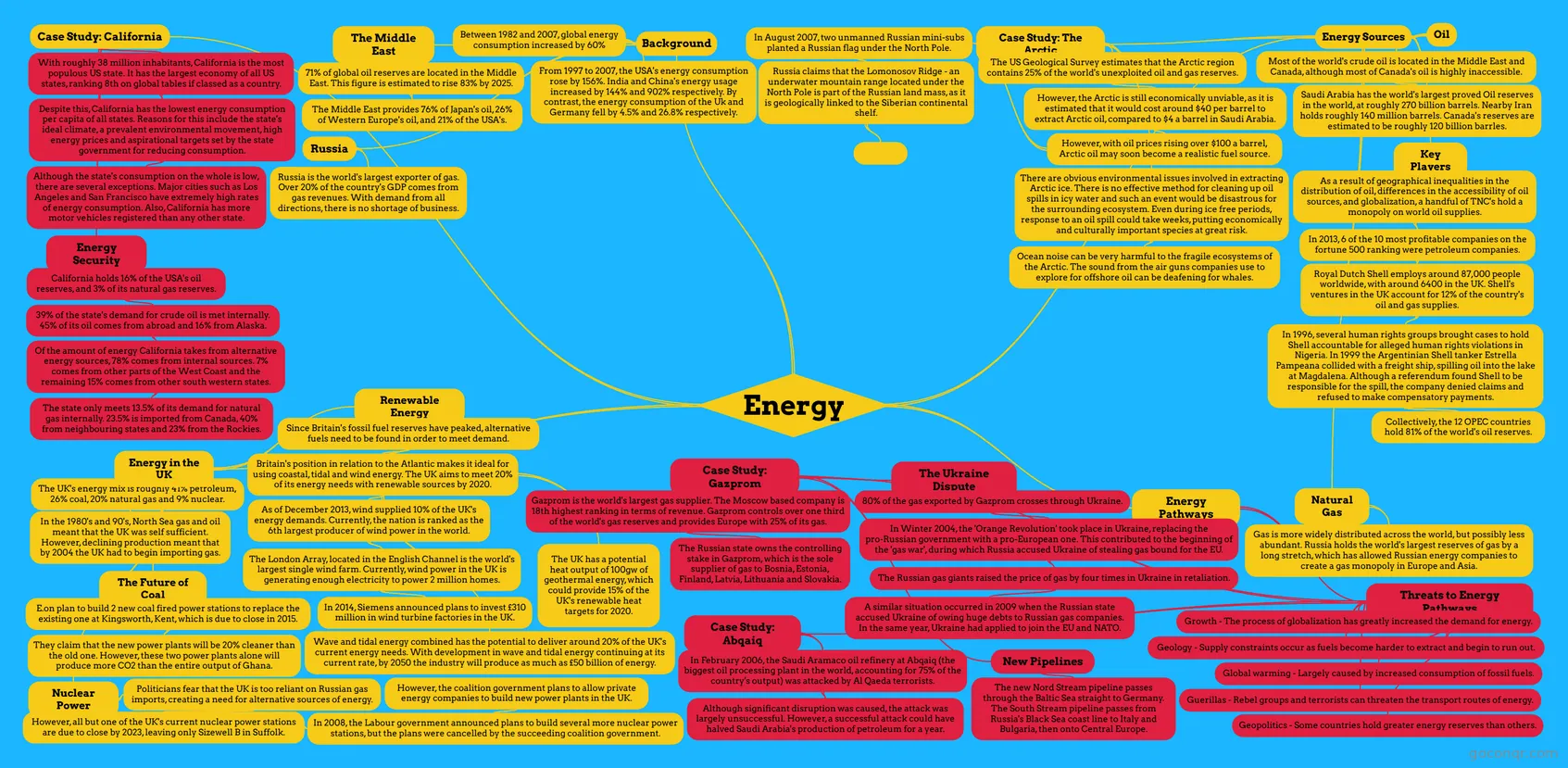
Mind map: Energy
Inhalt der Mindmap
Energy
Energy Sources
- Oil
- Most of the world's crude oil is located in the Middle East and Canada, although most of Canada's oil is highly inaccessible.
- Saudi Arabia has the world's largest proved Oil reserves in the world, at roughly 270 billion barrels. Nearby Iran holds roughly 140 million barrels. Canada's reserves are estimated to be roughly 120 billion barrles.
- Most of the world's crude oil is located in the Middle East and Canada, although most of Canada's oil is highly inaccessible.
- Natural Gas
- Gas is more widely distributed across the world, but possibly less abundant. Russia holds the world's largest reserves of gas by a long stretch, which has allowed Russian energy companies to create a gas monopoly in Europe and Asia.
- Case Study: The Arctic
- The US Geological Survey estimates that the Arctic region contains 25% of the world's unexploited oil and gas reserves.
- However, the Arctic is still economically unviable, as it is estimated that it would cost around $40 per barrel to extract Arctic oil, compared to $4 a barrel in Saudi Arabia.
- However, with oil prices rising over $100 a barrel, Arctic oil may soon become a realistic fuel source.
- In August 2007, two unmanned Russian mini-subs planted a Russian flag under the North Pole.
- Russia claims that the Lomonosov Ridge - an underwater mountain range located under the North Pole is part of the Russian land mass, as it is geologically linked to the Siberian continental shelf.
- Russia claims that the Lomonosov Ridge - an underwater mountain range located under the North Pole is part of the Russian land mass, as it is geologically linked to the Siberian continental shelf.
- In August 2007, two unmanned Russian mini-subs planted a Russian flag under the North Pole.
- However, with oil prices rising over $100 a barrel, Arctic oil may soon become a realistic fuel source.
- However, the Arctic is still economically unviable, as it is estimated that it would cost around $40 per barrel to extract Arctic oil, compared to $4 a barrel in Saudi Arabia.
- There are obvious environmental issues involved in extracting Arctic ice. There is no effective method for cleaning up oil spills in icy water and such an event would be disastrous for the surrounding ecosystem. Even during ice free periods, response to an oil spill could take weeks, putting economically and culturally important species at great risk.
- Ocean noise can be very harmful to the fragile ecosystems of the Arctic. The sound from the air guns companies use to explore for offshore oil can be deafening for whales.
- The US Geological Survey estimates that the Arctic region contains 25% of the world's unexploited oil and gas reserves.
- Key Players
- As a result of geographical inequalities in the distribution of oil, differences in the accessibility of oil sources, and globalization, a handful of TNC's hold a monopoly on world oil supplies.
- In 2013, 6 of the 10 most profitable companies on the fortune 500 ranking were petroleum companies.
- Royal Dutch Shell employs around 87,000 people worldwide, with around 6400 in the UK. Shell's ventures in the UK account for 12% of the country's oil and gas supplies.
- In 1996, several human rights groups brought cases to hold Shell accountable for alleged human rights violations in Nigeria. In 1999 the Argentinian Shell tanker Estrella Pampeana collided with a freight ship, spilling oil into the lake at Magdalena. Although a referendum found Shell to be responsible for the spill, the company denied claims and refused to make compensatory payments.
- Collectively, the 12 OPEC countries hold 81% of the world's oil reserves.
- In 1996, several human rights groups brought cases to hold Shell accountable for alleged human rights violations in Nigeria. In 1999 the Argentinian Shell tanker Estrella Pampeana collided with a freight ship, spilling oil into the lake at Magdalena. Although a referendum found Shell to be responsible for the spill, the company denied claims and refused to make compensatory payments.
- Royal Dutch Shell employs around 87,000 people worldwide, with around 6400 in the UK. Shell's ventures in the UK account for 12% of the country's oil and gas supplies.
- In 2013, 6 of the 10 most profitable companies on the fortune 500 ranking were petroleum companies.
- As a result of geographical inequalities in the distribution of oil, differences in the accessibility of oil sources, and globalization, a handful of TNC's hold a monopoly on world oil supplies.
- Oil
Background
- Between 1982 and 2007, global energy consumption increased by 60%
- From 1997 to 2007, the USA's energy consumption rose by 156%. India and China's energy usage increased by 144% and 902% respectively. By contrast, the energy consumption of the Uk and Germany fell by 4.5% and 26.8% respectively.
- The Middle East
- 71% of global oil reserves are located in the Middle East. This figure is estimated to rise 83% by 2025.
- The Middle East provides 76% of Japan's oil, 26% of Western Europe's oil, and 21% of the USA's.
- 71% of global oil reserves are located in the Middle East. This figure is estimated to rise 83% by 2025.
- Russia
- Russia is the world's largest exporter of gas. Over 20% of the country's GDP comes from gas revenues. With demand from all directions, there is no shortage of business.
- Between 1982 and 2007, global energy consumption increased by 60%
Case Study: California
- With roughly 38 million inhabitants, California is the most populous US state. It has the largest economy of all US states, ranking 8th on global tables if classed as a country.
- Despite this, California has the lowest energy consumption per capita of all states. Reasons for this include the state's ideal climate, a prevalent environmental movement, high energy prices and aspirational targets set by the state government for reducing consumption.
- Although the state's consumption on the whole is low, there are several exceptions. Major cities such as Los Angeles and San Francisco have extremely high rates of energy consumption. Also, California has more motor vehicles registered than any other state.
- Despite this, California has the lowest energy consumption per capita of all states. Reasons for this include the state's ideal climate, a prevalent environmental movement, high energy prices and aspirational targets set by the state government for reducing consumption.
- Energy Security
- California holds 16% of the USA's oil reserves, and 3% of its natural gas reserves.
- 39% of the state's demand for crude oil is met internally. 45% of its oil comes from abroad and 16% from Alaska.
- Of the amount of energy California takes from alternative energy sources, 78% comes from internal sources. 7% comes from other parts of the West Coast and the remaining 15% comes from other south western states.
- The state only meets 13.5% of its demand for natural gas internally. 23.5% is imported from Canada, 40% from neighbouring states and 23% from the Rockies.
- Of the amount of energy California takes from alternative energy sources, 78% comes from internal sources. 7% comes from other parts of the West Coast and the remaining 15% comes from other south western states.
- 39% of the state's demand for crude oil is met internally. 45% of its oil comes from abroad and 16% from Alaska.
- California holds 16% of the USA's oil reserves, and 3% of its natural gas reserves.
- With roughly 38 million inhabitants, California is the most populous US state. It has the largest economy of all US states, ranking 8th on global tables if classed as a country.
Energy in the UK
- The UK's energy mix is roughly 41% petroleum, 26% coal, 20% natural gas and 9% nuclear.
- In the 1980's and 90's, North Sea gas and oil meant that the UK was self sufficient. However, declining production meant that by 2004 the UK had to begin importing gas.
- The Future of Coal
- E.on plan to build 2 new coal fired power stations to replace the existing one at Kingsworth, Kent, which is due to close in 2015.
- They claim that the new power plants will be 20% cleaner than the old one. However, these two power plants alone will produce more CO2 than the entire output of Ghana.
- E.on plan to build 2 new coal fired power stations to replace the existing one at Kingsworth, Kent, which is due to close in 2015.
- Nuclear Power
- Politicians fear that the UK is too reliant on Russian gas imports, creating a need for alternative sources of energy.
- However, all but one of the UK's current nuclear power stations are due to close by 2023, leaving only Sizewell B in Suffolk.
- In 2008, the Labour government announced plans to build several more nuclear power stations, but the plans were cancelled by the succeeding coalition government.
- However, the coalition government plans to allow private energy companies to build new power plants in the UK.
- In 2008, the Labour government announced plans to build several more nuclear power stations, but the plans were cancelled by the succeeding coalition government.
- However, all but one of the UK's current nuclear power stations are due to close by 2023, leaving only Sizewell B in Suffolk.
- Politicians fear that the UK is too reliant on Russian gas imports, creating a need for alternative sources of energy.
- Renewable Energy
- Since Britain's fossil fuel reserves have peaked, alternative fuels need to be found in order to meet demand.
- Britain's position in relation to the Atlantic makes it ideal for using coastal, tidal and wind energy. The UK aims to meet 20% of its energy needs with renewable sources by 2020.
- As of December 2013, wind supplied 10% of the UK's energy demands. Currently, the nation is ranked as the 6th largest producer of wind power in the world.
- The London Array, located in the English Channel is the world's largest single wind farm. Currently, wind power in the UK is generating enough electricity to power 2 million homes.
- In 2014, Siemens announced plans to invest £310 million in wind turbine factories in the UK.
- The London Array, located in the English Channel is the world's largest single wind farm. Currently, wind power in the UK is generating enough electricity to power 2 million homes.
- Wave and tidal energy combined has the potential to deliver around 20% of the UK's current energy needs. With development in wave and tidal energy continuing at its current rate, by 2050 the industry will produce as much as £50 billion of energy.
- The UK has a potential heat output of 100gw of geothermal energy, which could provide 15% of the UK's renewable heat targets for 2020.
- As of December 2013, wind supplied 10% of the UK's energy demands. Currently, the nation is ranked as the 6th largest producer of wind power in the world.
- Britain's position in relation to the Atlantic makes it ideal for using coastal, tidal and wind energy. The UK aims to meet 20% of its energy needs with renewable sources by 2020.
- Since Britain's fossil fuel reserves have peaked, alternative fuels need to be found in order to meet demand.
Energy Pathways
- Threats to Energy Pathways
- Growth - The process of globalization has greatly increased the demand for energy.
- Geology - Supply constraints occur as fuels become harder to extract and begin to run out.
- Global warming - Largely caused by increased consumption of fossil fuels.
- Guerillas - Rebel groups and terrorists can threaten the transport routes of energy.
- Geopolitics - Some countries hold greater energy reserves than others.
- Case Study: Abqaiq
- In February 2006, the Saudi Aramaco oil refinery at Abqaiq (the biggest oil processing plant in the world, accounting for 75% of the country's output) was attacked by Al Qaeda terrorists.
- Although significant disruption was caused, the attack was largely unsuccessful. However, a successful attack could have halved Saudi Arabia's production of petroleum for a year.
- In February 2006, the Saudi Aramaco oil refinery at Abqaiq (the biggest oil processing plant in the world, accounting for 75% of the country's output) was attacked by Al Qaeda terrorists.
- Case Study: Gazprom
- Gazprom is the world's largest gas supplier. The Moscow based company is 18th highest ranking in terms of revenue. Gazprom controls over one third of the world's gas reserves and provides Europe with 25% of its gas.
- The Russian state owns the controlling stake in Gazprom, which is the sole supplier of gas to Bosnia, Estonia, Finland, Latvia, Lithuania and Slovakia.
- The Ukraine Dispute
- 80% of the gas exported by Gazprom crosses through Ukraine.
- In Winter 2004, the 'Orange Revolution' took place in Ukraine, replacing the pro-Russian government with a pro-European one. This contributed to the beginning of the 'gas war', during which Russia accused Ukraine of stealing gas bound for the EU.
- The Russian gas giants raised the price of gas by four times in Ukraine in retaliation.
- A similar situation occurred in 2009 when the Russian state accused Ukraine of owing huge debts to Russian gas companies. In the same year, Ukraine had applied to join the EU and NATO.
- The Russian gas giants raised the price of gas by four times in Ukraine in retaliation.
- In Winter 2004, the 'Orange Revolution' took place in Ukraine, replacing the pro-Russian government with a pro-European one. This contributed to the beginning of the 'gas war', during which Russia accused Ukraine of stealing gas bound for the EU.
- 80% of the gas exported by Gazprom crosses through Ukraine.
- New Pipelines
- The new Nord Stream pipeline passes through the Baltic Sea straight to Germany. The South Stream pipeline passes from Russia's Black Sea coast line to Italy and Bulgaria, then onto Central Europe.
- Gazprom is the world's largest gas supplier. The Moscow based company is 18th highest ranking in terms of revenue. Gazprom controls over one third of the world's gas reserves and provides Europe with 25% of its gas.
- Threats to Energy Pathways
Informationen
- Beschreibung
- A-level Geography (A2) Mindmap am Energy, erstellt von Callum Dwyer am 22/02/2015.
- Erstellt von
- Callum Dwyer
- Aufrufe
- 3
- Bewertung