
Mindmap
FORMS OF INTELLECTUAL PROPERTY
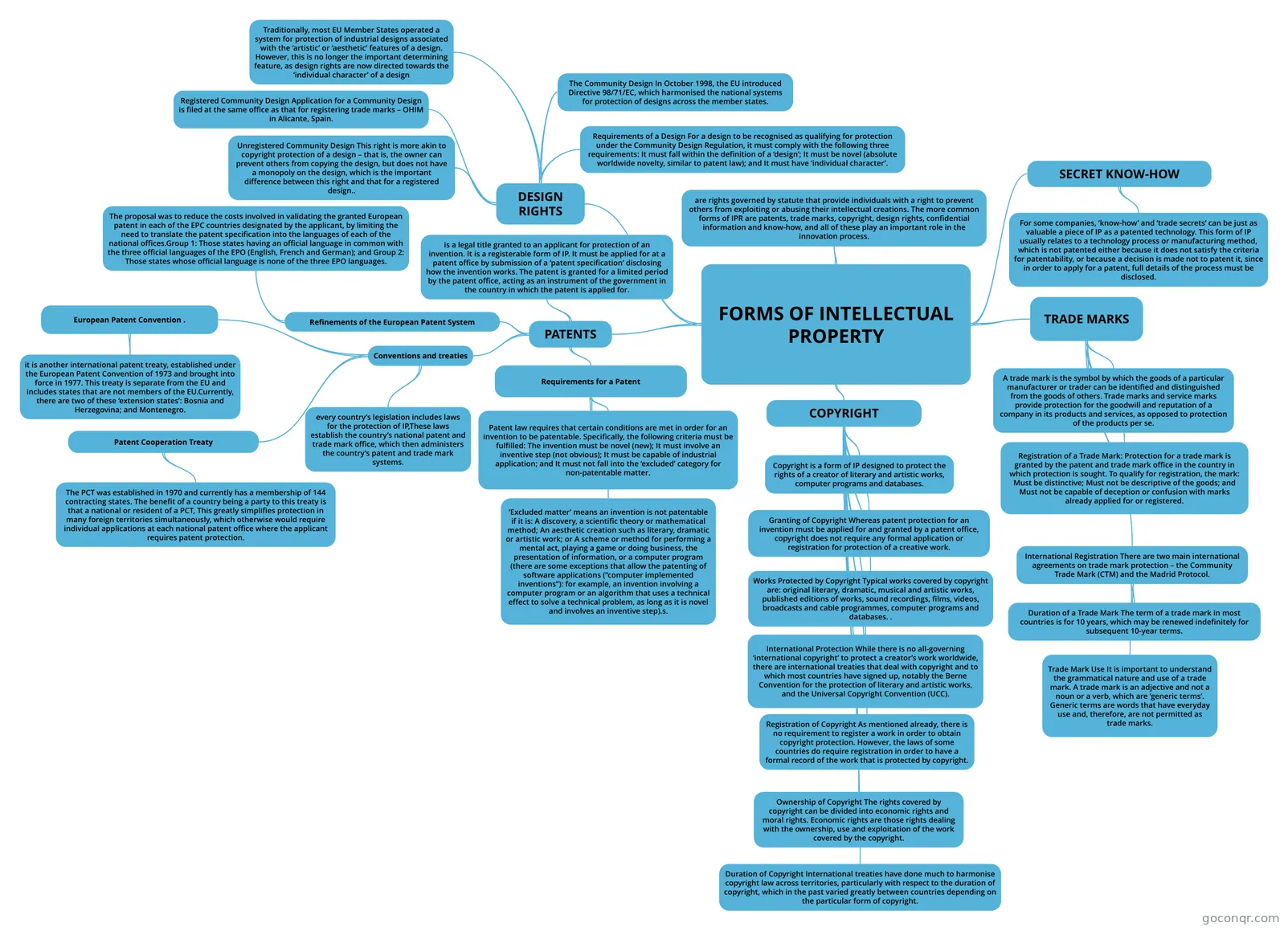
Mind map: Forms of intellectual property
Inhalt der Mindmap
FORMS OF INTELLECTUAL PROPERTY
are rights governed by statute that provide individuals with a right to prevent others from exploiting or abusing their intellectual creations. The more common forms of IPR are patents, trade marks, copyright, design rights, confidential information and know-how, and all of these play an important role in the innovation process.
PATENTS
- is a legal title granted to an applicant for protection of an invention. It is a registerable form of IP. It must be applied for at a patent office by submission of a ‘patent specification’ disclosing how the invention works. The patent is granted for a limited period by the patent office, acting as an instrument of the government in the country in which the patent is applied for.
- Conventions and treaties
- every country’s legislation includes laws for the protection of IP,These laws establish the country’s national patent and trade mark office, which then administers the country’s patent and trade mark systems.
- Patent Cooperation Treaty
- The PCT was established in 1970 and currently has a membership of 144 contracting states. The benefit of a country being a party to this treaty is that a national or resident of a PCT, This greatly simplifies protection in many foreign territories simultaneously, which otherwise would require individual applications at each national patent office where the applicant requires patent protection.
- European Patent Convention .
- it is another international patent treaty, established under the European Patent Convention of 1973 and brought into force in 1977. This treaty is separate from the EU and includes states that are not members of the EU.Currently, there are two of these ‘extension states’: Bosnia and Herzegovina; and Montenegro.
- Refinements of the European Patent System
- The proposal was to reduce the costs involved in validating the granted European patent in each of the EPC countries designated by the applicant, by limiting the need to translate the patent specification into the languages of each of the national offices.Group 1: Those states having an official language in common with the three official languages of the EPO (English, French and German); and Group 2: Those states whose official language is none of the three EPO languages.
- Requirements for a Patent
- Patent law requires that certain conditions are met in order for an invention to be patentable. Specifically, the following criteria must be fulfilled: The invention must be novel (new); It must involve an inventive step (not obvious); It must be capable of industrial application; and It must not fall into the ‘excluded’ category for non-patentable matter.
- ‘Excluded matter’ means an invention is not patentable if it is: A discovery, a scientific theory or mathematical method; An aesthetic creation such as literary, dramatic or artistic work; or A scheme or method for performing a mental act, playing a game or doing business, the presentation of information, or a computer program (there are some exceptions that allow the patenting of software applications (“computer implemented inventions”): for example, an invention involving a computer program or an algorithm that uses a technical effect to solve a technical problem, as long as it is novel and involves an inventive step).s.
COPYRIGHT
- Copyright is a form of IP designed to protect the rights of a creator of literary and artistic works, computer programs and databases.
- Granting of Copyright Whereas patent protection for an invention must be applied for and granted by a patent office, copyright does not require any formal application or registration for protection of a creative work.
- Works Protected by Copyright Typical works covered by copyright are: original literary, dramatic, musical and artistic works, published editions of works, sound recordings, films, videos, broadcasts and cable programmes, computer programs and databases. .
- International Protection While there is no all-governing ‘international copyright’ to protect a creator’s work worldwide, there are international treaties that deal with copyright and to which most countries have signed up, notably the Berne Convention for the protection of literary and artistic works, and the Universal Copyright Convention (UCC).
- Registration of Copyright As mentioned already, there is no requirement to register a work in order to obtain copyright protection. However, the laws of some countries do require registration in order to have a formal record of the work that is protected by copyright.
- Ownership of Copyright The rights covered by copyright can be divided into economic rights and moral rights. Economic rights are those rights dealing with the ownership, use and exploitation of the work covered by the copyright.
- Duration of Copyright International treaties have done much to harmonise copyright law across territories, particularly with respect to the duration of copyright, which in the past varied greatly between countries depending on the particular form of copyright.
TRADE MARKS
- A trade mark is the symbol by which the goods of a particular manufacturer or trader can be identified and distinguished from the goods of others. Trade marks and service marks provide protection for the goodwill and reputation of a company in its products and services, as opposed to protection of the products per se.
- Registration of a Trade Mark: Protection for a trade mark is granted by the patent and trade mark office in the country in which protection is sought. To qualify for registration, the mark: Must be distinctive; Must not be descriptive of the goods; and Must not be capable of deception or confusion with marks already applied for or registered.
- International Registration There are two main international agreements on trade mark protection – the Community Trade Mark (CTM) and the Madrid Protocol.
- Duration of a Trade Mark The term of a trade mark in most countries is for 10 years, which may be renewed indefinitely for subsequent 10-year terms.
- Trade Mark Use It is important to understand the grammatical nature and use of a trade mark. A trade mark is an adjective and not a noun or a verb, which are ‘generic terms’. Generic terms are words that have everyday use and, therefore, are not permitted as trade marks.
DESIGN RIGHTS
- Traditionally, most EU Member States operated a system for protection of industrial designs associated with the ‘artistic’ or ‘aesthetic’ features of a design. However, this is no longer the important determining feature, as design rights are now directed towards the ‘individual character’ of a design
- The Community Design In October 1998, the EU introduced Directive 98/71/EC, which harmonised the national systems for protection of designs across the member states.
- Requirements of a Design For a design to be recognised as qualifying for protection under the Community Design Regulation, it must comply with the following three requirements: It must fall within the definition of a ‘design’; It must be novel (absolute worldwide novelty, similar to patent law); and It must have ‘individual character’.
- Registered Community Design Application for a Community Design is filed at the same office as that for registering trade marks – OHIM in Alicante, Spain.
- Unregistered Community Design This right is more akin to copyright protection of a design – that is, the owner can prevent others from copying the design, but does not have a monopoly on the design, which is the important difference between this right and that for a registered design..
SECRET KNOW-HOW
- For some companies, ‘know-how’ and ‘trade secrets’ can be just as valuable a piece of IP as a patented technology. This form of IP usually relates to a technology process or manufacturing method, which is not patented either because it does not satisfy the criteria for patentability, or because a decision is made not to patent it, since in order to apply for a patent, full details of the process must be disclosed.
Informationen
- Beschreibung
- Mindmap am FORMS OF INTELLECTUAL PROPERTY, erstellt von javier delgado herrera am 12/03/2020.
- Erstellt von
- javier delgado herrera
- Aufrufe
- 0
- Bewertung
Mehr zu Types of Intellectual Property