
Mindmap
Energy transfer by heating
Inhalt der Mindmap
Energy transfer by heating
Every objects emits infrared radiation, but the hotter it is the more it will emit in a given time.
- Infrared radiation waves travel out from a hot source in all directions and do not require a medium to travel through.
Light and shiny surfaces absorb less and reflect more radiation than dark and matte surfaces. This is because it has a smooth surface which means the radiation is reflected and travels away, whilst dark surfaces are full of cavities so the reflected radiation hits the surface again.
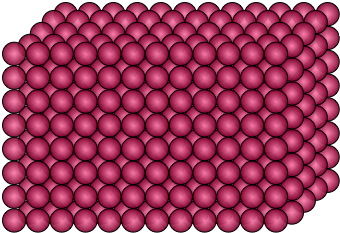
The particles in a solid are held next to each other in fixed positions. They vibrate about their fixed positions so the solid keeps its own shape. A solid cannot flow and has a much higher density than a gas. When a solid is melted it changes into a liquid and when it is heated to a degree, sublimation occurs and it changes into a gas.
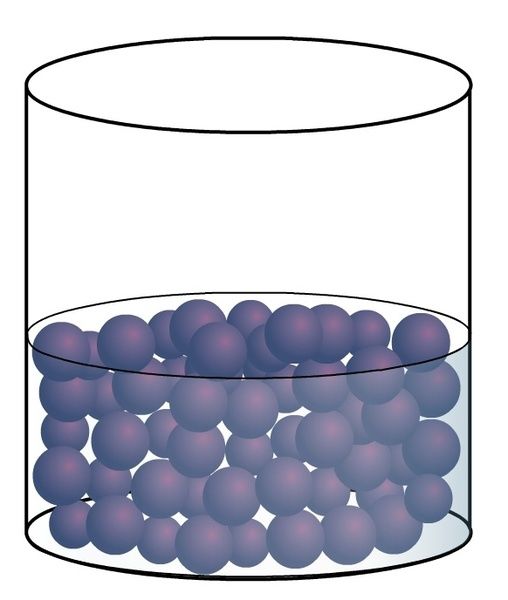
- The particles in a liquid are in contact with each other. They move about at random. So a liquid doesn't have its own shape but it fits the shape of the container and it can flow. It also has a fixed volume and a much higher density than a gas. When a liquid is heated, vaporisation occurs and it changes into a gas and when a liquid is cooled, it freezes and changes into a solid.
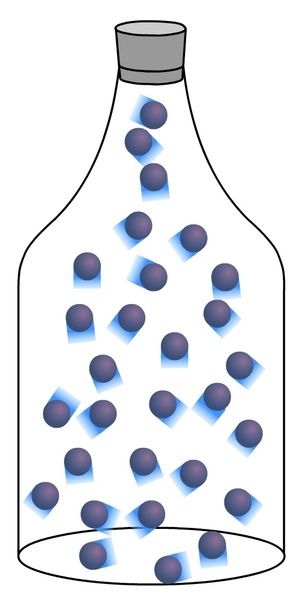
- The particles in a gas, move about at random much faster. They are, on average, much further apart from each other than in a liquid. So the density of a gas is much less than that of a solid or liquid. A gas can flow and it fits the container. However, the volume can be changed.
- The particles in a liquid are in contact with each other. They move about at random. So a liquid doesn't have its own shape but it fits the shape of the container and it can flow. It also has a fixed volume and a much higher density than a gas. When a liquid is heated, vaporisation occurs and it changes into a gas and when a liquid is cooled, it freezes and changes into a solid.
Conduction is the transfer of energy from particle to particle in a material. Generally, when one end of an object is heated, the particles at that end gain kinetic energy and vibrate much more. They then collide with their neighboring particles who collide with theirs and so on. By these collisions, heat energy is transferred through the solid until the whole object is heated. This is conduction.
- Conduction in metals occurs because of the free electrons metals contain. These electrons move about at random and hold the positive metal ions together. When a metal is heated at one end, the free electrons at that end gain kinetic energy and begins to move faster. The electrons diffuse; colliding with each other and with the positive ions in the cooler parts of the metal. As a result, they transfer kinetic energy to these electrons and ions. Therefore, the energy is transferred from the hot end to the cold end.
- In a non-metal, all the electrons are held in the atoms. Energy is only transferred because the atoms vibrate and shake each other. This is much less effective which is why metals are much better conductors.
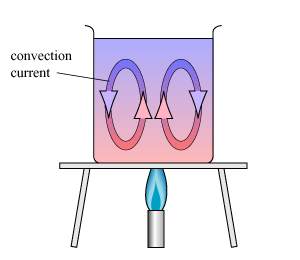
Convection is the circulation of a fluid (liquid or gas) when we heat it. The convection currents are caused because fluids rise when they are heated because they are less dense. Then they fall where they cool down because cooling makes them denser. The convection currents transfer energy from the hotter parts to the cooler parts.
- When a fluid is heated it expands because the particles gain kinetic energy and move about more, taking up more space. Because of this, the density of the fluid decreases because the same mass of fluid now occupies a larger volume. So heating a fluid makes it less dense and it rises.
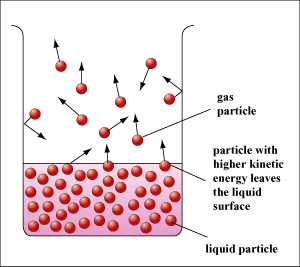
Evaporation is the change of state from a liquid to a gas. This happens when water molecules escape from the surface of water and enter the air as water vapour.
- Evaporation causes a cooling effect because there are weak forces of attraction that exist between the molecules in a liquid. The faster molecules that have more kinetic energy break away from these forces of attraction and escape the liquid. when they leave the liquid is cooler because the average kinetic energy of the remaining molecules has decreased.
- Evaporation of a liquid is increased by increasing the surface area of the liquid, increasing the temperature of the liquid (the more energy the particles will gain so the faster they will escape) and creating a draught of air(to take away the molecules that escaped) across the liquids surface.
- Evaporation causes a cooling effect because there are weak forces of attraction that exist between the molecules in a liquid. The faster molecules that have more kinetic energy break away from these forces of attraction and escape the liquid. when they leave the liquid is cooler because the average kinetic energy of the remaining molecules has decreased.
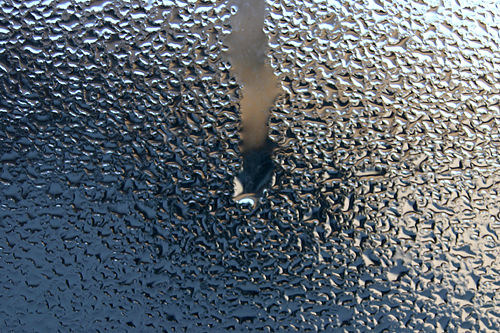
Condensation is the change of state from a gas to a liquid and it is a reversible reaction. When gas particles hit a cold surface , its energy is lost and it condenses into a liquid.
- The rate of condensation is increased by increasing the surface area (more space for particles to condense) and reducing the surface temperature (particles can lose energy faster).
Bilder und Dateien der Mindmap

Informationen
- Beschreibung
- Mindmap am Energy transfer by heating, erstellt von sndiaye2000 am 18/03/2015.
- Erstellt von
- sndiaye2000
- Aufrufe
- 0
- Bewertung