
Mindmap
Falsification Principle
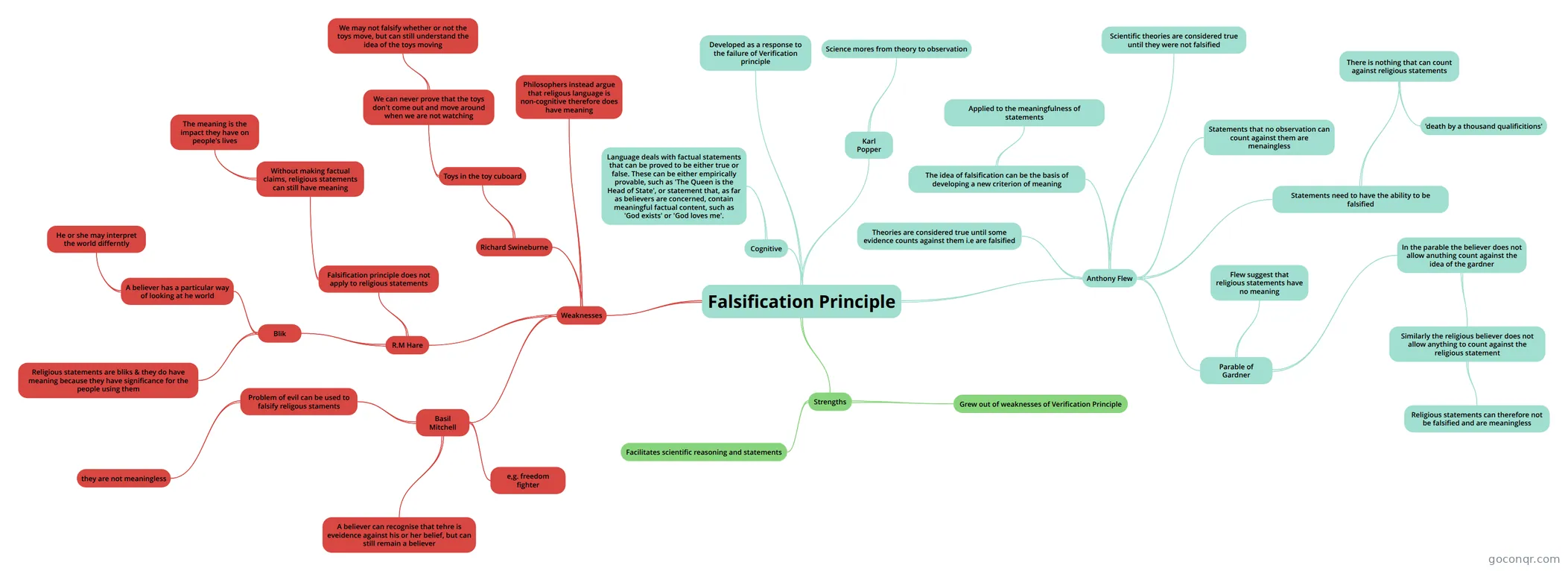
Mind map: Falsification principle
Inhalt der Mindmap
Falsification Principle
Cognitive
- Language deals with factual statements that can be proved to be either true or false. These can be either empirically provable, such as 'The Queen is the Head of State', or statement that, as far as believers are concerned, contain meaningful factual content, such as 'God exists' or 'God loves me'.
Anthony Flew
- The idea of falsification can be the basis of developing a new criterion of meaning
- Applied to the meaningfulness of statements
- Theories are considered true until some evidence counts against them i.e are falsified
- Scientific theories are considered true until they were not falsified
- Statements that no observation can count against them are menaingless
- Statements need to have the ability to be falsified
- There is nothing that can count against religious statements
- 'death by a thousand qualificitions'
- There is nothing that can count against religious statements
- Parable of Gardner
- Flew suggest that religious statements have no meaning
- In the parable the believer does not allow anuthing count against the idea of the gardner
- Similarly the religious believer does not allow anything to count against the religious statement
- Religious statements can therefore not be falsified and are meaningless
- Similarly the religious believer does not allow anything to count against the religious statement
- The idea of falsification can be the basis of developing a new criterion of meaning
Developed as a response to the failure of Verification principle
Karl Popper
- Science mores from theory to observation
Weaknesses
- Philosophers instead argue that religous language is non-cognitive therefore does have meaning
- Richard Swineburne
- Toys in the toy cuboard
- We can never prove that the toys don't come out and move around when we are not watching
- We may not falsify whether or not the toys move, but can still understand the idea of the toys moving
- We can never prove that the toys don't come out and move around when we are not watching
- Toys in the toy cuboard
- R.M Hare
- Falsification principle does not apply to religious statements
- Without making factual claims, religious statements can still have meaning
- The meaning is the impact they have on people's lives
- Without making factual claims, religious statements can still have meaning
- Blik
- A believer has a particular way of looking at he world
- He or she may interpret the world differntly
- Religious statements are bliks & they do have meaning because they have significance for the people using them
- A believer has a particular way of looking at he world
- Falsification principle does not apply to religious statements
- Basil Mitchell
- Problem of evil can be used to falsify religous staments
- they are not meaningless
- A believer can recognise that tehre is eveidence against his or her belief, but can still remain a believer
- e,g. freedom fighter
- Problem of evil can be used to falsify religous staments
Strengths
- Grew out of weaknesses of Verification Principle
- Facilitates scientific reasoning and statements
Informationen
- Beschreibung
- Mindmap am Falsification Principle, erstellt von muminaharshad am 28/03/2015.
- Erstellt von
- muminaharshad
- Aufrufe
- 2
- Bewertung
Mehr zu Verification and Falsification