
Religious Language
173 resources created by 109 users
This Religious Language page on GoConqr gathers community-made mind maps, flashcards, quizzes and notes on topics such as the Verification Principle, falsification, analogy, the Via Negativa and language games. It's built for school students revising a topic, university students and professional candidates filling gaps, and teachers after ready-made material. There are over 170 resources here, including more than 100 mind maps and over 30 flashcard decks, mostly at secondary level with some university material. Try a quiz to find your gaps, then pick a map to revise from.
Top Religious Language resources
-
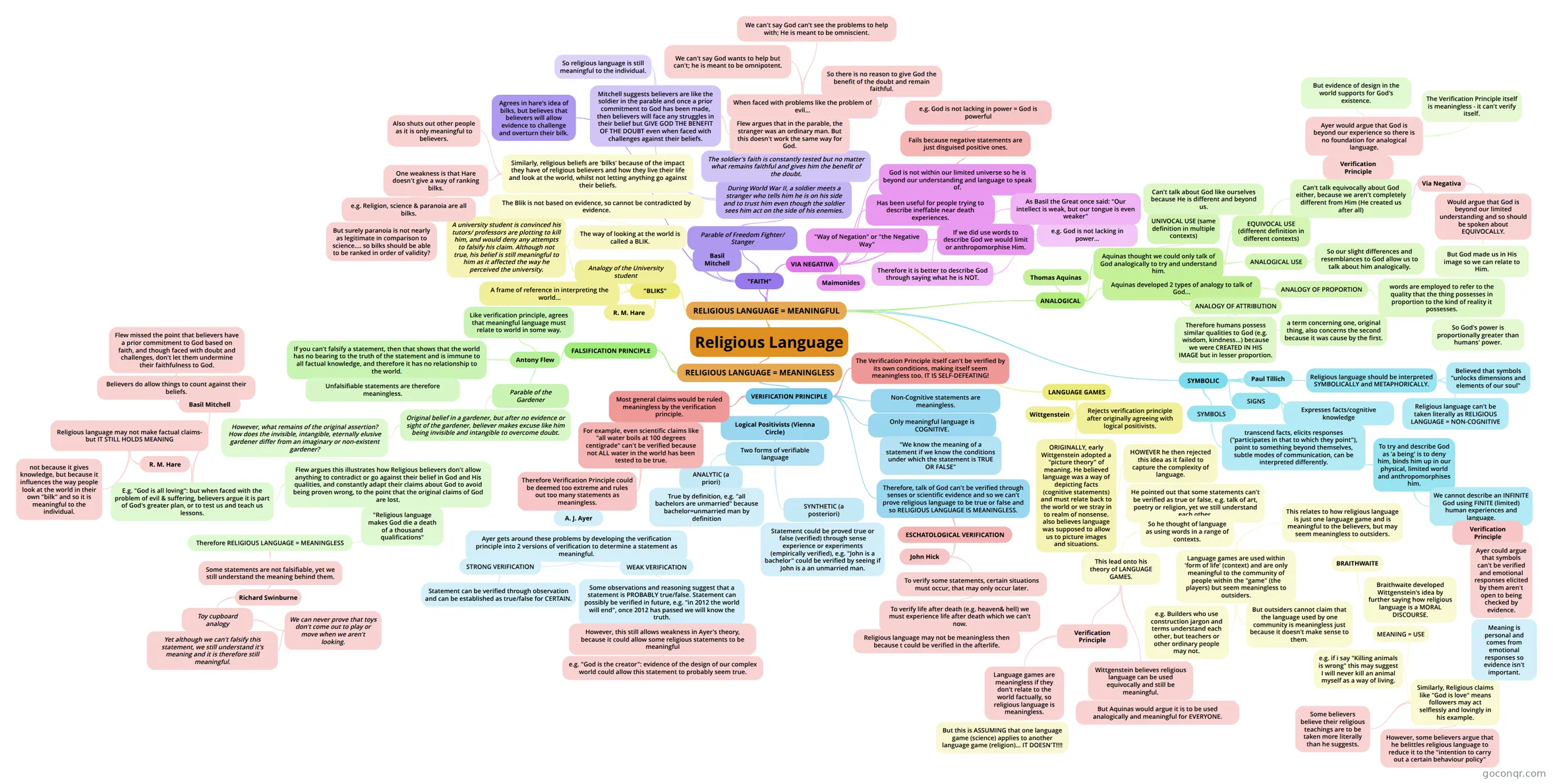 Mind map Religious Language A2 philosophy on 'Religious Language' (AQA)
-
28 questionsReligious Language Edexcel A Level Why is it difficult to talk about God?
-
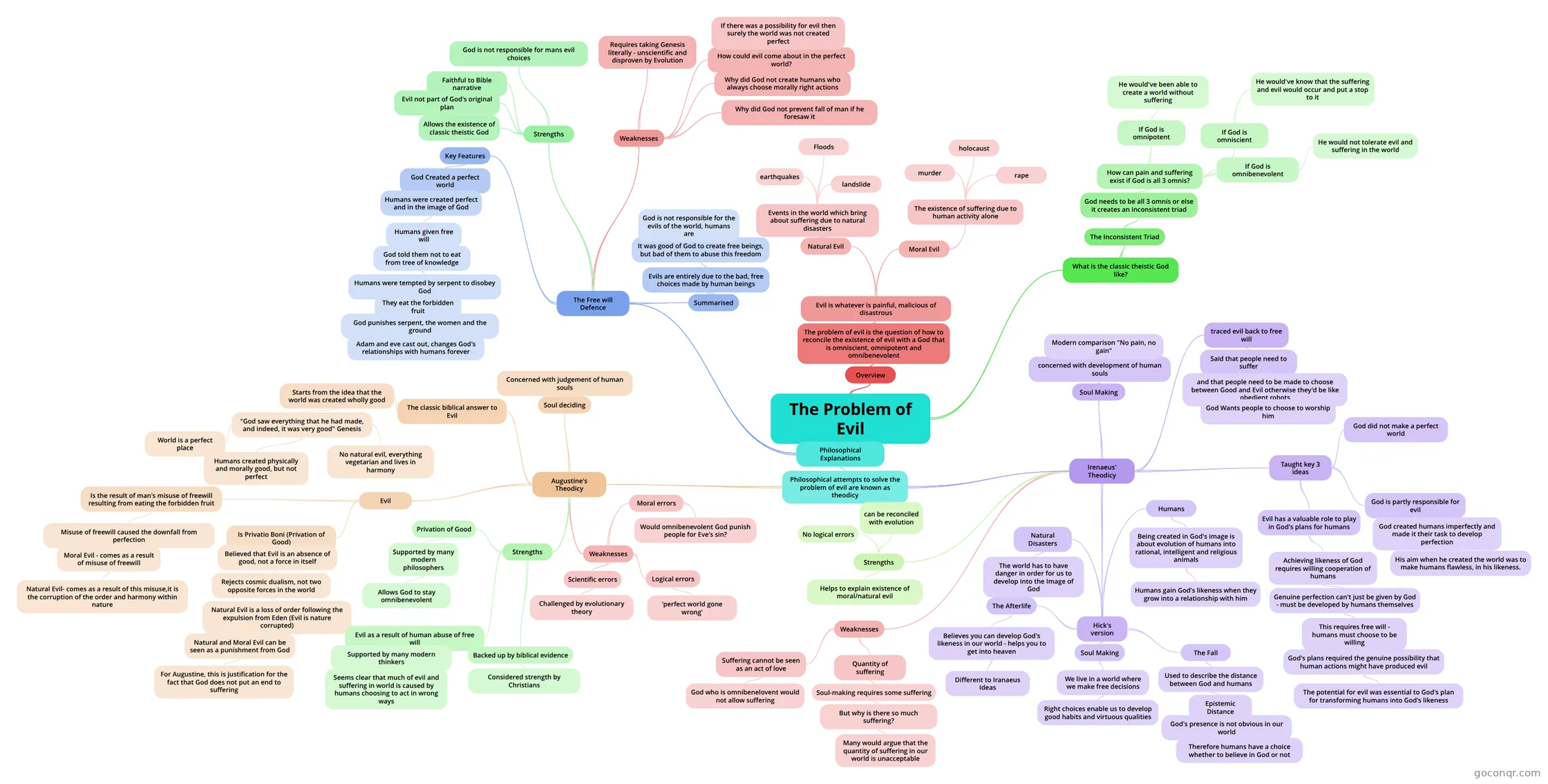 Mind map The Problem of Evil
-
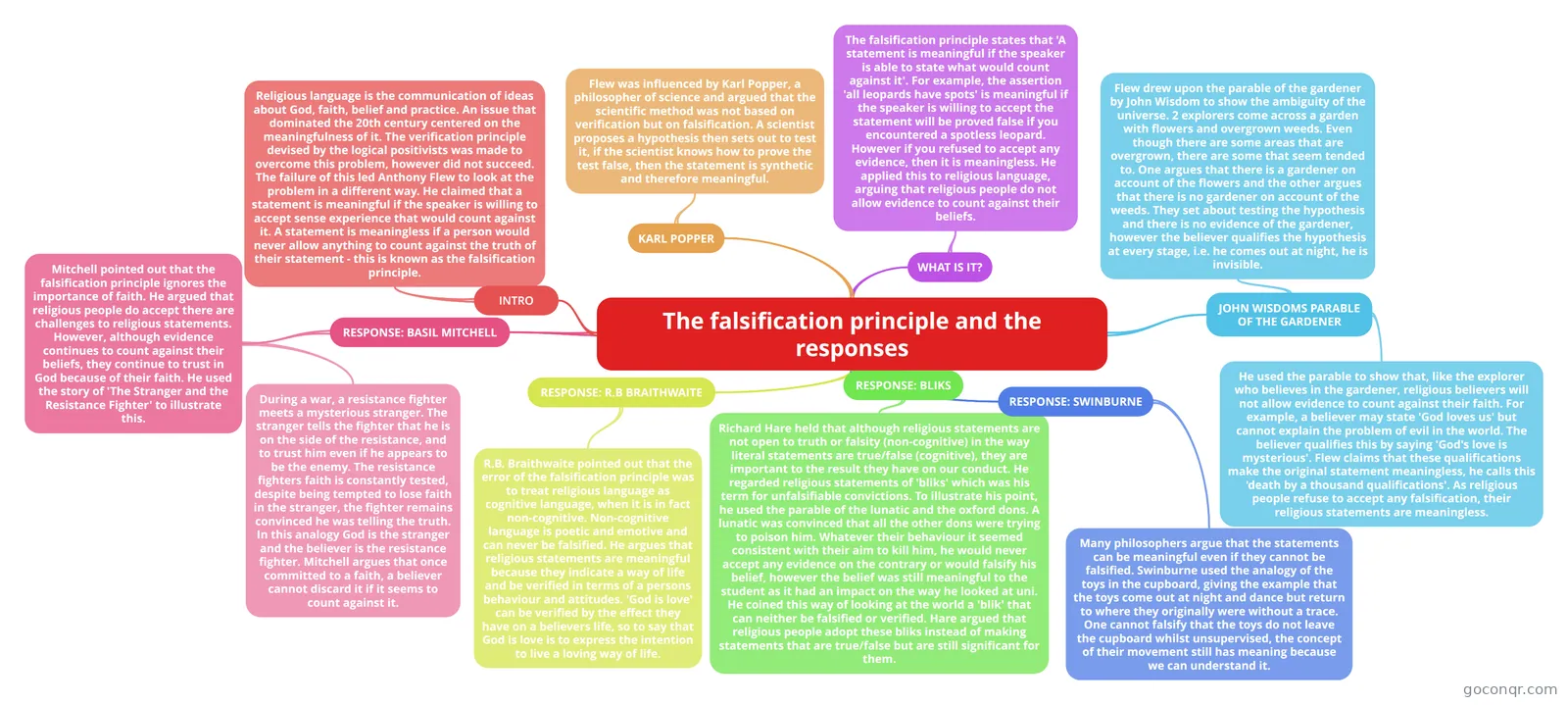 Mind map The falsification principle and the responses
-
18 cardsA2 Philosophy (Religious Language) Why would Religious Language be considered meaningless?
-
26 cardsThe Verification Principle Which group in the 1920s inspired the verification principle?
-
19 cardsThe Falsification Principle Who does the falsification principle originate from?
-
33 cardsReligious Language: Key Terms The Verification Principle
Quizzes
Mind maps
See all 117 mind maps-
Religious Language A2 philosophy on 'Religious Language' (AQA)
-
The Problem of Evil
-
The falsification principle and the responses
-
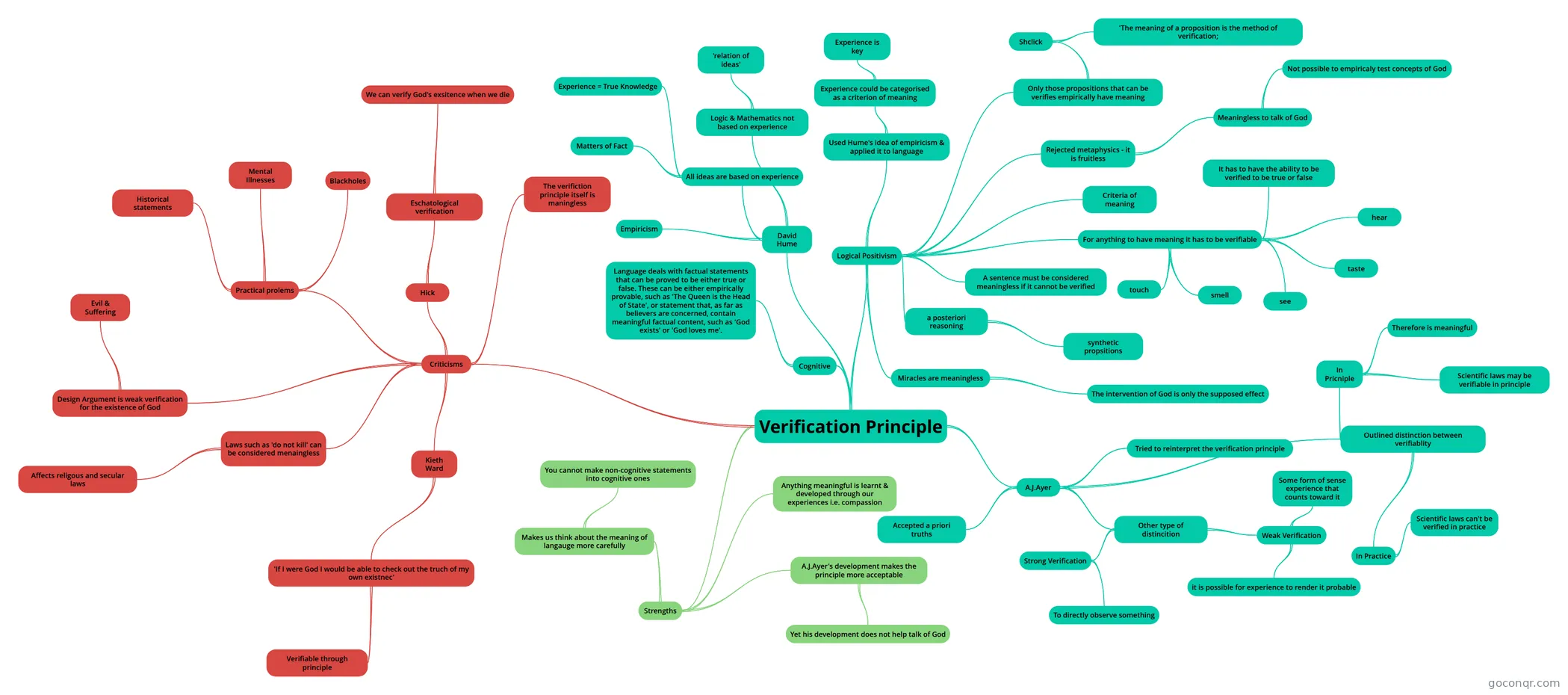 Verification Principle
-
Miracles AQA understandings of miracle: realist and anti-realist views comparison of Hume's and Wiles' argument
-
Religious language
-
Analogy and Aquinas
-
FALSIFICATION
Flashcards
See all 37 flashcards-
18 cardsA2 Philosophy (Religious Language) Why would Religious Language be considered meaningless?
-
26 cardsThe Verification Principle Which group in the 1920s inspired the verification principle?
-
19 cardsThe Falsification Principle Who does the falsification principle originate from?
-
33 cardsReligious Language: Key Terms The Verification Principle
-
63 cardsReligious Language
-
31 cardsReligious Language - verification principle What is the verification principle?
-
26 cardsReligious Language - Symbol What do symbols do?
-
13 cardsThe Verification Principle
Notes
See all 14 notes-
Verification & Falsification Principle
-
Religious Language and Verification (Clack and Clack) RELIGIOUS LANGUAGE DAVID HUME- Enquiry Concerning Human Understanding'Commit it then to to the flames; for it can contain nothing but sophistry and illusion', if it does not contain any reasoning concerning matter of ...
-
sample ayer essay 1 (a) Examine the argument and/or interpretation in the passage. A.J Ayer was a British philosopher who was known for his promotion of Logical Positivism with a focus on verificationism ; a theory of knowledge which a...
-
Twentieth-Century Perspectives Twentieth-Century Perspectives Cognitive - statements about God that can be known to be either true or false Non-Cognitive - statements about God aren't subject to truth or falsity Logical Positivism - movement in phi...
-
religious language overview religious language (from the book)the problem of religious language religious language is language that deals with god and other theological matters, including religious worship, practice, behaviour and doctrine. it i...
-
Religious Language Key Words Introduction to Religious Language In the 20th Century, philosophers realised that language is the only way we can make ourselves understood. In the philosophy of religion, we are describing concepts that no...
-
Untitled KeywordsVienna Circle:A group of philosophers who met in Vienna and gave rise to the Logical Positivist movement.Logical Positivism:The philosophical strand of thought which focuses upon the relationship between philo...
-
Wittgenstein's language games A word's meaning comes from the circumstance in which they are uttered and the meaning of other words alongside them If you use words in a way that doesn't follow the particular rules of the language then it won't mak...
Slides
Topics in Religious Language
More Philosophy topics
About Religious Language
GoConqr OriginalWhat the unit covers
The resources here follow the debate over whether talk about God can be meaningful. The Verification Principle is the starting point: the Vienna Circle and A J Ayer argued that only cognitive language, which can be verified, has meaning. Several maps and decks cover this, including the mind map Verification Principle and the deck The Verification Principle.
From there the page moves to falsification, including the parable of the garden, and to responses to verificationism. It then covers other ways of defending religious language: analogy and Aquinas, the Via Negativa, symbol, myth and Wittgenstein's language games.
Where to start
- Open the mind map Religious Language for an overview of the verification debate.
- Work through the flashcard deck Religious Language: Key Terms to learn the vocabulary, such as logical positivism and the picture theory of language.
- Move on to the mind map The falsification principle and the responses.
- Finish with the maps and decks on analogy, the Via Negativa and language games.
Using quizzes and maps together
Take the quiz Religious Language Edexcel A Level first. It asks, for example, who developed the Verification Principle. Note which questions you miss, then go back to the matching map and read that branch again. Retake the quiz afterwards to see what has stuck.
The notes add depth for essay work. Religious Language and Verification (Clack and Clack) and sample ayer essay suit students who want to see arguments set out in full. The resources mention A-level Religious Studies, A-level Philosophy and IB, so check which fits your course.
Where it sits
This unit belongs to the Philosophy of Religion strand within Philosophy. Some listed maps, such as the ones on the problem of evil and Kant's moral argument, link to neighbouring topics, which helps when you want to see how arguments connect.
Pick one map today and read it through. Then try making your own flashcards from it, so you remember it in your own words.
Frequently asked questions
Which resource should I start with?
Start with the mind map Religious Language, which sets out the Verification Principle, the Vienna Circle and the idea that only cognitive language is meaningful. Then use the flashcard deck Religious Language: Key Terms to learn the vocabulary before moving to falsification, analogy and the Via Negativa.
What do the mind maps cover?
The mind maps cover verification, falsification and the responses to them, analogy and Aquinas, the Via Negativa and language games. There are also maps on A J Ayer and on whether religious language is meaningful. A few link to neighbouring topics such as the problem of evil.
Are the resources free to use?
Yes. Every resource listed here is free to open, study and take, with no account needed. They were made by GoConqr users, not by GoConqr. A free account also saves your quiz scores and lets you make your own quizzes, mind maps, flashcards and notes.
Which levels and exams do they suit?
Most of the resources are at secondary level, with some university material. The listed resources mention A-level Religious Studies, A-level Philosophy and IB. The quiz Religious Language Edexcel A Level is aimed at one A-level course, so check it against your own.
How can I test myself on this unit?
Try the quiz Religious Language Edexcel A Level, which asks why talking about God is difficult and who developed the Verification Principle. There are also quizzes called Religious Language - Quiz and religious language. The flashcard decks on falsification and verification give extra recall practice.
What if I cannot find a topic I need?
Look through the related maps and decks first, as topics such as symbol, myth and language change have their own flashcards. If something is still missing, you can make your own notes, maps or flashcards and build the material you need.