
Mindmap
The 7 Linguistic Subsystems
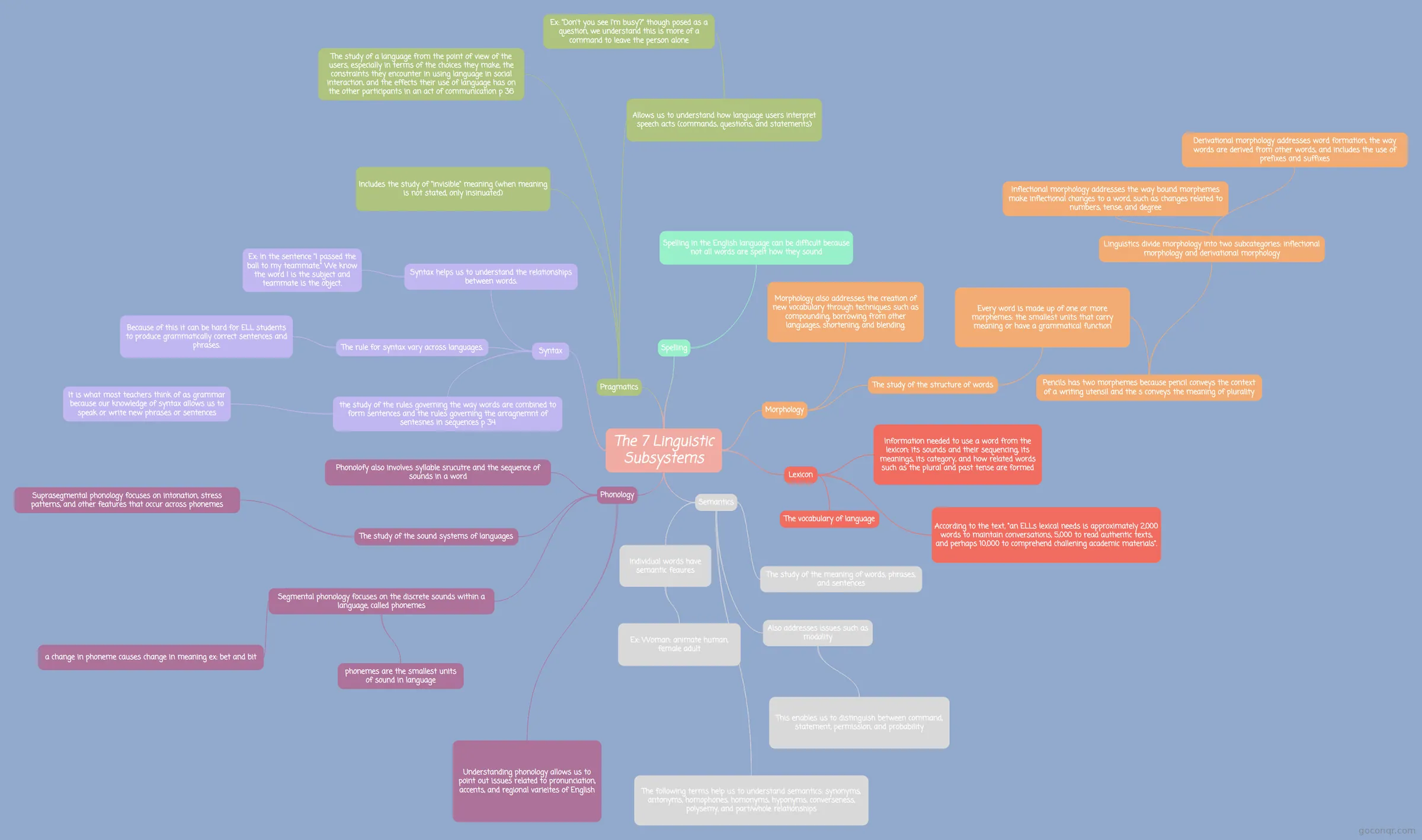
Mind map: the 7 linguistic subsystems
Inhalt der Mindmap
The 7 Linguistic Subsystems
Syntax
- the study of the rules governing the way words are combined to form sentences and the rules governing the arragnemnt of sentesnes in sequences p 34
- It is what most teachers think of as grammar because our knowledge of syntax allows us to speak or write new phrases or sentences
- Syntax helps us to understand the relationships between words.
- Ex: In the sentence "I passed the ball to my teammate." We know the word I is the subject and teammate is the object.
- The rule for syntax vary across languages.
- Because of this it can be hard for ELL students to produce grammatically correct sentences and phrases.
- the study of the rules governing the way words are combined to form sentences and the rules governing the arragnemnt of sentesnes in sequences p 34
Phonology
- The study of the sound systems of languages
- Suprasegmental phonology focuses on intonation, stress patterns, and other features that occur across phonemes
- Segmental phonology focuses on the discrete sounds within a language, called phonemes
- phonemes are the smallest units of sound in language
- a change in phoneme causes change in meaning ex: bet and bit
- Phonolofy also involves syllable srucutre and the sequence of sounds in a word
- Understanding phonology allows us to point out issues related to pronunciation, accents, and regional varieites of English
- The study of the sound systems of languages
Morphology
- The study of the structure of words
- Every word is made up of one or more morphemes: the smallest units that carry meaning or have a grammatical function
- Pencils has two morphemes because pencil conveys the context of a writing utensil and the s conveys the meaning of plurality
- Linguistics divide morphology into two subcategories: inflectional morphology and derivational morphology
- Inflectional morphology addresses the way bound morphemes make inflectional changes to a word, such as changes related to numbers, tense, and degree
- Derivational morphology addresses word formation, the way words are derived from other words, and includes the use of prefixes and suffixes
- Linguistics divide morphology into two subcategories: inflectional morphology and derivational morphology
- Pencils has two morphemes because pencil conveys the context of a writing utensil and the s conveys the meaning of plurality
- Every word is made up of one or more morphemes: the smallest units that carry meaning or have a grammatical function
- Morphology also addresses the creation of new vocabulary through techniques such as compounding, borrowing from other languages, shortening, and blending.
- The study of the structure of words
Pragmatics
- The study of a language from the point of view of the users, especially in terms of the choices they make, the constraints they encounter in using language in social interaction, and the effects their use of language has on the other participants in an act of communication p 36
- Includes the study of "invisible" meaning (when meaning is not stated, only insinuated)
- Allows us to understand how language users interpret speech acts (commands, questions, and statements)
- Ex: "Don't you see I'm busy?" though posed as a question, we understand this is more of a command to leave the person alone
Semantics
- The study of the meaning of words, phrases, and sentences
- Individual words have semantic feaures
- Ex: Woman: animate human, female adult
- The following terms help us to understand semantics: synonyms, antonyms, homophones, homonyms, hyponyms, converseness, polysemy, and part/whole relationships
- Also addresses issues such as modality
- This enables us to distinguish between command, statement, permission, and probability
Lexicon
- The vocabulary of language
- Information needed to use a word from the lexicon: its sounds and their sequencing, its meanings, its category, and how related words such as the plural and past tense are formed
- According to the text, "an ELLs lexical needs is approximately 2,000 words to maintain conversations, 5,000 to read authentic texts, and perhaps 10,000 to comprehend challening academic materials".
Spelling
- Spelling in the English language can be difficult because not all words are spelt how they sound
Informationen
- Beschreibung
- Mindmap am The 7 Linguistic Subsystems, erstellt von Neida Arellano am 03/09/2020.
- Erstellt von
- Neida Arellano
- Aufrufe
- 2
- Bewertung
Mehr zu Levels and Subsystems of Language