
Mindmap
Databases and Big Data
Inhalt der Mindmap
Databases and Big Data
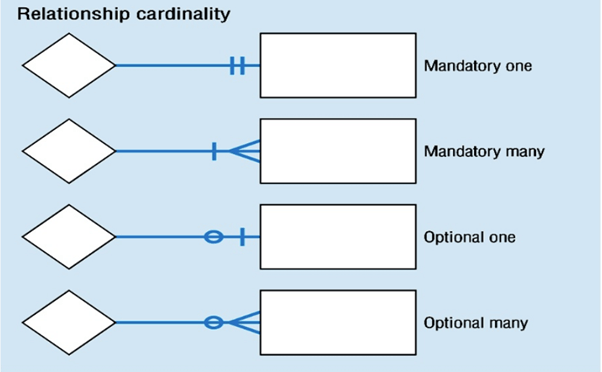
Entity Relationship
- An entity is a category of object, person, event, or thing of interest to an organisation about which data is to be recorded
- Each entity in a database system has attributes
Relational Databases
- A relational database is a collection of tables in which relationships are modelled by shared attributes.
- Tables may be linked through the use of a common attribute, if it is the primary key is used in another table, it is called a foreign key
- Normalisation
- Is the process used to come up with the best possible design for a relational database
- No data is unnecessarily duplicated
- Data is consistent throughout the database
- First Normal Form (1NF)
- A table is 1NF if it contains no repeating attributes or groups of attributes
- Second Normal Form (2NF)
- When 1NF and it contains no partial dependecies
- Third Normal Form (3NF)
- When 2NF and contains no "non-key" dependencies
- Is the process used to come up with the best possible design for a relational database
Client-Server Databases
- Use Database Management Software (DBMS) to run the network of servers.
- Advantages
- The consistency of the database is maintained because only one copy of the data is held
- An expensive resource can be made available to a large number of users
- Access right and security can be managed and controlled centrally
- Backup and recovery can be managed centrally
- Potential Problems
- Data can be comprimised and overwritten
- Solutions to problem
- Record Locks
- Locks the record whenever a user is editing or updating. Denieing access to anyone attempting to edit or update the record until the transaction is complete
- The problem with record locking is that if two users are attempting to update two records, a situation can arise which can result in a deadlock
- Serialisation
- This ensures that the transaction do not overlap in time so cannot interfere with each other.
- A transaction cannot start until the previous one has finished.
- This is implemented with timestamp ordering
- Timestamp ordering
- Whenever a transaction starts, it is given a timestamp. When transactions take affect, the earlier one applies first
- To ensure that transactions are not lost, every object has a read timstamp and write timestamp
- Before writing to an object, the read timestamp is check to be the same. If not then another transactions has taken place
- Commitment Ordering
- Transactions are ordered in terms of their dependencies on each other as well as the time they were initiated
- Record Locks
Big Data
- Three Aspects of Big Data are:
- Volume - too big to fit on a single server
- Velocity - Milliseconds or seconds to respond, particullary with streamed data
- Variety - The data may be in many forms such as structured, unstructured, text or multimedia
- Three Aspects of Big Data are:
Bilder und Dateien der Mindmap
Informationen
- Beschreibung
- Mindmap am Databases and Big Data, erstellt von Arthur Noreika am 14/09/2020.
- Erstellt von
- Arthur Noreika
- Aufrufe
- 1
- Bewertung