
Database Concepts and DBMS Fundamentals
170 resources created by 134 users
This GoConqr page gathers over 1,100 community-made resources on Database Concepts and DBMS Fundamentals: quizzes, mind maps, flashcards and notes to revise and practise with.
Top Database Concepts and DBMS Fundamentals resources
-
145 questionsSQL Server MTA 98-364 The terms "bitmap," "b-tree," and "hash" refer to which type of database structure?
-
200 cardsInfo Retrieval Mid Term Redundancy wastes space because you are storing different types of data in the same place.
-
75 questionsC175 Alternate Practice Test Database Foundations
-
49 questionsC175 - Practice Test What is a broad definition of data?
-
42 cardsDatabase systems and distributed systems: A2 Why use databases?
-
60 questionsCHAPTER 11: DATABASE PERFORMANCE TUNING AND QUERY OPTIMIZATION 1. One of the main functions of a database system is to provide timely answers to end users.
-
40 questionsChapter 16 (Multiple Choice) CIS 3365
-
45 cardsITEC 670 Final Data Definition Language (DDL)
Quizzes
See all 58 quizzes-
145 questionsSQL Server MTA 98-364 The terms "bitmap," "b-tree," and "hash" refer to which type of database structure?
-
75 questionsC175 Alternate Practice Test Database Foundations
-
49 questionsC175 - Practice Test What is a broad definition of data?
-
60 questionsCHAPTER 11: DATABASE PERFORMANCE TUNING AND QUERY OPTIMIZATION 1. One of the main functions of a database system is to provide timely answers to end users.
-
40 questionsChapter 16 (Multiple Choice) CIS 3365
-
40 questionsChapter 9 (Multiple Choice) CIS 3365
-
30 questionsChapter 10 (MC)
-
35 questionsMNSU CIS 440 Fall 2020 Quiz 4 Cursors are created using the DECLARE statement.
Mind maps
See all 42 mind maps-
 Transactions Revision mind map for transaction processing.
-
Distributed databases A2 ICT WJEC
-
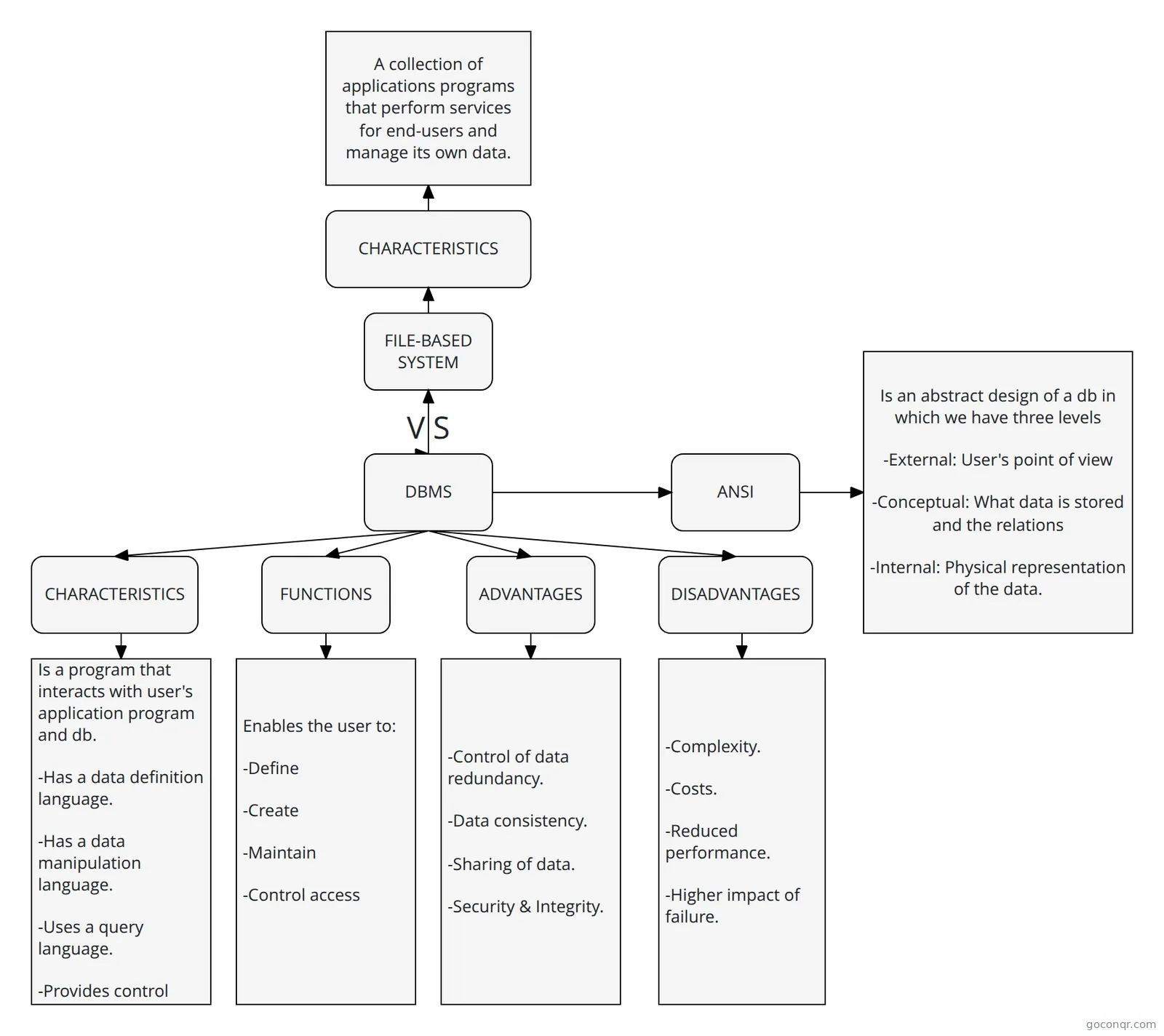
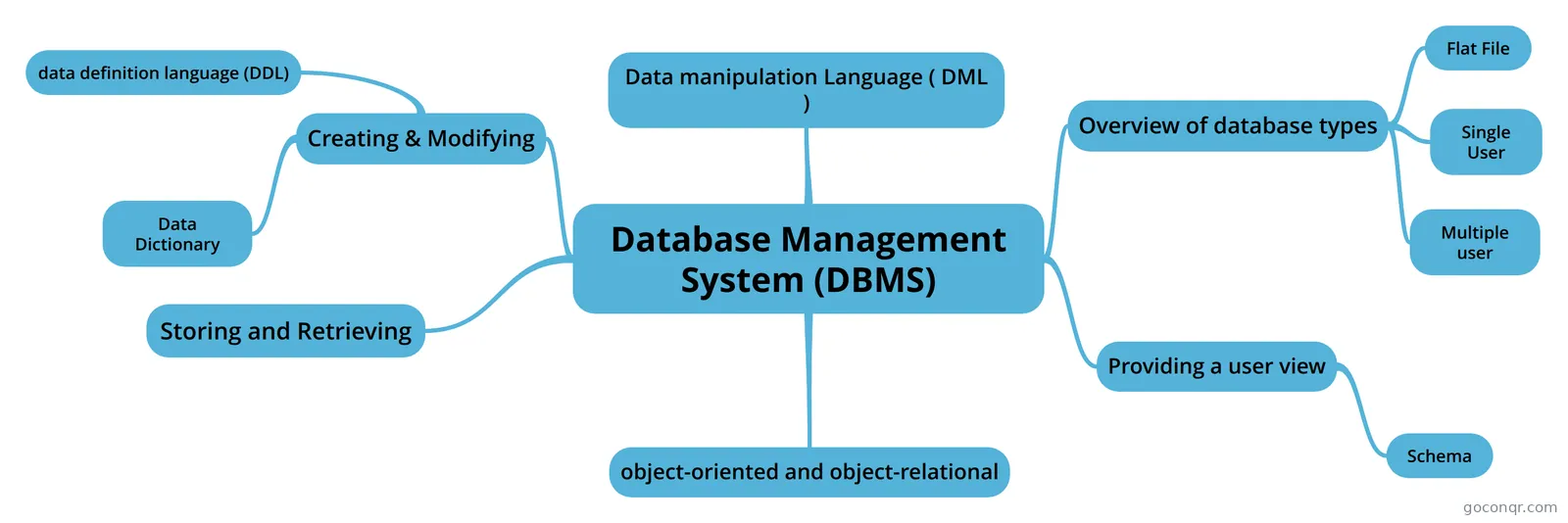 Database Management System (DBMS) hehe
-
ICT OCR A Level - Distributed Databases Notes on distributed databases
-
Databases Topic 1 Introduction to Databases
-
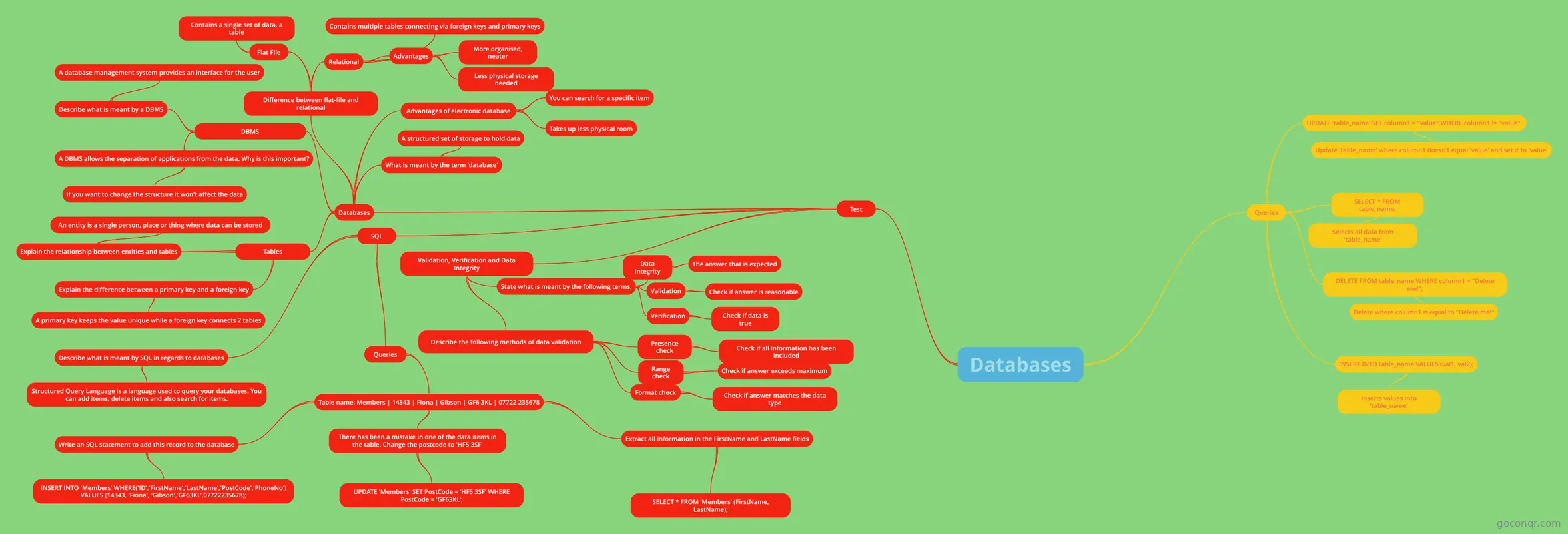 Databases This is a small mind map showing different queries and a bunch of questions i've encountered in tests
-
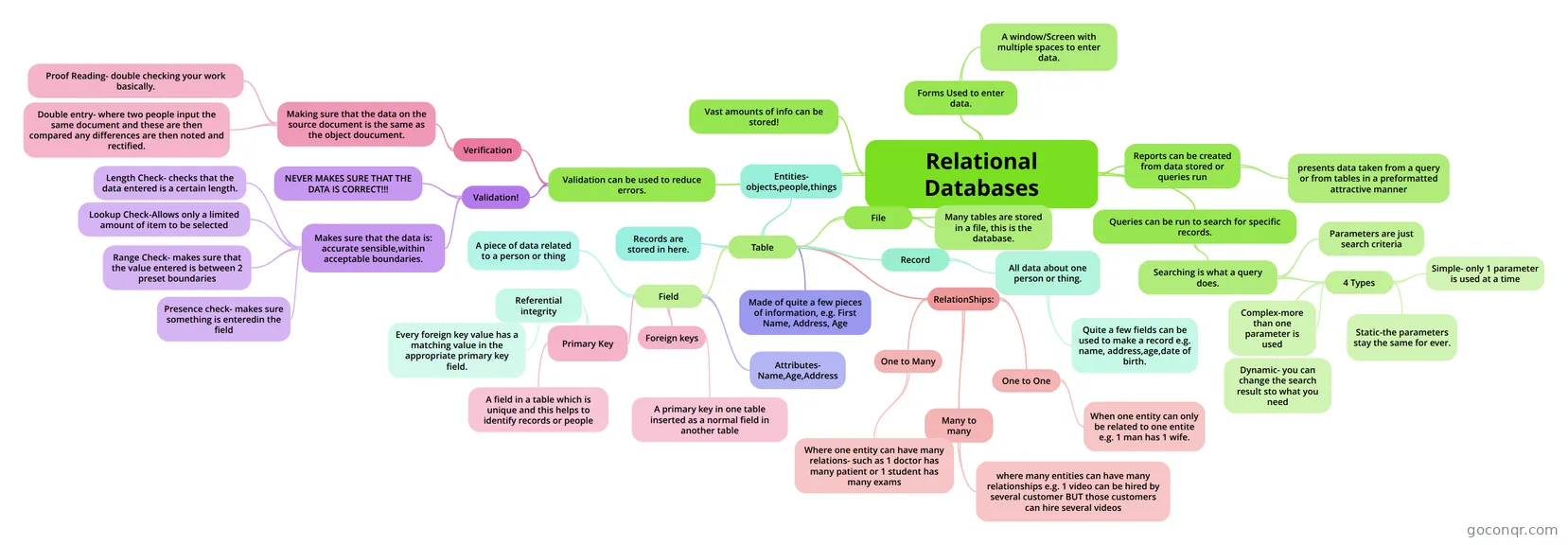 Relational Databases A Mind Map containing a compacted verion of everything you need to know for relationa database.
-
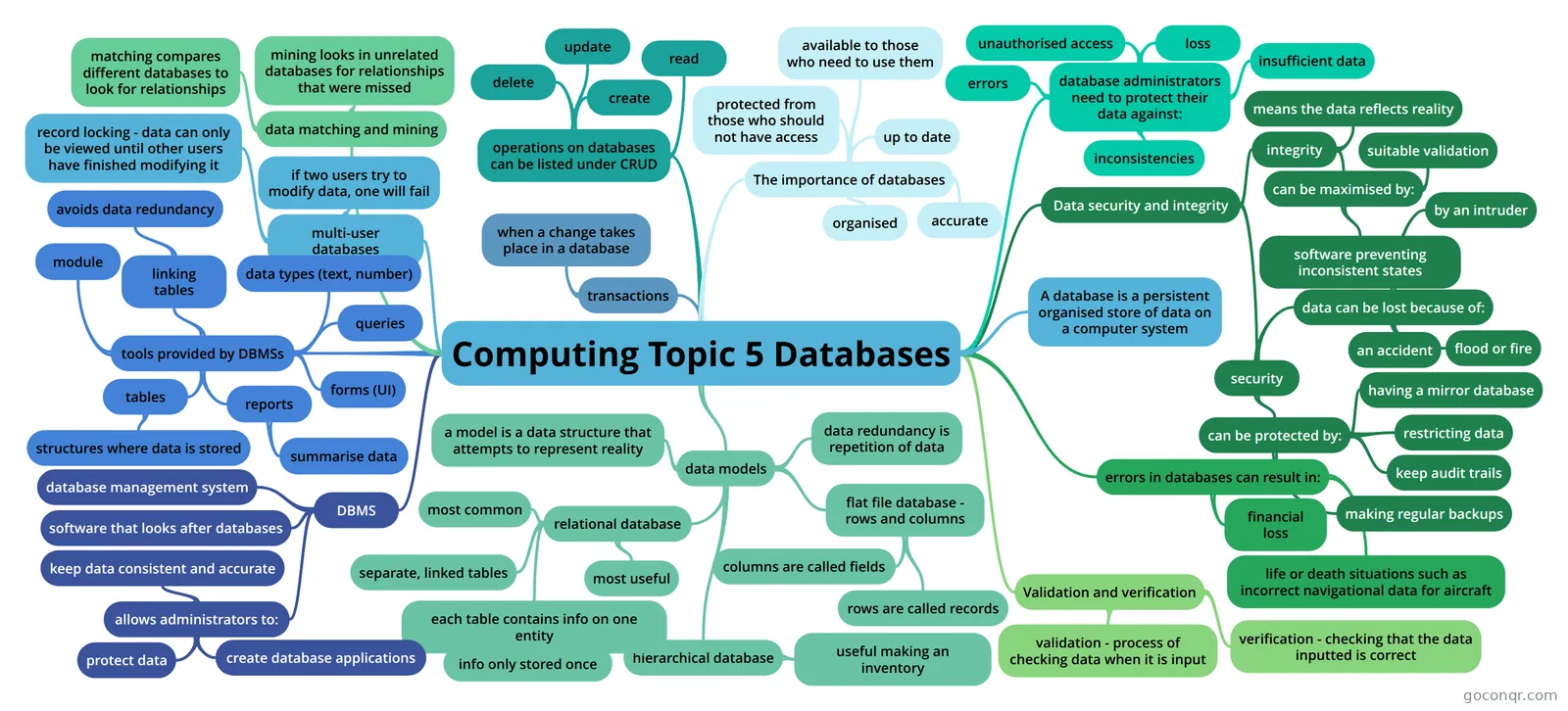 Computing Topic 5 Databases
Flashcards
See all 57 flashcards-
200 cardsInfo Retrieval Mid Term Redundancy wastes space because you are storing different types of data in the same place.
-
42 cardsDatabase systems and distributed systems: A2 Why use databases?
-
45 cardsITEC 670 Final Data Definition Language (DDL)
-
17 cardsFlash Cards Relatioanl Algebra Basic of "RELATIONAL ALGEBRA" Operations
-
21 cardsChapter 4 Key Terms Chap 4 Vocab-Relational Databases and Enterprise Systems
-
7 cardsYear 8 Computer Science Database Keywords just some Database Keywords for Year 8 Computer Science
-
82 cardsDatabases Topic 2 What is database query languages?
-
190 cardsCMPT 355 3 Alternative Database Models to the Relational Model
Flowcharts
Notes
See all 10 notes-
Chapter 4 HOMI-Database Management DBMS : A DBMS isolates the user programs from the file system , takes care of all data transfers to and from the database, maintains the integrity and consistency f the database. Also maintains rights and privilege an...
-
DBMS Important Terminology Database: Database is a collection of inter-related data which helps in efficient retrieval, insertion and deletion of data from database and organizes the data in the form of tables, views, sche...
-
Databases Revision A superkey is an attribute or a combination of attributes containing unique values for each tuple.A alternate key is any candidate key that is not chosen as the primary key.Two relations are union compatibility when t...
-
Microsoft Virtual Academy - SQL Server Basics SQL Server via Microsoft Virtual Academy Database Fundamentals: https://www.microsoftvirtualacademy.comhttps://www.microsoftvirtualacademy.com/en-US/training-courses/database-fundamentals-8243 01 Introducing Core Data...
-
Topic 6: Database Systems Database theoryExplain what is meant by:Data normalisationIt is a technique used for analysing data and is a staged process which improves the database design at each stage which... Minimises duplication of data - you...
-
Normalisation 1st Normal Form No repeating Groups (no arrays) All data is atomic Has primary key (No repeated tuples) 2nd Normal form In first normal form No Partial Dependencies Partial Dependencies: This is when non-key attribute...
-
LESSON 4 RELATIONAL ALGEBRA Relational Algebra is formal description of how relational database operates. It is a procedural query language, i.e. user must define both “how” and “what” to retrieve.
-
LESSON 2 DATABASE ENVIRONMENT A database environment is a system of components that regulate the collection, management and use of data. It includes software, hardware, people, procedures and the data itself.
More Databases and data science topics
About Database Concepts and DBMS Fundamentals
GoConqr OriginalWhat you will find here
The unit brings together material on what a database is and how a DBMS manages it. Mind maps such as Database Management System (DBMS), Relational database concepts and Database Security and Administration set out the core ideas. Others cover transactions, with the ACID properties of atomicity, consistency, isolation and durability, and distributed databases, described as a single logical database whose parts sit in more than one place.
Where to start
Begin with a broad map, then move to a short quiz. Online Test-Database Concepts and Relational Database Concept suit a first pass. The mind maps called Databases and Database Terminology help with vocabulary. Flashcard decks such as Databases Topic 2 and 2.1.5 - Databases Vocabulary are handy for key terms.
Going further
Several quizzes follow textbook chapters. The CIS 3365 sets start with what a DBMS does and how data becomes information, and later chapters look at database design and system development. CHAPTER 11: DATABASE PERFORMANCE TUNING AND QUERY OPTIMIZATION covers timely answers and evaluating performance. SQL Server MTA 98-364 asks about indexes and structures such as bitmap, b-tree and hash. Other listed items are tied to exam courses, including OCR A Level Computer Science, GCSE Computer Science and MTA Database Fundamentals.
Using quizzes and maps together
- Read a mind map and note the branches you could not explain.
- Take a quiz on that topic and check the answers.
- Go back to the map for anything you missed.
- Use flashcards for short, repeated recall.
Where it fits
This unit sits in the Database Foundations strand of Databases and data science. It is a good base before more specialised topics. Choose one resource today and see how far a short session takes you.
Frequently asked questions
Which resource should I open first?
Start with a mind map such as Database Management System (DBMS) or Relational database concepts to get the main ideas. Then try Online Test-Database Concepts as a short check. If you want exam-style practice, the MTA 98-364 quiz is a good next step.
What do the mind maps cover?
The mind maps range across the unit. They include transactions and the ACID properties, distributed databases, relationships, data storage, database recovery, security and administration, and the system development lifecycle. There are also maps on relational and object-relational databases.
Which exams are these resources linked to?
Listed resources mention GCSE Computer Science, GCSE Computing, GCSE ICT, A-level Computer Science, A-level Computing, A-level ICT and OCR A Level Computer Science. They also mention MTA Database, MTA 98-364 and MTA Database Fundamentals. Check each resource against your own course.
Are the resources free to use?
Yes. Every resource listed here is free to open, study and take, with no account needed. They were made by GoConqr users, not by GoConqr itself. A free account also saves your quiz scores and lets you make your own quizzes, mind maps, flashcards and notes.
Who is this page for?
It suits university students and professional candidates, school students, and teachers. Students can revise concepts, test themselves with quizzes and learn terms with flashcards. Teachers can pick ready-made quizzes, notes and slide sets to use with a class.
What if I cannot find my topic?
Try a nearby title first. Normalisation, SQL and queries, and database design each have notes, quizzes or maps. If your topic is still missing, you can build your own mind map or flashcards from your class notes.