
Mindmap
Adaptations for Sufficient Water in Dry Environments
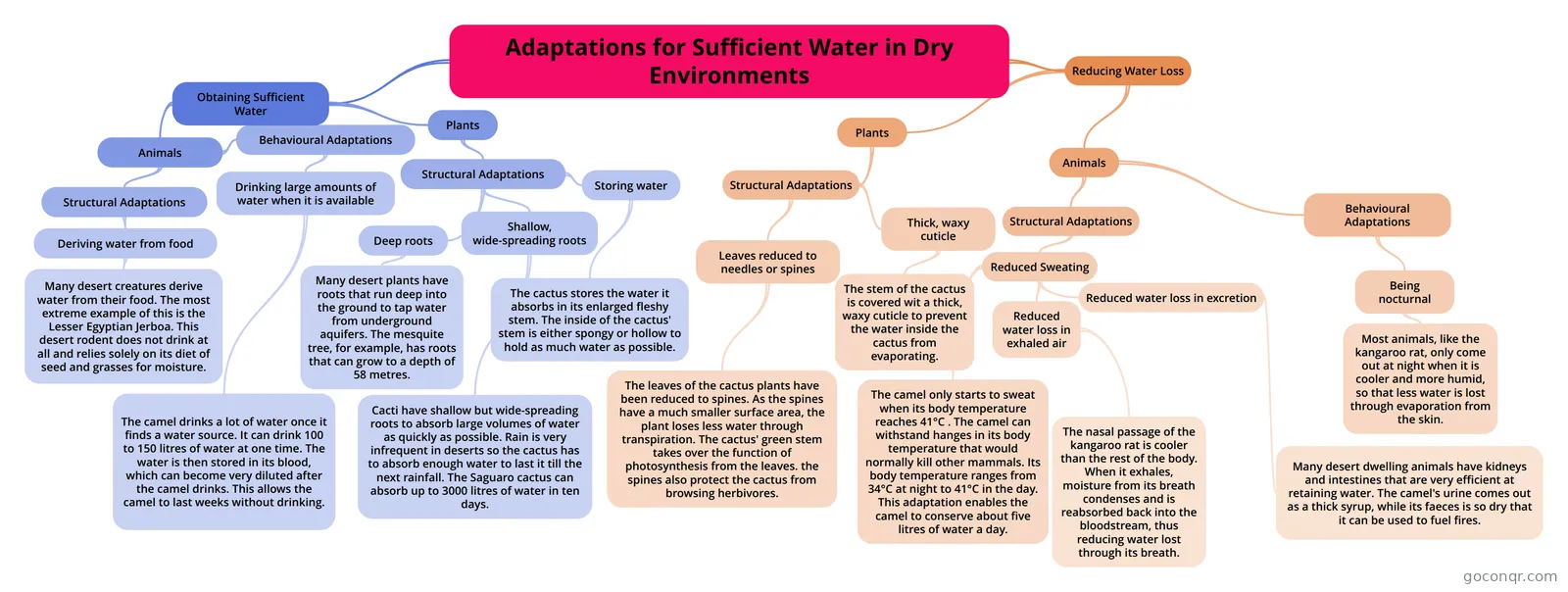
Mind map: Adaptations for sufficient water in dry environments
Inhalt der Mindmap
Adaptations for Sufficient Water in Dry Environments
Reducing Water Loss
- Plants
- Structural Adaptations
- Leaves reduced to needles or spines
- The leaves of the cactus plants have been reduced to spines. As the spines have a much smaller surface area, the plant loses less water through transpiration. The cactus' green stem takes over the function of photosynthesis from the leaves. the spines also protect the cactus from browsing herbivores.
- Thick, waxy cuticle
- The stem of the cactus is covered wit a thick, waxy cuticle to prevent the water inside the cactus from evaporating.
- Leaves reduced to needles or spines
- Structural Adaptations
- Animals
- Structural Adaptations
- Reduced Sweating
- The camel only starts to sweat when its body temperature reaches 41°C . The camel can withstand hanges in its body temperature that would normally kill other mammals. Its body temperature ranges from 34°C at night to 41°C in the day. This adaptation enables the camel to conserve about five litres of water a day.
- Reduced water loss in exhaled air
- The nasal passage of the kangaroo rat is cooler than the rest of the body. When it exhales, moisture from its breath condenses and is reabsorbed back into the bloodstream, thus reducing water lost through its breath.
- Reduced water loss in excretion
- Many desert dwelling animals have kidneys and intestines that are very efficient at retaining water. The camel's urine comes out as a thick syrup, while its faeces is so dry that it can be used to fuel fires.
- Reduced Sweating
- Behavioural Adaptations
- Being nocturnal
- Most animals, like the kangaroo rat, only come out at night when it is cooler and more humid, so that less water is lost through evaporation from the skin.
- Being nocturnal
- Structural Adaptations
- Plants
Obtaining Sufficient Water
- Animals
- Structural Adaptations
- Deriving water from food
- Many desert creatures derive water from their food. The most extreme example of this is the Lesser Egyptian Jerboa. This desert rodent does not drink at all and relies solely on its diet of seed and grasses for moisture.
- Deriving water from food
- Behavioural Adaptations
- Drinking large amounts of water when it is available
- The camel drinks a lot of water once it finds a water source. It can drink 100 to 150 litres of water at one time. The water is then stored in its blood, which can become very diluted after the camel drinks. This allows the camel to last weeks without drinking.
- Drinking large amounts of water when it is available
- Structural Adaptations
- Plants
- Structural Adaptations
- Deep roots
- Many desert plants have roots that run deep into the ground to tap water from underground aquifers. The mesquite tree, for example, has roots that can grow to a depth of 58 metres.
- Shallow, wide-spreading roots
- Cacti have shallow but wide-spreading roots to absorb large volumes of water as quickly as possible. Rain is very infrequent in deserts so the cactus has to absorb enough water to last it till the next rainfall. The Saguaro cactus can absorb up to 3000 litres of water in ten days.
- Storing water
- The cactus stores the water it absorbs in its enlarged fleshy stem. The inside of the cactus' stem is either spongy or hollow to hold as much water as possible.
- Deep roots
- Structural Adaptations
- Animals
Informationen
- Beschreibung
- Mindmap am Adaptations for Sufficient Water in Dry Environments, erstellt von Genevieve Ng Kim Sim am 25/04/2015.
- Erstellt von
- Genevieve Ng Kim Sim
- Aufrufe
- 0
- Bewertung